

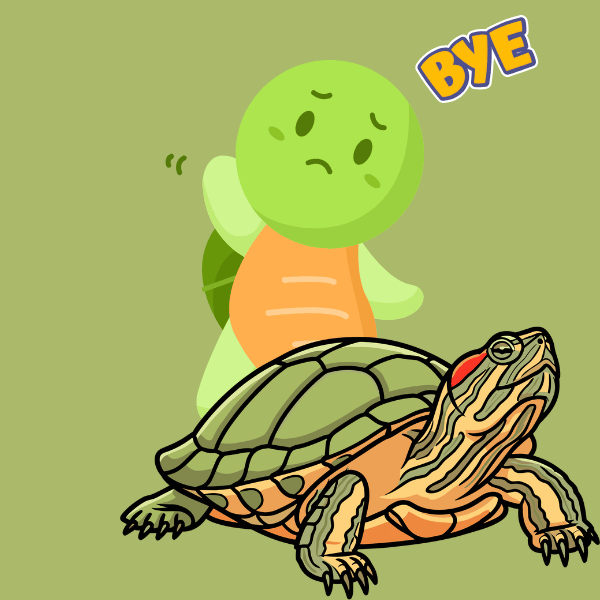
I thought we were finally getting a Red-Eared Slider.
Someone posted on Facebook that they were putting one up for adoption.
Naturally, I reached out.
We’ve been talking about finally putting up the turtle adoption center at the farm for a while now and a Red-Eared Slider would have been a perfect first resident… easy enough for people to understand, common enough that we’d be taking on something with real rehoming need, and genuinely a species I’ve worked with in the past and had great success taking care of.
We had a brief conversation.
Turns out they wanted to sell it.
Five thousand pesos.
I politely declined.
Look, it’s not that five thousand is an outrageous price for a healthy slider.
It’s more that when you post something as an adoption and then turn it into a sale once someone responds… that changes the nature of what you were doing.
I don’t really want to make a big thing of it.
People have their reasons.
I’m not angry.
Just a little disappointed.
I referred them to Malagos and the Davao Crocodile Park in case they needed a place to donate their turtle to if they couldn’t find a buyer.
And I also told them… if no one buys it and they want to let it go to someone who will actually take care of it, the turtle adoption center at the farm will take it.
No questions, no payment required on our end. That offer stands.
In the meantime, here’s a basic red eared slider care guide that I was going to write anyway. Because whether or not that particular turtle finds its way here, someone reading this might be the person who ends up with one.
And I’d rather they know what they’re getting themselves into.
| TURTLE ADOPTION CENTER UPDATE: our farm-based Turtle Adoption Center is actively seeking Red-Eared Sliders and other turtles, tortoises, terrapins, and the like, whose owners can no longer care for them. We will take any turtle. No fees. No judgment. If you have a turtle that needs a home, reach out to us. We have space, we have the setup, and we genuinely want them turtles. |
RED-EARED SLIDER — Quick Profile
| SCIENTIFIC NAME | Trachemys scripta elegans |
| ANIMAL CLASS | Reptile |
| ADULT SHELL LENGTH | 15 to 30 cm (6 to 12 inches); females grow larger than males |
| WEIGHT | 1 to 3 kg (2.2 to 6.6 lbs) at adult size |
| LIFESPAN | 20 to 30 years in the wild; up to 40 years in proper captivity |
| CONSERVATION STATUS | LC — Least Concern globally; considered an invasive species in the Philippines |
| LEGAL STATUS PH | Legal to keep as a pet; non-native species — do NOT release into Philippine waterways |
| DAVAO CLIMATE FIT | Good — warm water species; Davao’s ambient temperature suits them well without heating equipment |
Basic Care Sheet: Red-Eared Slider in Davao
If you’ve read the full turtle and tortoise guide on hayopetc.com you already know a lot of this. But for people coming to this article first, here is the honest, Davao-grounded version of what it takes to keep a Red-Eared Slider properly.
HOUSING
The rule is 40 liters of water per 2.5 cm of shell length. An adult female at 25 cm needs approximately 400 liters.
That is not a small aquarium.
That is a humongous tank
…or an outdoor pond.
In Davao, an outdoor concrete pond is actually the best option you can give a slider… natural sunlight for UVB, natural temperature regulation from Davao’s ambient warmth, and more swimming space than any glass tank can offer at a reasonable cost.
Every setup needs a dry basking platform where the turtle can fully exit the water and dry off completely under direct light.
This is not optional.
A turtle that cannot bask properly develops shell and skin infections. The basking spot should reach 30 to 35 degrees Celsius. In an outdoor Davao setup, morning sun handles this naturally.
The tank or pond must be escape-proof. Red-Eared Sliders are surprisingly determined climbers. Any wall or edge they can reach with their front feet becomes a potential exit point. Pond walls should be at least 30 cm above the waterline.
FILTRATION
Most slider pond setups fail without proper filtration.
Red-Eared Sliders produce an extraordinary amount of waste for their size.
An underpowered filter turns a large tank into a health hazard within days.
Use a canister filter rated for at least double your actual water volume.
Change 25 to 30 percent of the water weekly regardless of how clean it looks.
In an outdoor pond, rainwater dilution helps but does not replace active water changes.
FEEDING
Juveniles and young adults need more protein — commercial turtle pellets, small feeder shrimp, bloodworms, and occasional small feeder fish. As they mature, shift toward more plant matter: water hyacinth, kangkong, lettuce (not iceberg), and aquatic plants.
Overfeeding is the most common mistake — a slider’s stomach is roughly the size of its head. Feed once daily for juveniles, every other day for adults. Feeding them in a separate container keeps the main tank cleaner and makes monitoring appetite easier.
Calcium supplementation matters for shell health. Cuttlebone placed in the tank allows the turtle to self-regulate calcium intake. Vitamin D3 is handled naturally by outdoor sun exposure — one of the strongest arguments for an outdoor pond setup in Davao.
UVB LIGHTING
For indoor setups, UVB lighting is non-negotiable.
Without UVB, Red-Eared Sliders develop metabolic bone disease — their shells soften, deform, and eventually their skeletal structure is compromised.
Reptisun 5.0 or 10.0 bulbs are the standard. Replace every 6 months even if the bulb still lights up, because UV output degrades before the visible light does. For outdoor ponds with direct morning sun access, supplemental UVB lighting is not necessary.
Health Issues to Watch For
| Issue | What to Watch For |
| Shell rot | Soft spots, discoloration, foul smell — usually from poor water quality or wounds |
| Respiratory infection | Open-mouth breathing, wheezing, listing to one side when swimming |
| Swollen eyes | Vitamin A deficiency or bad water — diet and water quality review needed |
| Pyramiding shell | Uneven, raised scutes — often UVB deficiency or inconsistent diet |
| Salmonella risk | Not a turtle illness but a human concern — always wash hands after handling |
Finding a reptile-experienced vet in Davao takes some searching but they exist.
The slider that was almost ours is out there somewhere, hopefully with someone who will take care of it properly.
If not… the offer still stands.
The farm is ready when it is.
And if you’re reading this because you have a Red-Eared Slider you can no longer care for, please don’t release it into a river or lake in the Philippines.
It will survive — these turtles are resilient — but it will cause ecological damage to native species that cannot compete with it.
Bring it to Malagos, to the Davao Crocodile Park, or reach out to us here. We will find it a proper home.
That’s the whole point of building the adoption centre in the first place.

