


IRRAWADDY DOLPHIN
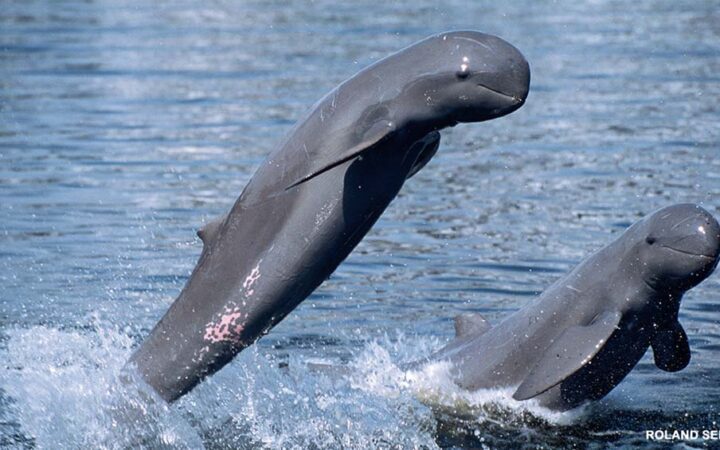
| COMMON NAME | Irrawaddy Dolphin |
| SCIENTIFIC NAME | Orcaella brevirostris |
| ANIMAL CLASS | Mammal |
Scientific Classification
| Kingdom | Animalia |
| Phylum | Chordata |
| Class | Mammalia |
| Order | Artiodactyla |
| Infraorder | Cetacea |
| Family | Delphinidae |
| Genus | Orcaella |
Physical Characteristics
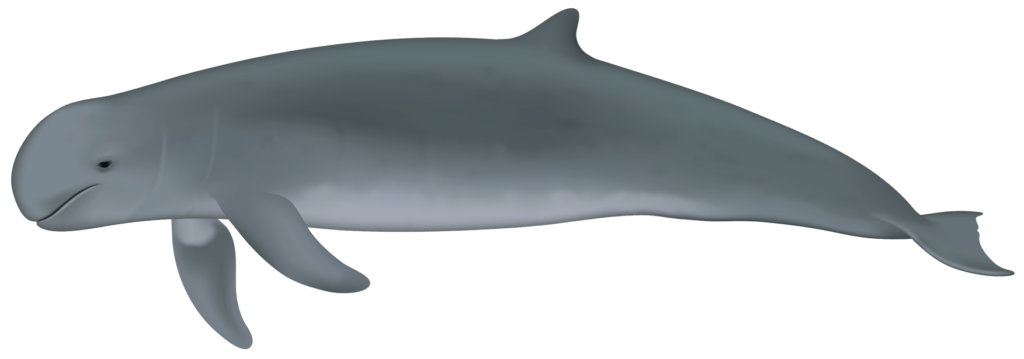
| Body Length | 2.3 m average (7.5 ft); maximum recorded 2.75 m (9.0 ft) |
| Weight | 90 to 200 kg (200 to 440 lbs) |
| Lifespan in Wild | Up to 30 years (estimated) |
| Lifespan in Captivity | Not well documented; some individuals over 20 years |
| Sexual Maturity | Not documented precisely; estimated 4 to 6 years |
Habitat & Distribution
| Native Range | Bay of Bengal, Southeast Asia — coastal waters, estuaries, and rivers of India, Bangladesh, Myanmar, Thailand, Cambodia, Vietnam, Indonesia, Philippines |
| Habitat Types | Coastal marine waters, river estuaries, freshwater rivers, brackish lagoons |
| Climate Preference | Tropical and subtropical; warm shallow waters |
| Conservation Status | EN — Endangered |
| Population Trend | Decreasing |
Diet & Behavior
| Diet Type | Carnivore |
| Primary Food | Bony fish (including catfish), cephalopods (squid, octopus, cuttlefish), crustaceans, fish eggs |
| Activity Pattern | Diurnal |
| Social Structure | Small groups of 2 to 3; occasionally up to 25 individuals |
| Reproduction | Year-round; peaks not clearly documented |
| Gestation Period | 14 months (estimated) |
| Litter Size | 1 calf |
PET SUITABILITY FOR DAVAO CITY: 1 out of 5
| 5 | Excellent — beginner-friendly, easy care |
| 4 | Good — suitable for experienced owners |
| 3 | Challenging — requires specific knowledge |
| 2 | Very difficult — experts only |
| 1 | Not suitable — wild animal or illegal |
OVERALL RECOMMENDATION: This dolphin belongs in the river and the sea, not in anyone’s care — appreciate it, protect its habitat, and if you’re in Davao, go see the remains at D’ Bone Collector Museum instead.
Suitability Analysis
Okay I’ll be honest with you… I only heard about the Irrawaddy Dolphin recently.
Like, genuinely recently.
I’ve been writing about animals for a while now and somehow this one completely passed me by.
And then someone mentioned it and I started reading and… wow.
This is a fascinating animal.
And also one of the most heartbreaking ones I’ve written about, because the more you learn about it, the more you realize how quietly it’s disappearing from the world.
Now, if memory serves me right (and I’m about 80 percent sure on this one), there was actually a display of a dolphin at D’ Bone Collector Museum in Bucana.
That museum is one of those Davao hidden gems that locals keep forgetting exists.
It’s run by Darrell Blatchley, an American who’s more Davaoeño than most of us by now, and he has this incredible three-story building full of animal skeletons and specimens.
I remember walking through the marine mammal section and seeing dolphin bones on display.
Whether it was specifically an Irrawaddy Dolphin I cannot say for certain… but the museum does work closely with BFAR and stranded marine mammal cases in the Davao Gulf, so it’s very possible. If you haven’t been, go.
It’s worth the trip even if you have to take a Grab from SM Lanang.
But back to the dolphin itself.
Can you keep one?
No.
Absolutely not, and not just because it’s impractical.
The Irrawaddy Dolphin is listed as Endangered on the IUCN Red List, and in the Philippines it is fully protected under RA 9147, the Wildlife Resources Conservation and Protection Act.
Keeping one, capturing one, or even disturbing one in the wild is a criminal offense.
This isn’t a grey area like some exotic reptiles where you might be able to get a DENR permit with enough paperwork and patience.
This is a strict prohibition.
Even setting the law aside for a moment… think about what keeping a dolphin actually requires. These are large, highly intelligent marine mammals that swim up to 100 kilometers a day in the wild.
They live in coastal waters, rivers, and estuaries.
The smallest dolphin pools in accredited marine parks are measured in the hundreds of thousands of liters.
A typical lot in a subdivision is 120 to 200 square meters.
Do the math.
I dare you.
Davao Gulf actually has historical records of Irrawaddy Dolphins in and around the area, which makes this feel a little closer to home than I expected when I started researching.
The fact that this species was once found in waters we swim in, fish in, take boats across… and that it’s now endangered and declining… that’s not a comfortable thought.
The climate here is fine for them in terms of temperature.
Warm tropical coastal waters are exactly their habitat. The problem isn’t the weather. The problem is fishing nets, boat traffic, habitat loss, and pollution.
Things we do.
Things that can be changed, if people care enough.
Care Guide
I want to be very clear upfront: this care guide is here for educational purposes only.
There is no legitimate scenario in which a private individual in Davao City, or anywhere in the Philippines, should be keeping an Irrawaddy Dolphin.
What I’m going to describe is what proper institutional care looks like, based on what we know from marine parks and rehabilitation centers that have housed cetaceans legally and professionally.
Housing for a dolphin of this size requires a pool of at minimum several hundred thousand liters of water. The pool needs to be saltwater (or at minimum brackish for this euryhaline species, which means it can tolerate varying salinities), temperature-controlled, filtered continuously, and chemically monitored daily.
The infrastructure cost alone runs into tens of millions of pesos for a proper setup.
Think about this: the Davao Crocodile Park has its own aquatic exhibits but nothing scaled for a dolphin.
Do you think you have aenough funds to rival that of Davao Croc Park?
Feeding an Irrawaddy Dolphin requires fresh fish… and a lot of it.
They eat bony fish, squid, octopus, cuttlefish, and crustaceans.
In the wild they have this remarkable behavior where they squirt streams of water to herd fish into a concentrated area before feeding.
Captive animals need trained feeding sessions multiple times a day.
Bankerohan Market has plenty of fresh fish and squid, yes, but sourcing the right species in the right quantities consistently, and storing it properly, is a logistical operation that requires dedicated staff.
Not a weekend project.
Temperature-wise, Davao’s tropical waters are actually close to what these dolphins prefer. They thrive in warm coastal and riverine environments. So the climate isn’t the problem here. The problem is everything else. Salinity management, filtration, water quality testing, veterinary oversight… these are the real challenges of cetacean care.
Health monitoring for an Irrawaddy Dolphin requires marine mammal veterinarians.
There are a small number of these professionals in the Philippines, mostly connected to government agencies like BFAR or to the handful of accredited marine facilities in the country.
There are none available for walk-in consultations in Davao City.
Dolphins are prone to stress-related illnesses in captivity, respiratory infections, skin conditions, and psychological decline from insufficient stimulation and space. A dolphin that isn’t thriving shows it in its behavior long before it shows physical symptoms.
Enrichment and handling… Irrawaddy Dolphins in the wild are described as shy and generally avoid boats and human contact.
In captivity, some dolphins have been trained to perform behaviors like spyhopping on command.
But training a wild-caught or rehabilitation dolphin takes months of patient, positive reinforcement work by trained specialists.
These are not animals that appreciate being petted or played with the way a dog does. They need social interaction with other dolphins, complex aquatic environments, and mental stimulation through feeding challenges and trained behaviors. A solo dolphin in an undersized pool deteriorates, both physically and mentally. It’s not something any responsible person wants to see.
LEGAL STATUS IN THE PHILIPPINES: Strictly prohibited for private ownership. The Irrawaddy Dolphin is fully protected under RA 9147 (Wildlife Resources Conservation and Protection Act). It is listed as Endangered on the IUCN Red List. Any capture, keeping, trade, or harm is a criminal offense under Philippine law.
CARE TAGS: Endangered Species • Illegal to Own • Marine Mammal • Government Protection Only • Wild Conservation Priority • Educational Viewing Only
Pros & Cons
| Pros (as a species to appreciate) | Cons (as a pet — not applicable) |
| Historically present in Philippine coastal and river waters | Illegal to own under RA 9147, full stop |
| Highly intelligent with unique behaviors like water-squirting to herd fish | Requires millions of pesos in infrastructure for proper housing |
| Climate-compatible with Davao’s warm tropical coastal environment | No private vet in Davao qualified to treat cetaceans |
| Skeleton specimens viewable at D’ Bone Collector Museum in Bucana, Davao City | Extremely sensitive to stress, noise, pollution, and captivity |
Trivia
- The Irrawaddy Dolphin is named after the Irrawaddy River in Myanmar, one of its known freshwater habitats — but it is found across Southeast Asia including the waters of the Philippines.
- Unlike most dolphins, the Irrawaddy has a rounded, beak-less head that makes it look more like a beluga whale than a typical dolphin. Its blowhole is also uniquely positioned to the left of center, opening toward the front of the animal.
- It can squirt streams of water up to 1.5 meters (nearly 5 feet) — a hunting behavior used to herd fish into concentrated areas before feeding.
- The Irrawaddy Dolphin is a euryhaline species, meaning it can survive in both saltwater and freshwater environments. Some populations live entirely in freshwater rivers far from the coast.
- Despite being in the same family as killer whales (Delphinidae), it is one of the most gentle and timid of all dolphins, typically diving and moving away when boats approach.
- D’ Bone Collector Museum in Bucana, Davao City — along San Pedro Street Extension — houses marine mammal specimens including dolphins and works with BFAR on stranded animal cases in the Davao Gulf. It is one of the only places in Mindanao where you can see cetacean remains up close.

