

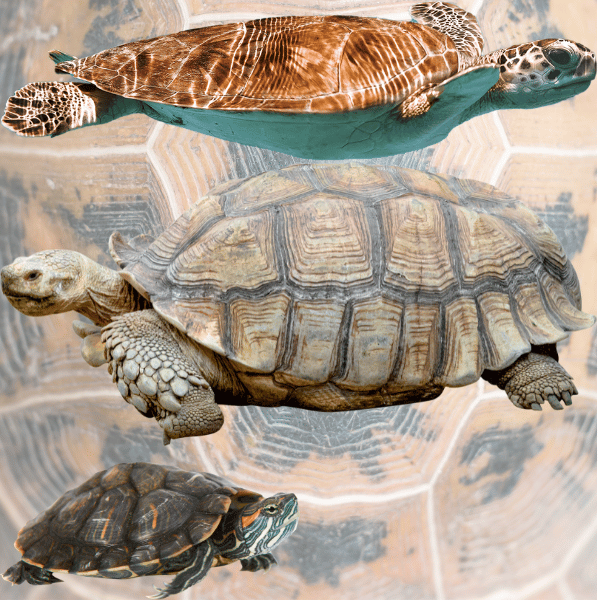
Okay, if it’s not obvious yet, I am obsessed with turtles and tortoises.
I had a dream not too long ago that I finally got an Aldabra Tortoise… I woke up, sat down at my computer, and immediately started writing a care sheet for the first twelve months of owning one.
I’ve already written about Sulcata Tortoises, Aldabra Tortoises, and Red-Eared Sliders… so the site has quite a few chelonian articles at this point.
This one is meant to be the overview.
The big picture.
The guide I wish I had when I first started getting seriously interested in these animals.
Because turtles, tortoises, and terrapins are not all the same thing, and people mix them up constantly, and that matters when you’re trying to figure out how to care for one properly.
Turtles vs Tortoises vs Terrapins: What’s the Difference?
| Feature | Turtle | Tortoise | Terrapin |
| Primary Habitat | Aquatic or semi-aquatic | Fully terrestrial (land only) | Brackish or freshwater, semi-aquatic |
| Feet/Flippers | Webbed feet or flippers | Stumpy, elephant-like feet | Webbed feet |
| Shell Shape | Flatter, streamlined | Dome-shaped, heavy | Moderate, semi-flat |
| Diet | Omnivore (most species) | Herbivore (most species) | Omnivore |
| Common Examples | Red-Eared Slider, Musk Turtle | Sulcata, Aldabra, Hermann’s | Diamond-back Terrapin |
| Lifespan | 20 to 40+ years | 50 to 150+ years | 25 to 40 years |
| In Philippines? | Yes (wild and captive bred) | Captive bred; not native | Rare in trade here |
There. Now you know the difference. Let’s talk about the specific species most relevant for people in the Philippines, and especially in Davao.
RED-EARED SLIDER (Trachemys scripta elegans)

| COMMON NAME | Red-Eared Slider |
| SCIENTIFIC NAME | Trachemys scripta elegans |
| ANIMAL CLASS | Reptile |
| Kingdom | Animalia | Phylum: Chordata | Class: Reptilia | Order: Testudines | Family: Emydidae | Genus: Trachemys |
| Shell Length (Adult) | 15 to 30 cm (6 to 12 inches); females larger than males |
| Weight | 1 to 3 kg (2.2 to 6.6 lbs) |
| Lifespan in Wild | 20 to 30 years |
| Lifespan in Captivity | Up to 40 years with proper care |
| Sexual Maturity | 2 to 5 years |
| Native Range | Mississippi River Valley, USA; now invasive across Southeast Asia including the Philippines |
| Conservation Status | LC — Least Concern (wild populations); considered invasive species in the Philippines |
| Diet Type | Omnivore — aquatic plants, fish, insects, crustaceans, leafy greens |
| Activity Pattern | Diurnal |
| Gestation / Incubation | 59 to 112 days |
| Clutch Size | 2 to 30 eggs per clutch; multiple clutches per season |
PET SUITABILITY FOR DAVAO CITY: 3 out of 5
| 5 | Excellent — beginner-friendly, easy care |
| 4 | Good — suitable for experienced owners |
| 3 | Challenging — requires specific knowledge |
| 2 | Very difficult — experts only |
| 1 | Not suitable — wild animal or illegal |
OVERALL RECOMMENDATION: Great turtle, more work than people expect, and a 40-year commitment that most buyers don’t think through — but for a prepared owner, genuinely rewarding.
Red-Eared Slider: Suitability Analysis
I would not recommend them as a first pet for young children.
I know that sounds harsh because you see them in pet shops looking small and cute and cheap and it feels like an easy decision.
It’s not.
These turtles grow fast.
What’s barely the size of a five-peso coin in the shop can triple in size within a year.
And the tank has to grow with them, and the filter has to grow with them, and your patience has to grow with them too.
That said… I love Red-Eared Sliders.
I genuinely do.
I keep thinking about Kamp Kenan‘s turtle setup on YouTube… that beautifully organized, well-thought-out habitat that gives each turtle exactly what it needs.
That’s what I want.
I want to build a rescue turtle center.
And I can start with Red-Eared Sliders.
I can take in unwanted Red-Eared Sliders, from owners who got overwhelmed, turtles that outgrew their tank, turtles that someone bought on impulse and then couldn’t care for.
I’ll take any turtle.
That’s the plan.
These turtles are actually very well-suited to our climate.
They’re a warm-water species and Davao’s ambient temperature keeps their outdoor pond or indoor tank naturally in their comfort range for most of the year.
No expensive heating equipment needed the way you would in a temperate country.
You still need a UVB light if they’re kept indoors (non-negotiable for shell health), a good external filter because these turtles produce a shocking amount of waste, and a basking platform where they can dry off completely under the light.
The tank or pond needs a water section deep enough for them to fully submerge and turn around, plus a dry basking area.
Legally, Red-Eared Sliders are not native to the Philippines and are actually considered invasive. They can be kept legally as pets but should never be released into local waterways.
They are not protected under RA 9147 as they’re not native wildlife, but releasing them into Philippine rivers and lakes is environmentally irresponsible and potentially harmful to local ecosystems.
So, if you don’t want your turtle anymore, give it to me, or else keep them in their enclosure.
Forever.
Red-Eared Slider: Care Guide
Housing is the foundation of slider care and it’s where most beginners make mistakes.
The general rule is 40 liters of water per 2.5 cm of shell length… which means an adult female at 28 cm needs a tank of at least 450 liters.
That’s not a small aquarium.
That’s a serious setup.
For a Davao home, an outdoor concrete pond is actually an excellent option and cheaper to build than buying a large glass tank. It allows natural sunlight for UVB, natural temperature regulation, and more swimming space.
I’ve seen some beautifully built backyard turtle ponds in Davao and they’re the best setup you can give these animals without going full Kamp Kenan.
Filtration is critical. Red-Eared Sliders are messy eaters and heavy waste producers. An under-powered filter will foul the water within days and a turtle in bad water gets sick fast.
Get a canister filter rated for at least twice your tank volume. Change 25 to 30 percent of the water weekly regardless of how clean it looks. The water may look clear and still be chemically unsafe for the turtle.
Feeding is where it gets fun.
Hatchlings and juveniles need more protein (commercial turtle pellets, small feeder fish, bloodworms, shrimp). Adults shift toward more plant matter (leafy greens, aquatic plants, some fruit).
You can source feeder fish and shrimp easily.
Commercial turtle pellets are available at SM Lanang and most pet shops in Davao.
- Feeding Tip: Feed them in a separate container if possible to keep the main tank cleaner, that’s a tip I learned the hard way.
Temperature in Davao is naturally suitable. Water temperature of 24 to 28 degrees is ideal and Davao’s ambient handles most of that without equipment. The basking spot should reach 30 to 35 degrees under a heat lamp or in direct sun.
UVB lighting for indoor setups is non-negotiable… without it, metabolic bone disease develops and the shell softens and deforms. Reptisun 5.0 or 10.0 bulbs are the standard and can be ordered online.
Health issues to watch for: soft or pyramiding shell (usually dietary or UVB deficiency), respiratory infections (wheezing, open-mouth breathing), swollen eyes (vitamin A deficiency or bad water), shell rot (from wounds or chronic poor water quality).
Finding a reptile-experienced vet in Davao takes some searching…
Don’t wait until the turtle is very sick before finding a vet. Identify one while everything is still fine.
Handling… Red-Eared Sliders tolerate being picked up but they’re not cuddly animals.
They recognize their owners over time and will come to the surface for feeding. That recognition is its own kind of bond, even if it’s not the same as a dog coming to greet you. Enrichment is about the environment: hiding spots, varied food, clean water, and enough space to behave naturally.
LEGAL STATUS: Legal to own in the Philippines. Not protected under RA 9147 as a non-native species. Releasing into wild waterways is environmentally harmful and strongly discouraged.
CARE TAGS: Long Commitment (40 years) • UVB Lighting Required • Strong Filtration Essential • Climate-Friendly for Davao • Not for Young Children • Pond Setup Ideal
Pros & Cons — Red-Eared Slider
| Pros | Cons |
| Widely available and affordable in Davao | Messy — requires strong filtration and regular water changes |
| Davao’s climate naturally suits their temperature needs | Live 20 to 40 years — most buyers don’t think this through |
| Recognizes owners over time; interactive at feeding | UVB lighting needed for indoor setups; adds cost and complexity |
| Pond setup in a Davao home is highly achievable | Salmonella risk means careful handwashing is always necessary |
COMMON MUSK TURTLE
| COMMON NAME | Common Musk Turtle / Stinkpot |
| SCIENTIFIC NAME | Sternotherus odoratus |
| ANIMAL CLASS | Reptile |
| Kingdom | Animalia | Phylum: Chordata | Class: Reptilia | Order: Testudines | Family: Kinosternidae | Genus: Sternotherus |
| Shell Length (Adult) | 7.5 to 13.7 cm (3 to 5.4 inches) — stays small permanently |
| Weight | Up to 600 g (1.3 lbs) |
| Lifespan in Wild | Up to 50 years (documented) |
| Lifespan in Captivity | 30 to 50 years under proper care |
| Sexual Maturity | 3 to 5 years |
| Native Range | Eastern North America, from southern Canada to Florida and Texas |
| Conservation Status | LC — Least Concern |
| Diet Type | Omnivore — small fish, invertebrates, carrion, aquatic plants, algae |
| Activity Pattern | Crepuscular to Nocturnal |
| Incubation Period | 60 to 90 days |
| Clutch Size | 1 to 9 eggs |
PET SUITABILITY FOR DAVAO CITY: 4 out of 5
| 5 | Excellent — beginner-friendly, easy care |
| 4 | Good — suitable for experienced owners |
| 3 | Challenging — requires specific knowledge |
| 2 | Very difficult — experts only |
| 1 | Not suitable — wild animal or illegal |
OVERALL RECOMMENDATION: If you can source one legally, this is possibly the ideal aquatic turtle for a Davao home — small, hardy, long-lived, and genuinely fascinating to watch.
Musk Turtle: Suitability Analysis
This is the one I keep coming back to.
Every time I go down the turtle rabbit hole… I end up thinking about Musk Turtles.
Specifically, if the opportunity presents itself, I want a small Musk Turtle.
Maybe two.
Why?
Becaues they stay small.
Permanently.
A full-grown Common Musk Turtle maxes out at about 13 centimeters.
That’s it.
Their dark, heavily textured shell and serious little eyes plus their slow methodical way of moving along the bottom of the tank… there’s just something about it that’s hypnotic.
They look like something that was alive when dinosaurs were around.
Maybe bcause their ancestors essentially were.
The challenge in Davao is sourcing one.
Musk Turtles are not native to the Philippines and are much harder to find than Red-Eared Sliders.
You’re looking at specialist importers or private breeders, and you need to make sure any animal you acquire comes with documentation showing it was legally imported or captive bred.
Under RA 9147, importing wildlife without proper permits is illegal, and CITES Appendix II applies to many chelonian species in the international trade. Do your homework before buying. Join the Philippine reptile and exotic keeper communities online and ask around. Good sources exist. They just require more effort to find than walking into SM Lanang.
Climate-wise, Davao suits them reasonably well. They’re a North American species that prefers slightly cooler water than a Red-Eared Slider (ideally 22 to 26 degrees), which is on the cool end of what Davao naturally provides.
An indoor setup with a fan for air circulation and the tank positioned away from afternoon sun should keep temperatures manageable without a chiller.
Musk Turtle: Care Guide
Housing for a Musk Turtle is wonderfully compact compared to sliders. A pair of adults can live comfortably in a 75 to 100 liter tank. They’re bottom-dwellers and enjoy climbing, so a tank with some height, driftwood, and cork bark for them to clamber on suits them well.
Shallow enough water that they can stretch their neck to the surface to breathe without having to swim hard is ideal, though they’re strong enough swimmers for deeper setups too if you provide structures to rest on near the surface.
Filtration still matters. Musk Turtles are tidier than sliders but still produce waste that will foul unfiltered water quickly. A canister filter or a good internal filter is necessary. Weekly partial water changes remain good practice. UVB lighting is recommended even though they are partly crepuscular… it supports shell and metabolic health over their very long lifespan (up to 50 years, so you want to do this right from the start).
Feeding is easy once they’re settled.
They’ll take commercial turtle pellets, earthworms, small feeder shrimp, small pieces of fish. Earthworms are great.
They can be a bit defensive when first handled (they produce a musky odor when stressed, hence the name), but they usually calm down with regular, gentle handling over time.
Temperature management in Davao means keeping them out of the hottest spots. No direct afternoon sun on the tank. A thermometer in the water always. If water exceeds 28 degrees consistently, you may need to consider a small aquarium chiller, which is an added expense but protects an animal that could live five decades.
Health issues are similar to other aquatic turtles: shell problems from poor water quality or UVB deficiency, respiratory infections, eye issues. Finding an experienced chelonian vet in Davao takes legwork but the effort is worth it.
LEGAL STATUS: Not native to the Philippines. Legal to own if acquired through legal import or captive breeding with proper documentation. CITES regulations apply to importation. Wild collection from native range is prohibited under US law; always verify provenance.
CARE TAGS: Stays Small • Long-Lived (50 years) • Compact Setup • Specialist Sourcing Required • Bottom Dweller • Hardy Once Established
Pros & Cons — Common Musk Turtle
| Pros | Cons |
| Stays small — manageable tank size forever | Hard to source legally in the Philippines |
| Extremely long lifespan means a true lifelong companion | Prefers slightly cooler water than Davao naturally provides |
| Compact setup suits even smaller Davao homes | Can be defensive and musky when stressed; takes time to settle |
| Fascinating behavior — climbs, forages, bottom-walks | Documentation and legal sourcing adds cost and complexity |
SULCATA TORTOISE (Centrochelys sulcata)
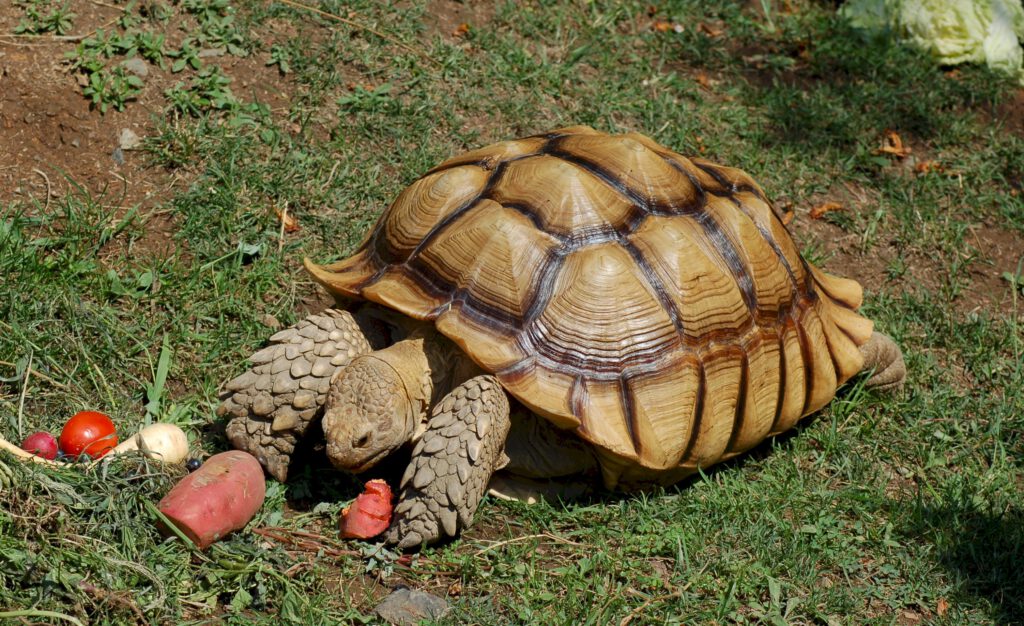
| COMMON NAME | Sulcata Tortoise / African Spurred Tortoise |
| SCIENTIFIC NAME | Centrochelys sulcata |
| ANIMAL CLASS | Reptile |
| Kingdom | Animalia | Phylum: Chordata | Class: Reptilia | Order: Testudines | Family: Testudinidae | Genus: Centrochelys |
| Shell Length (Adult) | 60 to 83 cm (24 to 33 inches) |
| Weight | 54 to 105 kg (120 to 230 lbs); males larger |
| Lifespan in Wild | 50 to 150 years |
| Lifespan in Captivity | 70 to 100+ years under proper care |
| Sexual Maturity | 5 to 7 years |
| Native Range | Sahel region of sub-Saharan Africa — Senegal, Mali, Niger, Chad, Ethiopia, Sudan |
| Habitat Types | Semi-arid savanna, scrubland, desert edges |
| Climate Preference | Hot and dry; 27 to 40 degrees C, low humidity |
| Conservation Status | VU — Vulnerable |
| Population Trend | Decreasing |
| Diet Type | Herbivore — grasses, hay, leafy greens, cactus pads |
| Activity Pattern | Diurnal |
| Incubation Period | 90 to 120 days |
| Clutch Size | 15 to 30 eggs; multiple clutches per year |
PET SUITABILITY FOR DAVAO CITY: 2 out of 5
| 5 | Excellent — beginner-friendly, easy care |
| 4 | Good — suitable for experienced owners |
| 3 | Challenging — requires specific knowledge |
| 2 | Very difficult — experts only |
| 1 | Not suitable — wild animal or illegal |
OVERALL RECOMMENDATION: Magnificent animal, terrible surprise — buy one as a hatchling without knowing they reach the size of a coffee table and you will be in serious trouble within five years.
Sulcata Tortoise: Suitability Analysis
Sulcatas are the third largest tortoise species in the world.
Hatchlings may be small and adorable and fit in the palm of your hand when you first get them but just remember that they grow up to become adults that weigh over 50 kilograms and can exceed 80 centimeters in shell length.
They will destroy a garden.
They are strong enough to push through wooden fencing.
They dig burrows.
They need enormous outdoor space as adults.
A farm.
They need a farm.
- If you have one and can no longer care for it, I can take it off your hands. We have a farm, that’s enough space for a large tortoise like a Sulcata.
Davao’s temperature is actually somewhat compatible… Sulcatas like heat, and Davao is hot.
But they come from arid environments and our humidity is the problem. Consistently high humidity can cause respiratory infections and shell issues in Sulcatas, which are adapted to dry heat. If you keep one in Davao, you need a setup that provides good drainage, dry resting areas, and air circulation. Possible, but requires deliberate design.
The good news for our farm is that a Sulcata would genuinely thrive in a large outdoor enclosure with proper drainage and access to grazing land. They eat mostly grass and hay.
The farm has both.
This is the kind of tortoise that makes sense on a property with space… not in a small house with a garden the size of a parking space.
Sourcing in the Philippines is possible through captive breeders.
They require a DENR permit as they are CITES Appendix II listed. Legal channels exist and the reptile keeper community can help you find reputable sources. What I would caution strongly against is buying from someone who has no documentation and no knowledge of where the animal came from.
Sulcata Tortoise: Care Guide
Housing a Sulcata properly means thinking ahead. A lot ahead. That hatchling needs a 60×60 cm enclosure now, and in five years needs a space measured in square meters, not centimeters.
Adult Sulcatas in the Philippines are often kept in large outdoor pens with real grass to graze on, shade structures, and a sleeping shelter. This is the right approach for Davao. The outdoor heat and humidity require covered dry sleeping areas and drainage so the ground doesn’t stay wet after rain.
Feeding is actually simple once you accept that they mostly eat grass and hay. Timothy hay or Bermuda grass are the staples. Fresh leafy greens (not iceberg lettuce, ever) as a supplement. Calcium supplementation is important for shell health. No fruit in large quantities because the sugar causes digestive issues. No high-protein food. They are strict herbivores and the gut bacteria that process their food are tuned to a specific diet. Deviate from it and you cause problems.
Humidity management in Davao requires dry sleeping areas and good drainage in the outdoor pen. A humid substrate stays wet and leads to respiratory problems over time. The basking area should allow the tortoise to warm up fully during the day.
Fresh water always available in a shallow dish they can drink from without drowning. Sulcatas soak in water and will drink deeply when given access.
Health issues in Sulcatas in the Philippines often relate to respiratory problems from humidity, pyramiding shell from incorrect diet or low humidity (yes, both too much and too little humidity can cause different problems), and parasite loads in tortoises acquired from uncertain sources.
Finding a reptile vet experienced with large tortoises in Davao is challenging but not impossible. The tortoise community in the Philippines is active and connected.
Handling is limited by size as they grow. A hatchling can be picked up and examined easily. An adult Sulcata over 40 kilograms cannot really be handled in the conventional sense… you interact with them on the ground, during feeding, during health checks.
They recognize their keepers over time and will approach for food. Some become quite personable in a slow, deliberate, ancient sort of way.
LEGAL STATUS: CITES Appendix II — international trade regulated. DENR permit required for keeping in the Philippines. Captive-bred individuals available through licensed breeders with proper documentation.
CARE TAGS: Farm or Large Property Only • Grows Very Large • DENR Permit Required • 100-Year Commitment • Grazing Diet • Humidity Management Critical
Pros & Cons — Sulcata Tortoise
| Pros | Cons |
| Thrives in Davao heat with proper dry setup | Grows to 50+ kg — not suitable for subdivision living |
| Eats mostly grass — cheapest diet of any large animal | Lives 70 to 150 years — you are making a multigenerational commitment |
| Fascinating, personable animals with long memories | Humidity in Davao requires deliberate management for their health |
| Ideal for farm properties with outdoor space | DENR permit required; not a casual purchase |
Turtle Adoption Center Plan
We have land.
We have space on the farm.
And there are a lot of turtles in the Philippines that end up without homes because people bought them on impulse and then couldn’t keep up with the care, or their situation changed, or the turtle got too big, or they just didn’t know what they were getting into.
So here’s what I want to do.
I want to set up a proper turtle and tortoise adoption center at the farm, modeled loosely on what I’ve seen from Kamp Kenan’s setup on YouTube… a real habitat, not a makeshift tank, where chelonians can live properly and either stay permanently or be rehomed to people who are actually prepared. We will take any turtle.
Red-Eared Sliders that outgrew their tank.
Sulcatas that someone bought as a hatchling and now can’t handle.
Any chelonian that needs a place to go.
If you’re in the Philippines and you have a turtle or tortoise you can no longer care for, reach out to us. We are not there yet, but we’re working toward it.
And the goal is to have a setup worthy of the animals we take in.
They deserve that much.
Trivia: Things About Chelonians That Might Surprise You
- Tortoises are some of the longest-lived vertebrates on Earth. Jonathan, a Seychelles Giant Tortoise, is currently estimated to be over 190 years old and is the oldest known living land animal.
- The Red-Eared Slider is considered one of the world’s 100 worst invasive species by the IUCN, having been introduced to waterways across Asia, Europe, and Australia through the pet trade. Never release one into Philippine rivers or lakes.
- Common Musk Turtles (Stinkpots) can walk along the bottom of a body of water rather than swimming, using their feet to push along the substrate. They are remarkably agile climbers and have been found in tree branches overhanging water.
- Sulcata Tortoises are the third largest tortoise species in the world after the Aldabra Giant Tortoise and the Galapagos Tortoise. They are the largest tortoise native to the African continent.
- All chelonians (turtles, tortoises, and terrapins) lack teeth. They use sharp, keratinous beaks to bite and tear food, and their bite force is surprisingly powerful relative to their size.
- The sex of most chelonian species is determined by the temperature during incubation of the eggs, not by genetics. Higher incubation temperatures typically produce more females; cooler temperatures produce more males. Climate change is already skewing sex ratios in wild populations.

