

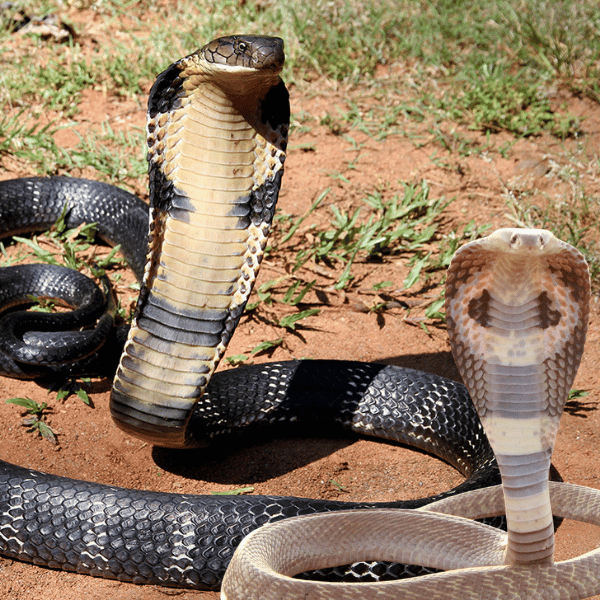
You know, people mix these two up all the time.
Heck, even I mixed them up before I knew any better.
After all, they’re both cobras, they both have that iconic hood, and they’re both found in Asia… but they are very, very different animals.
I’ve written about both of them separately, and we even have a few articles specifically about the different types of King Cobras. But I thought it would be useful to put them side bya side so you can see exactly what makes each one its own thing.
Check them out here:
Goodbye King Cobra, There are Three New King Cobras in Town
Can You Have a Pet King Cobra?
I’ll be straight with you… I’m not exactly a neutral observer here. We currently have three King Cobras living on our farm.
So I have a few thoughts about these animals that go a little beyond just reading Wikipedia.
Quick Comparison at a Glance
| Feature | Indian Cobra | King Cobra |
| Scientific Name | Naja naja | Ophiophagus hannah |
| Max Length | Up to 2.2 m (7.2 ft) | Up to 5.85 m (19.2 ft) |
| Venom Type | Neurotoxic + cytotoxic | Primarily neurotoxic |
| Venom Volume per Bite | Up to 600 mg | Up to 7 ml (massive dose) |
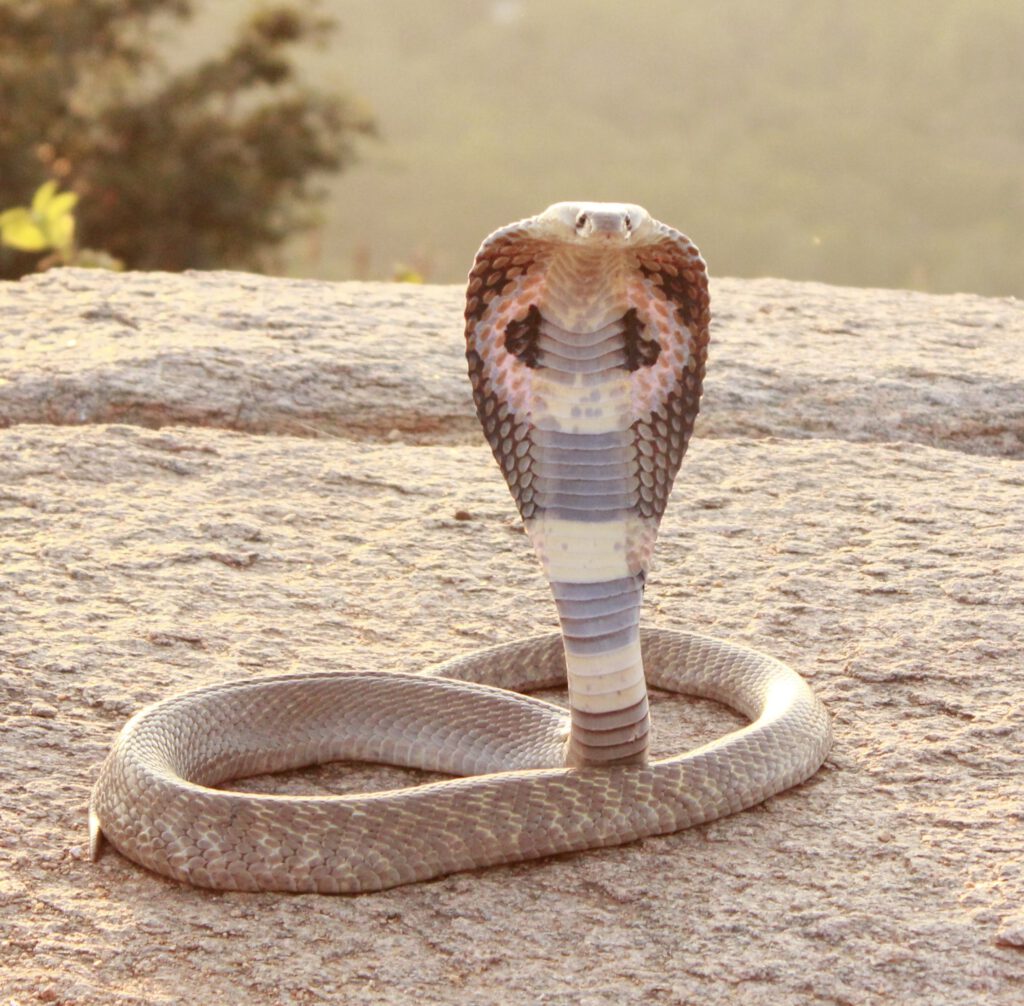
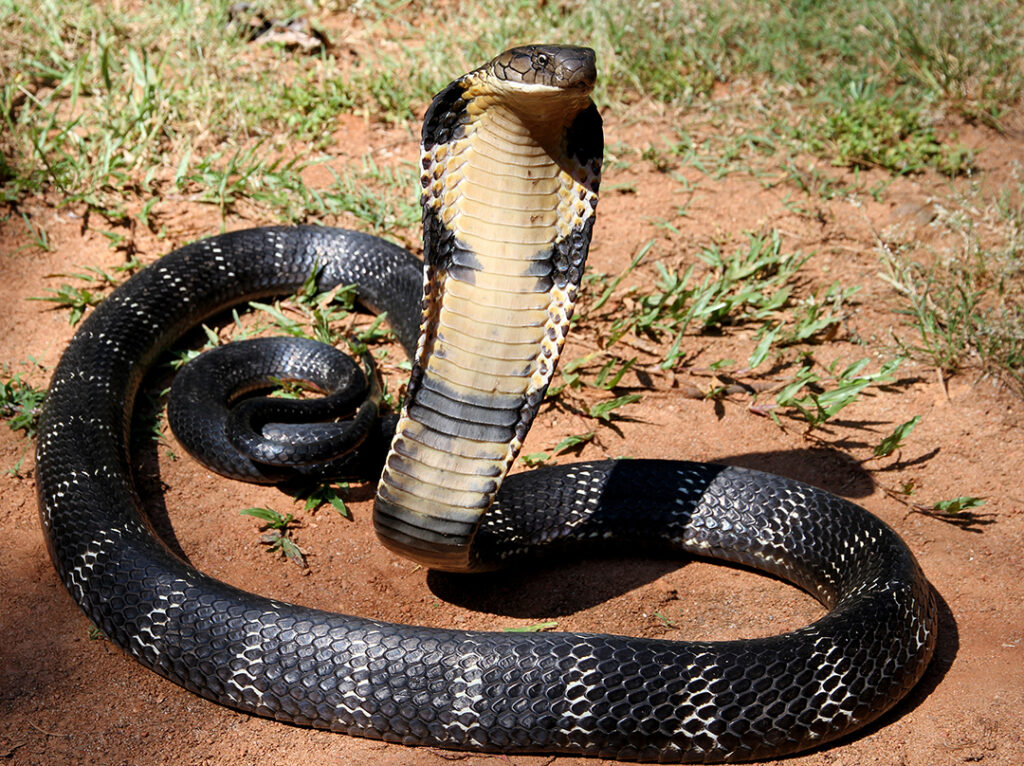
| Hood | Distinctive, wide with spectacle marking | Narrower hood, no spectacle |
| Diet | Rodents, frogs, small reptiles | Almost exclusively other snakes |
| Conservation Status | LC — Least Concern | VU — Vulnerable |
| Kept on hayopetc.com farm? | No | Yes — 3 individuals |
| Legal in PH (private ownership)? | Regulated under RA 9147 | Regulated under RA 9147 |
The Indian Cobra (Naja naja)
| COMMON NAME | Indian Cobra / Spectacled Cobra |
| SCIENTIFIC NAME | Naja naja |
| ANIMAL CLASS | Reptile |
Scientific Classification
| Kingdom | Animalia |
| Phylum | Chordata |
| Class | Reptilia |
| Order | Squamata |
| Family | Elapidae |
| Genus | Naja |
Physical Characteristics
| Body Length | 1.0 to 2.2 m (3.3 to 7.2 ft) |
| Weight | 1 to 6 kg (2.2 to 13.2 lbs) |
| Lifespan in Wild | 20 to 30 years |
| Lifespan in Captivity | Up to 20 years (documented) |
| Sexual Maturity | 2 to 3 years |
Habitat & Distribution
| Native Range | Indian subcontinent: India, Pakistan, Sri Lanka, Bangladesh, Nepal, Bhutan; parts of Southeast Asia |
| Habitat Types | Forest edges, agricultural fields, rice paddies, scrubland, urban outskirts |
| Climate Preference | Tropical and subtropical; 20 to 35 degrees C |
| Conservation Status | LC — Least Concern |
| Population Trend | Decreasing (habitat loss, persecution, illegal trade) |
Diet & Behavior
| Diet Type | Carnivore |
| Primary Food | Rodents, frogs, lizards, birds, eggs, other small snakes |
| Activity Pattern | Diurnal and crepuscular |
| Social Structure | Solitary |
| Reproduction | Seasonal (typically February to April) |
| Incubation Period | 48 to 69 days |
| Clutch Size | 10 to 30 eggs |
PET SUITABILITY FOR DAVAO CITY: 1 out of 5
| 5 | Excellent — beginner-friendly, easy care |
| 4 | Good — suitable for experienced owners |
| 3 | Challenging — requires specific knowledge |
| 2 | Very difficult — experts only |
| 1 | Not suitable — wild animal or illegal |
OVERALL RECOMMENDATION: Fascinating animal to read about, genuinely terrifying to consider keeping, and illegal to own without a permit you almost certainly won’t get.
Suitability Analysis
So I’ve already written a full article about the Indian Cobra if you want the really deep dive. But for this comparison piece, let me give you the honest version of what keeping an Indian Cobra in Davao would actually look like… and why the answer is basically no.
The Indian Cobra is one of the four snakes responsible for the most snakebite deaths in South Asia. They call them the Big Four over there.
This is not a beginner snake.
This is not even really an experienced keeper snake.
This is the kind of snake that professional herpetologists handle with long hooks, thick gloves, and a hospital thirty minutes away with antivenom stocked.
We have exactly one antivenom production facility in the Philippines (the Research Institute for Tropical Medicine in Muntinlupa) and exotic snake antivenom is not readily available at your local Davao hospital.
That alone should give you reason to stop and consider owning one based on the risks.
Legally… it’s complicated.
Under RA 9147, wild-caught cobras cannot be traded or kept without a DENR permit, and getting that permit is not a simple process.
Indian Cobras are not native to the Philippines (their range is primarily the Indian subcontinent and parts of Southeast Asia), so importing one adds another layer of permits and CITES considerations.
The short answer is: unless you are a licensed facility or researcher, you are not getting one legally.
Climate-wise, Davao is actually suitable for them. Indian Cobras thrive in tropical heat and humidity, so the 27 to 32 degrees and 80-odd percent humidity here wouldn’t be a problem for the snake.
The problem is for you and your neighbors.
A venomous escape in a subdivision or a townhouse complex is… not a scenario anyone wants.
These snakes are fast, they are defensive, and they absolutely will bite if cornered or surprised. The hood display is a warning.
If you see it, you’re already too close.
Space requirements for proper enclosure are actually manageable (adults do fine in a well-secured 4x2x2 foot enclosure), but the security requirements are extreme.
Every seal, every lock, every hinge needs to be escape-proof. One gap and you have a loose cobra in your house.
I cannot stress enough how different that is from a loose hamster.
Care Guide
Again, this care guide is strictly educational.
I’m not encouraging anyone to keep an Indian Cobra.
But if you’re a licensed keeper or working in a facility, here’s what proper care looks like.
Housing needs to be a fully secure, front-opening enclosure with at least two separate locking mechanisms. Glass or PVC enclosures with sealed seams work best.
Adults do fine in a 120x60x60 cm setup. The enclosure needs a hide on each end (warm side and cool side), a water dish large enough to soak in, and substrate that holds some humidity without staying wet (coconut fiber or cypress mulch works).
Ventilation needs to be fine enough that the snake cannot push through it.
This is non-negotiable.
Feeding is actually one of the simpler parts of cobra care.
Indian Cobras eat pre-killed rodents readily once established in captivity. Mice and small rats every 7 to 14 days for adults. Never feed live prey to a venomous snake… the risk of the prey injuring the snake while you’re dealing with a stressed, hooded cobra is just not worth it.
Frozen feeder mice can be sourced from some of the more specialist reptile keepers, but this is not easy. You’ll need contacts.
Temperature in Davao is naturally in range for this species. A thermal gradient of 26 to 32 degrees is ideal, which Davao’s ambient temperature almost provides on its own. Just make sure the enclosure doesn’t overheat if placed in direct sun or near a warm wall. A ceramic heat emitter on a thermostat handles the warm end if needed. No special humidity adjustments required here.
Cleaning needs to happen regularly but carefully.
Spot clean waste as soon as you see it, full substrate change every 4 to 6 weeks.
Always use a hook to move the snake to a secure transport container before cleaning.
Never reach into an occupied enclosure.
Never.
Health issues include respiratory infections (usualy from incorrect humidity), mites, and parasites in wild-caught individuals. Finding a vet in Davao experienced with venomous elapids is genuinely difficult. The Philippine Animal and Reptile Keepers Society may be able to point you toward someone.
Handling an Indian Cobra is not something a private keeper should be doing casually.
Hook training and tong management are the standard. These snakes do not tame in the way a ball python does.
Enrichment is mostly about providing the right environment: hides, appropriate temperatures, a proper day-night cycle. They don’t need you to play with them. They need you to leave them alone and keep their house clean.
LEGAL STATUS IN THE PHILIPPINES: Regulated. Cannot be taken from the wild or traded without DENR permit under RA 9147. Not native to the Philippines; importation requires CITES documentation. Private ownership without permit is illegal.
CARE TAGS: Expert Keepers Only • Venomous • DENR Permit Required • Antivenom Access Critical • Not for Subdivision Keeping
Pros & Cons — Indian Cobra
| Pros | Cons |
| Thrives in Davao’s tropical climate naturally | One of the most dangerous snakes in Asia |
| Fascinating behavior and iconic hood display | Legal to keep only with hard-to-obtain DENR permit |
| Relatively manageable enclosure size for adults | No reliable antivenom access in most Davao hospitals |
| Longer lifespan in captivity under proper care | Not a tameable or handleable snake for most keepers |
Trivia — Indian Cobra
- The ‘spectacle’ marking on the back of the Indian Cobra’s hood (two connected circles) is unique to this species and inspired its other common name: the Spectacled Cobra.
- Indian Cobras are one of the ‘Big Four’ snakes responsible for the most snakebite deaths in South Asia, estimated at tens of thousands of fatalities per year.
- They play an important ecological role as rodent controllers in agricultural areas and are considered sacred in Hindu tradition, particularly associated with the god Shiva.
- Despite their fearsome reputation, Indian Cobras will often choose to flee rather than fight. The hood display is a bluff as much as a warning.
- Snake charmers in India traditionally use Indian Cobras. The snake is not actually responding to music but to the movement of the pungi flute, which it perceives as a threat.
- The venom of the Indian Cobra contains both neurotoxins and cytotoxins, meaning it attacks both the nervous system and destroys tissue at the bite site.
The King Cobra (Ophiophagus hannah)
| COMMON NAME | King Cobra |
| SCIENTIFIC NAME | Ophiophagus hannah |
| ANIMAL CLASS | Reptile |
Scientific Classification
| Kingdom | Animalia |
| Phylum | Chordata |
| Class | Reptilia |
| Order | Squamata |
| Family | Elapidae |
| Genus | Ophiophagus |
Physical Characteristics
| Body Length | 3.0 to 4.0 m average; up to 5.85 m (19.2 ft) recorded |
| Weight | 6 to 9 kg (13 to 20 lbs); large individuals up to 12 kg |
| Lifespan in Wild | 17 to 20 years |
| Lifespan in Captivity | Up to 20 to 25 years under proper care |
| Sexual Maturity | 3 to 6 years |
Habitat & Distribution
| Native Range | South and Southeast Asia: India, southern China, Philippines, Malaysia, Indonesia, Vietnam, Thailand |
| Habitat Types | Dense highland forest, bamboo thickets, mangrove edges, rivers in forested areas |
| Climate Preference | Tropical and subtropical; prefers cooler forest interiors, 20 to 32 degrees C |
| Conservation Status | VU — Vulnerable |
| Population Trend | Decreasing |
Diet & Behavior
| Diet Type | Carnivore (ophiophagous — snake-eating) |
| Primary Food | Almost exclusively other snakes; occasionally lizards and small mammals |
| Activity Pattern | Diurnal |
| Social Structure | Solitary; pairs only during mating season |
| Reproduction | Seasonal (January to March typically) |
| Incubation Period | 60 to 90 days |
| Clutch Size | 21 to 40 eggs; female actively guards the nest |
PET SUITABILITY FOR DAVAO CITY: 1 out of 5
| 5 | Excellent — beginner-friendly, easy care |
| 4 | Good — suitable for experienced owners |
| 3 | Challenging — requires specific knowledge |
| 2 | Very difficult — experts only |
| 1 | Not suitable — wild animal or illegal |
OVERALL RECOMMENDATION: We have three on our farm and we leave them alone and they also just come and go as they please.
Suitability Analysis
King Cobras are the longest venomous snake in the world. The one we have that’s the biggest is honestly the size of a small tree trunk when it’s fully stretched out. There is nothing quite like being in the presence of a four-meter King Cobra. It is humbling in a way that’s hard to describe… it’s not exactly fear, it’s more like a very strong awareness of your own mortality. Your brain reminds you, very clearly, that you are not at the top of this particular food chain right now.
They are native to the Philippines, by the way.
That’s an important distinction from the Indian Cobra. You can find King Cobras in parts of Mindanao, Palawan, and some of the other major islands.
So from a climate standpoint, Davao is absolutely suitable. They are forest animals though, and they prefer slightly cooler, shadier environments than full tropical sun. Our farm setup gives them shaded areas with natural cover, which makes a big difference to their stress levels.
The legal situation in the Philippines is serious. Under RA 9147, King Cobras are a protected species here and cannot be taken from the wild. Captive-bred individuals require DENR documentation and permits to keep legally.
This is not like getting a permit for a bird… this is a multi-step process involving inspection of your facility, proof of proper husbandry capability, and ongoing compliance. If you don’t have that sorted, you don’t have a legal King Cobra.
Keeping one in a Davao City subdivision?
Not realistic.
At all.
The minimum enclosure size for an adult King Cobra is enormous, the feeding requirements are unusual (they primarily eat other snakes), and the risk profile if something goes wrong is about as high as it gets in the reptile world.
There is no King Cobra antivenom available at most Philippine hospitals. In the event of a bite, you are looking at a race against time and a very unpleasant experience.
These are not animals for a 150 sqm lot in Matina or Buhangin.
Care Guide
Housing for a King Cobra needs to be genuinely large. An adult needs a minimum of 2.4 x 1.2 x 1.2 meters of secure enclosure, and bigger is always better. They are active animals and they will use the space. The enclosure needs to be escape-proof in a way that would satisfy a security engineer.
Double-door entry systems (where one door must be closed before the other can be opened) are standard for large elapids.
Wood and glass custom builds are common.
The lock mechanisms need to be something the snake cannot manipulate… and yes, King Cobras are intelligent enough that this is an actual concern.
Feeding is the genuinely unusual part.
King Cobras eat snakes.
That’s it.
In the wild, they eat ratsnakes, pythons, other cobras… they will eat almost any snake species they can overpower.
In captivity, many keepers feed ratsnakes as the staple prey. Sourcing feeder snakes in Davao is possible but it requires connections in the reptile community.
You cannot just walk into a store and buy a bag of feeder snakes.
Some experienced keepers have transitioned their King Cobras to pre-killed or even scented rodents but this is tricky and not always successful.
Temperature-wise, Davao’s ambient climate works reasonably well, but King Cobras from forest habitats actually prefer slightly cooler temperatures than peak Davao heat. A thermal gradient of 24 to 30 degrees with a basking spot up to 32 degrees is ideal.
On the farm we have natural shade providing the cooler end and surface heating for the warm end. In an indoor Davao enclosure you’d need a thermostat-controlled heating setup and possibly some cooling on the hottest afternoons.
Cleaning is always done with the snake secured in a locked transport container first.
Always.
No exceptions.
Substrate changes every 4 to 6 weeks, spot cleaning as needed. These animals produce significant waste for their size. Health monitoring is critical… watch for any changes in posture, respiratory sounds, or feeding behavior.
Finding a vet qualified to treat a King Cobra in Davao is extreamly difficult.
Build your network of contacts before you need them, not during an emergency.
Handling is a topic I approach with a lot of respect.
King Cobras are intelligent.
They learn your routines.
They can become calmer over time with consistent, respectful handling… but they never truly tame the way a non-venomous snake might.
They are always capable of a strike and they are always large enough that a bite is a medical emergency.
Enrichment for them is mostly about environmental complexity: climbing branches, multiple hides, appropriate temperatures, and a consistent routine. Stress in King Cobras shows up as refusal to eat, which becomes its own problem when the prey is other snakes.
LEGAL STATUS IN THE PHILIPPINES: Protected species under RA 9147. Native to the Philippines; wild capture is prohibited. Captive-bred individuals may be kept only with proper DENR permits and documented provenance. CITES Appendix II listing applies to international trade.
CARE TAGS: Expert and Facility Keepers Only • DENR Permit Required • Snake-Eating Diet • Largest Venomous Snake • Native to Philippines • Intelligent and Complex
Pros & Cons — King Cobra
| Pros | Cons |
| Native to the Philippines — climate-adapted | Requires DENR permit; illegal without documentation |
| Highly intelligent and behaviorally complex | Feeds almost exclusively on other snakes — difficult to source |
| Impressive, majestic animal with long lifespan | No antivenom readily available in most Davao hospitals |
| Thrives in farm or large rural property settings | Absolutely not suitable for subdivision or urban keeping |
Trivia — King Cobra
- The King Cobra is the world’s longest venomous snake, with the record individual measured at 5.85 meters (19.2 feet) — longer than most jeepneys.
- Its scientific genus name Ophiophagus means ‘snake-eater’ in Greek, which is exactly what it is. It will eat other venomous snakes, including other cobras.
- Unlike most snakes, King Cobras are caring parents. Females build nests from leaves and debris and actively guard their eggs for the entire two to three month incubation period.
- Despite having enough venom to kill an elephant (or twenty people), King Cobras are generally shy and prefer to avoid conflict. Most bites occur when humans accidentally step on or corner them.
- King Cobras are found in the Philippines, particularly in Palawan and parts of Mindanao, making them part of our local natural heritage and a species worth protecting rather than persecuting.
- They can raise the front third of their body upright when threatened, which means a large individual can look you directly in the eye while standing on the ground. It is not a comfortable experience.
Final Thoughts
I think cobras deserve to be understood properly rather than just feared.
Both of these animals are incredible.
Both of them are not pets in the conventional sense.
The Indian Cobra is a wild animal doing its job in the ecosystems it belongs to.
The King Cobra is one of the most intelligent reptiles on the planet and a flagship species for Philippine forest conservation.
Respecting them from an appropriate distance is honestly the best thing most people can do for them.
But if you’re serious about learning, if you have the space, the infrastructure, the permits, and the patience…
There are people doing this responsibly and doing it well.
Just make sure you know what you’re getting into before you get into it.

