

When I was around 9 or 10, while vacationing in Siocon, my brother and I jumped off a bridge into a river teeming with crocodiles.
Ok I’m exaggerating but maybe my mind made up the huge numbers of crocodiles there but we did jump off a bridge because all the other boys in our neighborhood did it.
And only found out the next day the danger we put our young lives in after our grandmother pinched our ears when we got home and told her about our adventure.
And when our grandfather got home, he tag teamed our grandma in punishing us by giving us some well placed blows in the buttocks using a branch or switch he cut off from the guava tree outside.
The next day, on our way t Tibangao farm, we looked out onto the riverbanks and saw a crocodile. It was a small one. Or maybe that was because of the distance but there was a crocodile there.
And that’s when we understood that that river had crocodiles in it.
And that’s my first experience with the Philippine crocodile.
Or maybe it was a saltwater croc.
I don’t know.
I still can’t tell the difference between the two if I ever had to tell which was which.
They’re all just buwayas here in the Philippines.
Anyhoo…
Most Filipinos know buwaya as a word for a corrupt politician.
Fewer know that the actual animal behind the word is quietly disappearing from our rivers.
And fewer still know that it is coming back… slowly, stubbornly, against considerable odds, in a handful of creeks and wetlands in Luzon and Mindanao where people have chosen to protect it rather than kill it.
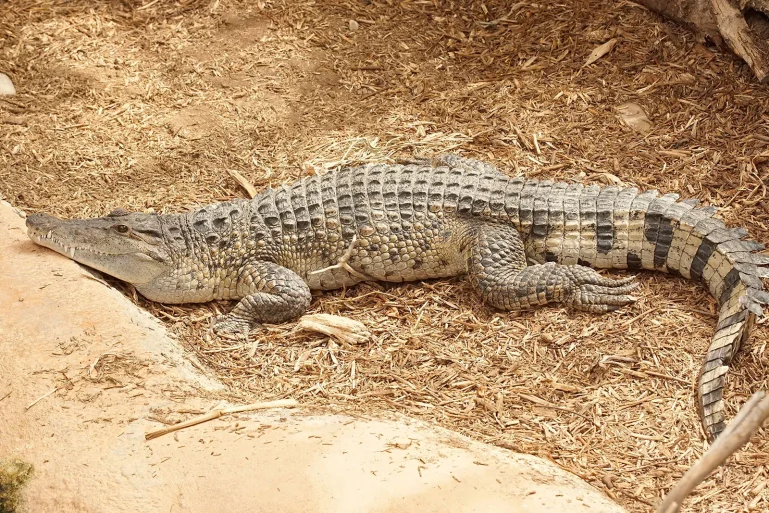
The Philippine Crocodile, Crocodylus mindorensis, is not the saltwater crocodile which is considered the bigger one of the two.
PHILIPPINE CROCODILE
| COMMON NAME | Philippine Crocodile / Philippine Freshwater Crocodile / Mindoro Crocodile |
| SCIENTIFIC NAME | Crocodylus mindorensis |
| ANIMAL CLASS | Reptile |
| SIZE | Adult males up to 3.0 m (9.8 ft); females smaller, typically 1.5 to 2.0 m (5 to 6.6 ft) |
| WEIGHT | 15 to 100 kg depending on age and sex |
| COLORATION | Juveniles golden-brown with dark banding; adults brown to gray — distinctly different from the saltwater crocodile’s darker coloration |
| LIFESPAN | Estimated 60 to 80 years in the wild |
| CONSERVATION STATUS | CR — Critically Endangered (IUCN since 1996) |
| WILD POPULATION (2024) | Estimated 250 to 500 individuals across all wild populations — exact count uncertain |
| CITES STATUS | Appendix I — commercial international trade completely prohibited |
| NATIVE RANGE | Endemic to the Philippines — once distributed across the entire archipelago; now confined to northeast Luzon and fragmented populations in Mindanao |
Scientific Classification
| Kingdom | Animalia |
| Phylum | Chordata |
| Class | Reptilia |
| Order | Crocodilia |
| Family | Crocodylidae |
| Genus | Crocodylus |
Behavior & Ecology
| Diet Type | Carnivore — fish, invertebrates, small mammals, water birds |
| Habitat Types | Freshwater rivers, creeks, lakes, marshes, and wetlands; not found in saltwater or brackish coastal areas |
| Activity Pattern | Nocturnal hunter; basking diurnally on riverbanks |
| Social Structure | Solitary; territorial; females actively guard nests |
| Reproduction | Nests built from vegetation; 7 to 33 eggs per clutch; females guard eggs for 65 to 70 day incubation |
| Threat to Humans | Very low — unlike saltwater crocodiles, the Philippine Crocodile is small, shy, and has an extremely limited record of human conflict |
The Comeback Kid
In 1999, a survey team found a single adult Philippine Crocodile in the rivers of San Mariano, Isabela Province, in northeast Luzon. One adult. In a river system that once supported a thriving population.
By 2024, that same area had 125 individual crocodiles. From one to one hundred and twenty-five in twenty-five years.
That increase meant that the conservation efforts worked.
The recovery was led by the Mabuwaya Foundation in partnership with local communities and Indigenous Agta elders who had traditional knowledge of the species and a cultural relationship with it that the conservation scientists were wise enough to learn from rather than dismiss.
Community sanctuary guards, called Bantay Sanktuwaryo, were trained and deployed to protect nesting sites from illegal fishing nets, which were the primary accidental killer of Philippine Crocodiles.
Local people who once killed crocodiles out of fear became the people most invested in keeping them alive.
In Mindanao, a breeding population has been confirmed in the Muleta River in Damulog, Bukidnon. Surveys are ongoing in Ligawasan Marsh in North Cotabato and the Linao-Cawayan watershed in Oriental Mindoro.
In 2023, three juvenile Philippine Crocodiles bred in captivity at the Cologne Zoo in Germany were repatriated to the Philippines… animals born in Europe, coming home to Philippine rivers.
The wild population is estimated at somewhere between 250 and 500 individuals depending on the survey and the methodology. DENR has reported alarm at continued declines in some areas even as others show recovery.
| THE DIFFERENCE FROM THE SALTWATER CROCODILE: Many Filipinos do not know that the Philippines has two crocodile species. The Saltwater Crocodile (Crocodylus porosus) is the massive apex predator found in coastal and estuarine areas — the species I’ve written about extensively on hayopetc.com, and the one that took a piglet in Siocon. The Philippine Crocodile is a completely separate, smaller, freshwater species that poses minimal risk to humans. The fear and hostility that comes from saltwater crocodile encounters has historically been displaced onto the Philippine Crocodile, contributing to its persecution. These are not the same animal. |
Why You Should Not Keep One if You’re Crazy Enough to Want One — and What to Do Instead
The Philippine Crocodile is CITES Appendix I and fully protected under RA 9147. Private ownership is illegal without DENR permit and even licensed facilities must justify their possession as contributing to conservation, not personal collection.
But beyond the legal reality, there is a more important point. The Philippine Crocodile’s survival depends on wild populations recovering in wild habitats. Every individual that is removed from the wild, legally or otherwise, is one fewer breeding adult in a population that can only sustain losses so well.
The animal does not need us to keep it.
It needs us to protect the rivers it lives in.
Here is what you can actually do:
- Support the Mabuwaya Foundation: the primary organization driving Philippine Crocodile conservation in northeast Luzon. Find them at mabuwaya.org.
- Report sightings and illegal capture: DENR-BMB hotlines 925-8952 and 925-8953, or facebook.com/denrbiodiversity. A Philippine Crocodile sighting in your area is valuable data. A Philippine Crocodile being sold or captured is a crime.
- Do not support illegal wildlife markets: Philippine Crocodile parts including eggs and hatchlings are occasionally found in wildlife trade. Demand drives supply.
- Protect riparian forests: The Philippine Crocodile needs intact freshwater habitat. Deforestation of riverbanks and wetland conversion destroy the habitat directly. If you have land near a river, keep the trees.
- Change how you talk about crocodiles: The buwaya-as-corrupt-politician metaphor has consequences for the actual animal. When people hear the word buwaya used as an insult for decades, the animal itself absorbs that cultural hostility. The Philippine Crocodile is not corrupt. It is critically endangered.
LEGAL STATUS IN THE PHILIPPINES: Strictly protected under RA 9147 (Wildlife Resources Conservation and Protection Act). CITES Appendix I — commercial trade prohibited internationally. Killing, capturing, possessing, or trading a Philippine Crocodile without DENR permit is a criminal offense carrying up to 12 years imprisonment and fines up to PHP 1,000,000.
CARE TAGS: Critically Endangered • Philippine Endemic • Do Not Keep • Protect Wild Populations • Support Mabuwaya Foundation • CITES Appendix I
Reasons for Hope vs Ongoing Threats
| Reasons for Hope | Ongoing Threats |
| San Mariano population grew from 1 adult in 1999 to 125 individuals by 2024 | Total wild population still estimated under 500 — critically fragile |
| Community-led Bantay Sanktuwaryo program proving that local protection works | Illegal fishing nets remain the primary accidental killer of Philippine Crocodiles |
| Confirmed breeding population in Muleta River, Bukidnon, Mindanao | Agricultural encroachment and deforestation destroying freshwater habitat |
| International captive breeding programs in Germany, Australia, USA, Denmark supporting genetic diversity | Hybridization with saltwater crocodiles in some captive breeding programs compromises reintroduction efforts |
| Indigenous Agta knowledge being formally integrated into conservation science | Inadequate law enforcement allows continued killing driven by fear and misinformation |
Trivia
| ANIMAL TRIVIA: The Philippine Crocodile is the only crocodile species in the world found exclusively within a single country’s borders. Every individual of this species on Earth — in the wild and in captivity — traces its ancestry to Philippine rivers. This makes the Philippines uniquely and completely responsible for its survival or extinction. No other country can save this animal. Only us. |
The Philippine Crocodile is not the buwaya of political cartoons.
It is a small, shy, freshwater reptile that has been on this Earth for millions of years, that survived mass extinctions and ice ages and volcanic archipelago formations, and that is now teetering on the edge because of us. Because of fear, because of habitat loss, because of fishing nets and agricultural runoff and the slow erosion of the wild places where it lives.
It came back in San Mariano. One adult to one hundred and twenty-five in twenty-five years. If it can do that there, it can do it elsewhere. But only if we give it the rivers it needs and the protection it deserves. That is the whole story. That is what we have to decide.
Maybe the reason why we didn’t get attacked was because they would rather not deal with human beings.
Or mabe it was just pure dumb lucjk.

