

SALTWATER CROCODILE
| COMMON NAME | Saltwater Crocodile / Estuarine Crocodile / Indo-Pacific Crocodile |
| SCIENTIFIC NAME | Crocodylus porosus |
| ANIMAL CLASS | Reptile |
Scientific Classification
| Kingdom | Animalia |
| Phylum | Chordata |
| Class | Reptilia |
| Order | Crocodilia |
| Family | Crocodylidae |
| Genus | Crocodylus |
Physical Characteristics
| Body Length | Males: 4.0 to 5.0 m average (13 to 16 ft); record 6.17 m (20.2 ft). Females: 2.5 to 3.0 m (8 to 10 ft) |
| Weight | Males: 400 to 700 kg (880 to 1,540 lbs); large individuals over 1,000 kg recorded. Females: 76 to 103 kg (168 to 227 lbs) |
| Lifespan in Wild | 70 years or more (estimated) |
| Lifespan in Captivity | 50 to 70+ years under proper care |
| Sexual Maturity | 10 to 16 years (males); 10 to 12 years (females) |
Habitat & Distribution
| Native Range | Eastern India, Sri Lanka, Bangladesh, Myanmar, Thailand, Malaysia, Brunei, Indonesia, Philippines, Papua New Guinea, Solomon Islands, Vanuatu, Australia |
| Habitat Types | Saltwater and brackish coastal habitats, estuaries, mangroves, river deltas, tidal rivers; can cross open ocean |
| Climate Preference | Tropical and subtropical; 25 to 34 degrees C water temperature preferred |
| Conservation Status | LC — Least Concern (globally); some regional subpopulations remain under pressure |
| Population Trend | Stable to Increasing (recovered from near-extinction after hunting bans in the 1970s) |
Diet & Behavior
| Diet Type | Carnivore (apex predator) |
| Primary Food | Fish, crustaceans, reptiles, birds, mammals (including large prey such as buffalo, cattle, wild boar, sharks); opportunistic — will take almost any prey within reach |
| Activity Pattern | Nocturnal (hunting); Diurnal (basking and thermoregulation) |
| Social Structure | Solitary; territorial; dominance hierarchy among males |
| Reproduction | Seasonal (wet season, typically November to March in the Philippines) |
| Incubation Period | 80 to 98 days |
| Clutch Size | 40 to 60 eggs; female guards nest actively |
PET SUITABILITY FOR DAVAO CITY: 1 out of 5
| 5 | Excellent — beginner-friendly, easy care |
| 4 | Good — suitable for experienced owners |
| 3 | Challenging — requires specific knowledge |
| 2 | Very difficult — experts only |
| 1 | Not suitable — wild animal or illegal |
OVERALL RECOMMENDATION: You cannot keep one and you probably shouldn’t want to — but understanding this animal properly might be the most important wildlife lesson a Filipino can learn.
Suitability Analysis
I’ve spent an unhealthy amount of time thinking about saltwater crocodiles than most people would be comfortable with.
I’ve watched Pangil at Davao Crocodile Park more times than I can count… back when I was still single I used to go there and just park myself near his enclosure for an hour or two.
Just watching.
There’s something about observing a creature like that up close that does something to your brain.
You feel simultaneously safe because of the barrier between you and him, and also very, very aware that you are not even close to the top of the food chain in his presence.
Pangil passed away in early 2025 and Isad about it.
He was 18 feet long and over a ton of animal, the second largest crocodile in captivity in the Philippines after Lolong… and he had this heavy, slow-moving dignity about him that was genuinely mesmerizing.
He was touted as a gentle giant.
And look, I know that’s how people talked about him and I get why.
Nothing terrible happened during all those years he was at the park.
But to be clear: that gentleness was an illusion created by well-trained, experienced handlers who knew exactly what they were doing every single moment.
Pangil was not gentle.
Pangil was a saltwater crocodile.
He was patient.
Those are very different things.
Given the chance, given one mistake by one keeper on one off day… I have absolutely no doubt he would have taken someone apart. The reason nothing happened is because the Davao Crocodile Park’s team were genuinely excellent at their jobs.
Credit where it’s due.
I also visited Lolong at the National Museum of Natural History in Manila just in January 2025 with my wife and son.
Lolong died in captivity in 2013, and what’s left of him is on display there.
Standing in front of his mounted remains is one of those experiences that makes you recalibrate your sense of scale.
I went there specifically to see him… my toddler was more interested in running around, but I stood in front of that enclosure and just stared.
He was 6.17 meters.
The lenght of a jeepney.
It is genuinely hard to process.
Can you keep a saltwater crocodile in Davao?
No.
Not legally and not practically.
Under RA 9147, Crocodylus porosus is a protected species in the Philippines.
Permits are required even for licensed facilities.
For a private individual housing an adult saltwater crocodile is a very expensive endeavor. A saltie can clear five meters in length, weigh more than a small car, and has the strongest bite force ever measured on any animal. Your garden wall is not an adequate barrier.
These are animals that have survived mass extinctions.
They were here before us and with proper protection, they’ll be here long after.
Care Guide
This care guide is written for educational purposes and for the reality of licensed, institutional care.
There is no scenario in which a private individual should be keeping an adult saltwater crocodile.
Housing a saltwater crocodile properly means thinking in terms of an entire ecosystem, not an enclosure.
Even hatchlings, which start at just 20 to 30 centimeters, grow fast. Within a few years you’re dealing with an animal that needs a pool large enough to fully submerge and turn around in, a dry basking area with access to real sunlight or high-output UVB lighting, secure perimeter barriers that account for the fact that a saltwater crocodile can lunge its full body length in under a second, and drainage and filtration systems that can handle the waste output of a large apex predator.
Licensed crocodile farms in the Philippines, like those in Palawan and parts of Mindanao that operate under DENR permits, give you a sense of what proper infrastructure looks like.
Feeding is straightforward in concept and complicated in practice.
Saltwater crocodiles are opportunistic apex predators.
In captivity they are typically fed whole prey animals… fish, chickens, pork cuts, occasionally larger mammals for bigger individuals.
The feeding frequency is lower than people expect.
Adult crocodiles can go weeks between meals because their metabolism is so efficient.
At Davao Crocodile Park, Pangil’s feeding times were a scheduled event that drew crowds because the response was so explosive and powerful.
One moment stillness.
The next, an eruption of force that made people flinch back even at a safe distance.
Sourcing protein for a facility-kept crocodilian involve suppliers or direct arrangements with poultry operations, but again, this is institutional territory.
Temperature and humidity in Davao are actually well-suited for saltwater crocodiles.
They are tropical animals and Davao’s 27 to 32 degrees ambient temperature is right in their comfort range.
They thermoregulate by basking in sun and retreating to water to cool down.
A proper outdoor setup in the Philippine climate eliminates a lot of the heating infrastructure that crocodile keepers in temperate countries have to deal with.
This is genuinely one area where our climate is an advantage for facilities that house them legally.
Hygiene and enclosure maintenance requires regular water changes and filtration for the pool area, removal of uneaten food (which crocodiles sometimes ignore for days), and monitoring of the basking area for waste.
The animals themselves are clean in the sense that they spend time in water, but their enclosures are not.
Dedicated husbandry staff working in shifts is the realistic model for any serious facility.
Health and veterinary care for saltwater crocodiles requires specialist knowledge.
Respiratory infections, skin conditions from poor water quality, nutritional deficiencies from an improper diet, and stress-related illness are the main concerns.
There are veterinarians in the Philippines with crocodilian experience, mostly connected to the DENR’s crocodile rehabilitation programs and licensed breeding facilities.
There are none available for casual consultation in Davao City.
Handling is the part where I want to be most blunt.
You do not casually handle a saltwater crocodile.
Even juveniles have the reflexes, jaw strength, and instincts of an apex predator.
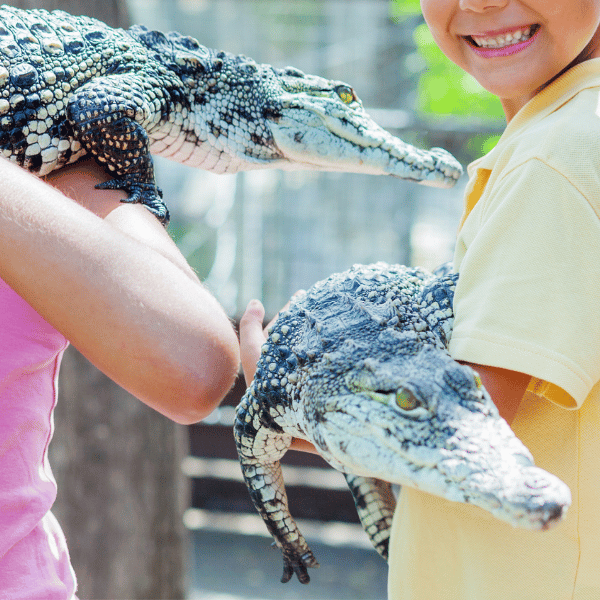
At Davao Crocodile Park, every interaction with Pangil and the other large crocodiles involved multiple trained handlers, specific positioning, specific tools, and a protocol that had been refined over years. The illusion of control that you see in photos and videos of people posing with crocodiles is exactly that. An illusion, maintained by expertise and training that took years to develop. Don’t be fooled by it.
LEGAL STATUS IN THE PHILIPPINES: Protected species under RA 9147 (Wildlife Resources Conservation and Protection Act). Private ownership without DENR permit is illegal. CITES Appendix II listing applies to international trade. Licensed breeding and farming operations exist under strict regulatory oversight from the DENR and the Palawan Council for Sustainable Development.
CARE TAGS: Apex Predator • DENR Permit Required • Institutional Care Only • Protected Philippine Species • Not for Private Ownership • Living Dinosaur
Pros & Cons
| Pros (as a species to understand) | Cons (as a private pet — not applicable) |
| Native to the Philippines — part of our natural heritage | Illegal to own without DENR permit; enforcement is serious |
| Climate-compatible with Davao’s tropical environment | Can exceed 5 meters and 500 kg — no private facility can house one safely |
| Long lifespan — a properly cared-for individual can outlive its keeper | Strongest bite force of any animal ever measured |
| Conservation success story — recovered from near-extinction after hunting bans | No private vet in Davao or most of the Philippines qualified to treat one |
| Viewable at Davao Crocodile Park, the best place to experience one safely | Feeding logistics, waste management, and water filtration require institutional infrastructure |
Trivia
- Lolong, the largest saltwater crocodile ever measured in captivity, was caught in Bunawan, Agusan del Sur in 2011 and measured 6.17 meters (20.2 feet). He died in captivity in 2013 and his preserved remains are now on display at the National Museum of Natural History in Manila — worth a visit if you’re ever in the area.
- Pangil, the iconic crocodile of Davao Crocodile Park, measured 18 feet (approximately 5.5 meters) and was the second largest crocodile in captivity in the Philippines. He passed away in early 2025. He is genuinely missed.
- Saltwater crocodiles have the strongest measured bite force of any living animal on Earth — up to 3,700 pounds per square inch (psi). For reference, a lion’s bite is around 650 psi and a great white shark is approximately 4,000 psi.
- They can regulate their buoyancy by swallowing stones (gastroliths), which act as ballast and may also aid digestion. A crocodile floating with just its eyes and nostrils above water is already in hunting position.
- Saltwater crocodiles can swim thousands of kilometers in open ocean using tidal currents. This is how they colonized islands across the Pacific and how they occasionally appear in unexpected locations far from known populations.
- In the Philippines, the word ‘buwaya’ (crocodile) is used to describe corrupt politicians. This is widely considered unfair to actual crocodiles, which don’t steal public funds or accept bribes. They’re just trying to eat and survive, like most of us.

