

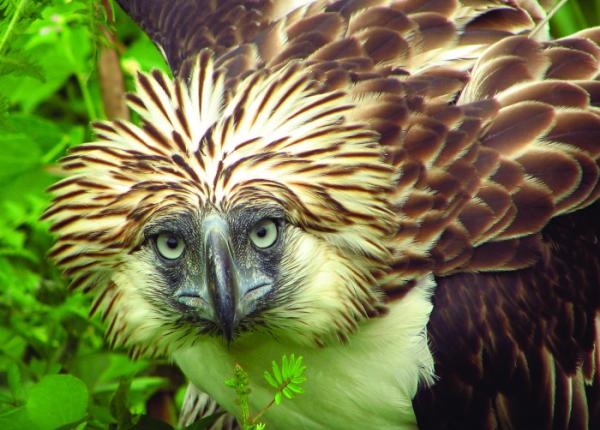
The Philippine Eagle Week runs from June 4 to 10 every year.
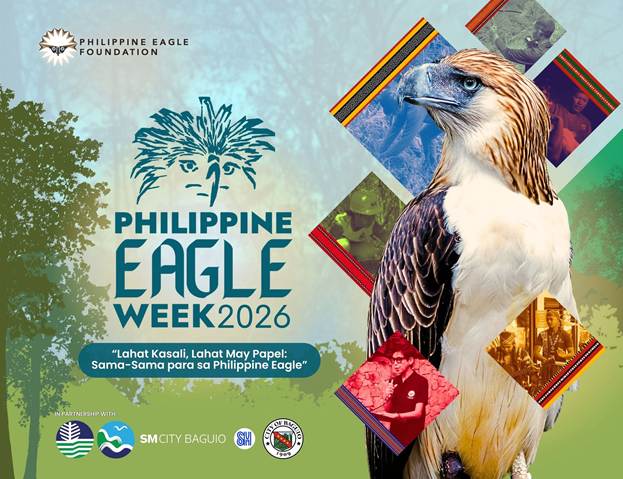
Independence Day is June 12.
If there is one animal in this country that carries the full weight of what independence means… the freedom, the dignity, the refusal to be diminished… it is this bird.
The Philippine Eagle.
Pithecophaga jefferyi.
The largest, most powerful eagle in the world by some measures, found only here, in our forests, on our islands.
Nowhere else on Earth.
I’ve written about this bird before.
I’ve talked about seeing it at the Philippine Eagle Center in Malagos, about the pair of eagles I’ve watched circle the skies in Siocon over my lolo’s land, about the time one took a piglet in a single explosive strike that sounded like a sack of rice hitting the ground.
I’ve talked about my Tito Dan buying National Geographic for me as a child and me misreading the name ‘Monkey-eating Eagle’ and spending years confused about whether a bird was eating a monkey or a monkey was eating an eagle.
But this article is different.
This one isn’t just about the bird as an animal. This one is about what the bird means.
And what it says about us as a nation that we have let it get to where it is today.
PHILIPPINE EAGLE
| COMMON NAME | Philippine Eagle / Agila ng Pilipinas |
| SCIENTIFIC NAME | Pithecophaga jefferyi |
| ANIMAL CLASS | Bird |
| NATIONAL STATUS | National Bird of the Philippines — declared by Proclamation No. 615 (1995) |
Scientific Classification
| Kingdom | Animalia |
| Phylum | Chordata |
| Class | Aves |
| Order | Accipitriformes |
| Family | Accipitridae |
| Genus | Pithecophaga |
| Species | P. jefferyi |
Physical Characteristics
| Body Length | 86 to 102 cm (34 to 40 inches) |
| Wingspan | 184 to 220 cm (72 to 87 inches) — among the largest wingspans of any eagle |
| Weight | 4.7 to 8.0 kg (10.4 to 17.6 lbs) |
| Distinctive Features | Shaggy brown-and-white mane of feathers framing the face; pale undersides; massive hooked bill; piercing blue-grey eyes |
| Lifespan in Wild | Up to 30 years |
| Lifespan in Captivity | Up to 41 years (documented at PEF facilities) |
| Sexual Maturity | 5 to 7 years |
Habitat & Distribution
| Native Range | Philippines only — endemic to the archipelago; primary populations in Mindanao; smaller populations in Leyte, Samar, and Luzon |
| Habitat Types | Old-growth tropical rainforest and montane forest; forest-dependent at every life stage |
| Territory | Each breeding pair requires 25 to 50 square kilometers of intact forest — one of the largest territory requirements of any eagle species |
| Conservation Status | CR — Critically Endangered |
| Wild Population (2026) | Estimated maximum of 392 breeding pairs — and possibly fewer, as suitable habitat continues to shrink (PEF, February 2026) |
| Population Trend | Decreasing |
Diet & Behavior
| Diet Type | Carnivore — apex aerial predator |
| Primary Food | Flying lemurs (colugos), monkeys, large lizards, snakes, hornbills, small deer, pigs |
| Hunting Style | Perch-hunting through forest canopy; explosive short bursts of speed; attacks at close range with powerful talons |
| Activity Pattern | Diurnal |
| Social Structure | Monogamous, mates for life |
| Breeding Cycle | One egg every two years — among the slowest reproductive rates of any bird |
| Incubation Period | 58 to 68 days |
| Fledging | 18 to 24 months before juveniles become independent |
PET SUITABILITY FOR DAVAO CITY: 1 out of 5
| 5 | Excellent — beginner-friendly, easy care |
| 4 | Good — suitable for experienced owners |
| 3 | Challenging — requires specific knowledge |
| 2 | Very difficult — experts only |
| 1 | Not suitable — national symbol, illegal, and belongs in the wild |
OVERALL RECOMMENDATION: You cannot keep this bird and you should not want to — what you should want is for it to still be flying over Mindanao’s forests a hundred years from now.
What the Eagle and Independence Have in Common
Here is what I keep coming back to when I think about this bird in the context of June 12.
The Philippine Eagle does not survive in a degraded forest. It is what scientists call a keystone species and what I would call a truth-teller.
Like Deadpool and Wolverine when they were taken out of existence in the Multiverse…

If the eagle is present, the forest is intact.
If the forest is gone, the eagle cannot survive, no matter how many laws protect it on paper.
It needs the real thing.
Old growth.
Canopy.
Understory.
Prey base.
Territory.
It needs the Philippines to actually be the forested, biodiverse archipelago we claim to celebrate on Independence Day every year.
We declared independence in 1898.
We declared the Philippine Eagle our national bird in 1995.
Both declarations were moments of pride.
Both came with responsibilities we have not fully honored.
At last count, the Philippine Eagle Foundation estimates a maximum of 392 breeding pairs surviving in the wild. That number includes a margin of optimism built into the modeling. The actual number of pairs may be considerably lower, because some of that remaining suitable habitat has already lost its eagles to hunting, to habitat loss, to the slow violence of deforestation that never makes the front page because it happens incrementally, one tree at a time, one burning kaingin at a time, one illegal logging road at a time.
To put 392 into perspective… that is fewer individuals than the number of people who might attend a single university graduation ceremony.
The entire remaining wild breeding population of our national bird, the one on the seal, the one we put on our money, the one we named a sports team after… fits in a university gymnasium.
I am not saying this to make you feel hopeless.
I am saying it because the distance between hopeless and motivated is information.
If you didn’t know the number, you couldn’t feel the urgency.
Now you know.
The good news, and there is good news, is that the Philippine Eagle Foundation has been doing extraordinary work for 39 years based in Malagos right here in Davao.
In 2025 they successfully released Philippine Eagles back into the wild in Leyte, a genuinely historic milestone. They documented new nesting sites in Luzon and Mindanao, which means that when forests are protected, the eagles respond.
They soar back.
They nest.
They raise the next generation.
The forest is still capable of supporting them if we give it the chance to do so.
Philippine Eagle Week ending two days before Independence Day is not a coincidence I can ignore. Because to me, the eagle is the most honest measure of Philippine independence we have.
Not just flags, and definitely not speeches or fireworks shot over the bay.
The eagle.
A critically endangered bird clinging to the last fragments of forest on a group of islands that used to be 70 percent covered in primary rainforest and is now closer to 7 percent.
That bird is asking us a question every June 12.
It has been asking it for decades.
The question is not whether we can declare independence from colonial powers.
We answered that in 1898, however imperfectly. The question the eagle is asking is whether we can be independent enough in our thinking to protect what we actually have… the forests, the watersheds, the biodiversity, the living heritage that makes the Philippines worth being proud of in the first place.
I have seen these eagles circling in Siocon. I have watched one take a piglet off the ground in one strike.
I have stood in front of Lolong‘s remains in Manila and felt the scale of what we almost lost.
And I have stood in the Philippine Eagle Center in Malagos and looked at these birds up close and thought: this animal should not have to be here.
It should be out there, in the forest, fifty kilometers from the nearest human being, doing what it was designed by four million years of evolution to do.
That is independence.
Real independence.
Not a cage, however comfortable.
Not a center, however well-run.
The forest. Intact, endless, theirs.
Happy Independence Day!
| Philippine Eagle Week: June 4 to 10, 2026. Proclaimed annually by virtue of Proclamation No. 79 signed by President Joseph Estrada on February 24, 1999. Philippine Independence Day: June 12, 2026 — the 128th anniversary of the declaration of Philippine independence. Support the Philippine Eagle Foundation at philippineeaglefoundation.org or visit the Philippine Eagle Center at Malagos, Baguio District, Davao City. |
What You Can Actually Do
This section exists in place of the usual care guide because there is no private care guide for the Philippine Eagle. There is only a conservation guide. And here it is.
Visit the Philippine Eagle Center in Malagos. It is one of the only places in the world where you can see these birds up close in a setting designed for their welfare and for public education. Your entrance fee goes directly toward the Foundation’s conservation work. Take your kids. Let them see it before it exists only in photographs.
Support the Philippine Eagle Foundation directly. Donations, adoptions of specific eagles, corporate partnerships — all of it funds real fieldwork in real forests. The PEF is based here in Davao. They are our neighbors. Supporting them is a local act with national consequences.
Protect forests. This sounds abstract but it is very concrete. Don’t buy illegaly logged hardwood furniture. Report kaingin burning to the DENR. Support local government officials who actually enforce forest protection laws. If you have land with trees on it, keep the trees.
If you have the means to reforest, reforest.
Do not support the wildlife trade.
Any eagle, any raptor, any Philippine endemic bird offered for sale privately is almost certainly wild-caught and illegal under RA 9147.
Do not buy it.
Do not photograph it approvingly.
Do not share it without reporting it.
The demand that keeps the trade alive is made of individual choices.
Tell people about the 392 pairs.
Tell the number to someone who doesn’t know it.
Let them feel what you felt when you first heard it. Information is the beginning of urgency and urgency is the beginning of action.
LEGAL STATUS IN THE PHILIPPINES: Strictly protected under RA 9147 (Wildlife Resources Conservation and Protection Act) and RA 6147. Killing, capturing, possessing, or trading a Philippine Eagle carries penalties of up to twelve years imprisonment and fines of up to P1,000,000. CITES Appendix I listing prohibits international commercial trade. The most protected bird in the Philippines.
CARE TAGS: Critically Endangered • National Bird • Philippine Endemic • Forest Dependent • 392 Pairs Remaining • Support PEF
Reasons for Hope vs Reasons for Urgency
| Reasons for Hope | Reasons for Urgency |
| Successful wild releases in Leyte in 2025 — the eagles came back | Estimated maximum of 392 breeding pairs remaining in the wild (PEF, 2026) |
| New nesting sites discovered in Luzon and Mindanao in 2025 — forests still respond when protected | Breeding cycle produces only one egg every two years — recovery is extremely slow |
| 39 years of PEF conservation work has maintained and grown captive breeding programs | Philippine forest cover reduced from approximately 70% to under 7% of original extent |
| Philippine Eagle Center in Malagos provides world-class facility for public education | Illegal hunting and shooting still documented — RA 9147 penalties not consistently enforced |
| Growing national pride in the species creates conservation community and public awareness | Minimum territory of 25 to 50 sq km per pair means remaining forests may already be at capacity |
Trivia
- The Philippine Eagle was known as the Monkey-eating Eagle until 1978, when President Ferdinand Marcos officially renamed it by presidential proclamation. The original name came from early reports from Samar that it preyed exclusively on monkeys — later research showed its diet is dominated by flying lemurs (colugos), not monkeys, though it will take monkeys when available.
- Philippine Eagle Week was established by Proclamation No. 79 signed by President Joseph Estrada on February 24, 1999 — observed annually from June 4 to 10. Independence Day falls two days later on June 12, making the first half of June the most patriotic wildlife period in the Philippine calendar.
- The Philippine Eagle is the only member of its genus, Pithecophaga. It has no close living relatives and its evolutionary lineage is distinct from all other large eagles. It is, in a very real biological sense, one of a kind.
- Each Philippine Eagle produces only one chick every two years, and both parents invest heavily in rearing that single offspring for up to two years after hatching. If a chick is lost, the pair does not breed again for another two years. This is why every individual matters and why illegal killing is so devastating to the population.
- The Philippine Eagle Foundation has been based in Davao City since its founding in 1987. The Philippine Eagle Center at Malagos, Baguio District, Davao City is one of the few places in the world with a successful captive breeding program for this species. Davao is, in this sense, the conservation capital of the Philippine Eagle.
- In Siocon, Zamboanga del Norte, wild Philippine Eagle pairs have been documented nesting on old-growth trees on private land for multiple generations. Their continued presence is direct evidence that private landowners who choose to protect their forest make a meaningful difference to this species’ survival — not just governments, not just NGOs, individual Filipinos with land and the will to keep it forested.
Sources: Wikipedia (Philippine Eagle — Pithecophaga jefferyi), Philippine Eagle Foundation (PEF) — philippineeaglefoundation.org, Manila Bulletin (February 19, 2026 — forest loss threatens Philippine Eagle), Sun Star Davao (February 18, 2026 — PEF 39th anniversary), BMB.gov.ph (23rd Philippine Eagle Week message), Proclamation No. 615 (National Bird), Proclamation No. 79 (Philippine Eagle Week), RA 9147 (Wildlife Resources Conservation and Protection Act), personal visits to Philippine Eagle Center Malagos and field observations in Siocon, Zamboanga del Norte.

