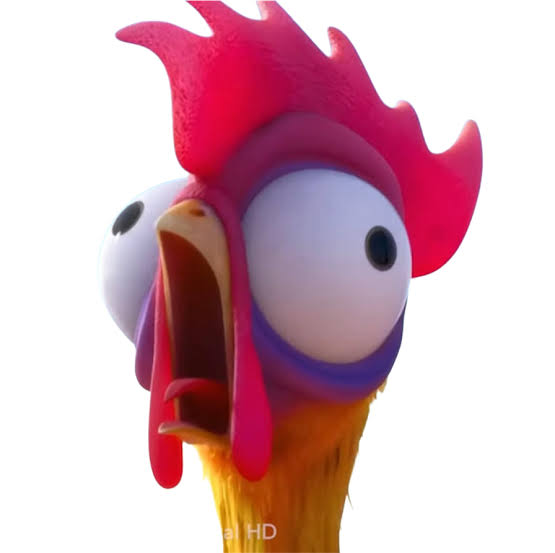

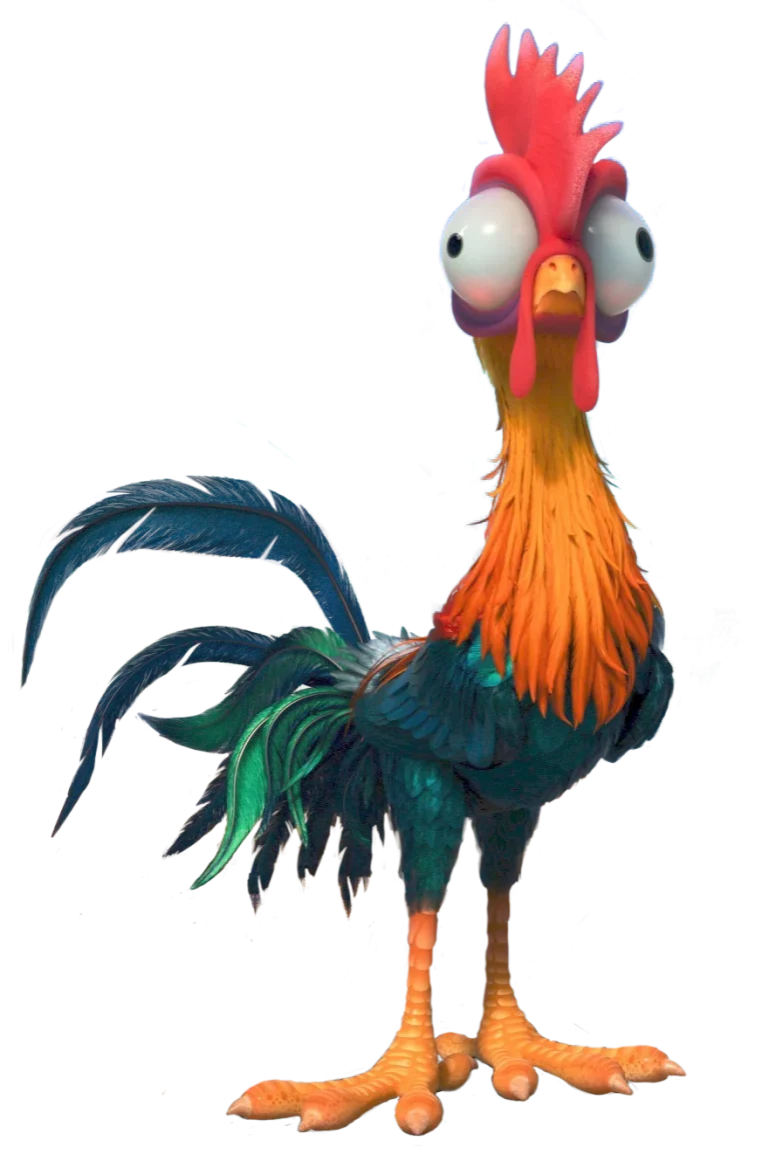
When Moana came out in 2016, people everywhere fell in love with a rooster who was, according to the filmmakers themselves, possibly the stupidest character in the history of Disney Animation.
His name?
Heihei
…which, funnily enough, literally means ‘chicken’ in Maori… and he is a bantam rooster.
Small, red-feathered, completely oblivious to his surroundings, and yet somehow absolutely essential to the story by the time the credits roll.
Chickens have been a part of my life since I was a kid.
If you follow this blog, you’ll also remember that I’ve posted articles chickens as pets, Australorps, and the top egg-laying breeds for the Philippines.
But Heihei specifically is a bantam rooster, and bantams are their own thing entirely.
They are the teacup dogs of the chicken world.
Compact, full of personality, surprisingly hardy for their size, and genuinely enjoyable to keep… if you know what you’re getting yourself into.
| ABOUT HEIHEI: Disney’s Heihei is officially described as a bantam rooster with physical traits resembling a Red Jungle Fowl (Gallus gallus) — the wild ancestor of all domestic chickens — crossed with characteristics of the Nankin Bantam, one of the oldest true bantam breeds. He is voiced by Alan Tudyk, who has called it one of his most enjoyable roles. Co-director Ron Clements described Heihei as ‘might be the stupidest character in the history of Disney Animation.’ The word heihei or hei hei means ‘chicken’ in Maori. |
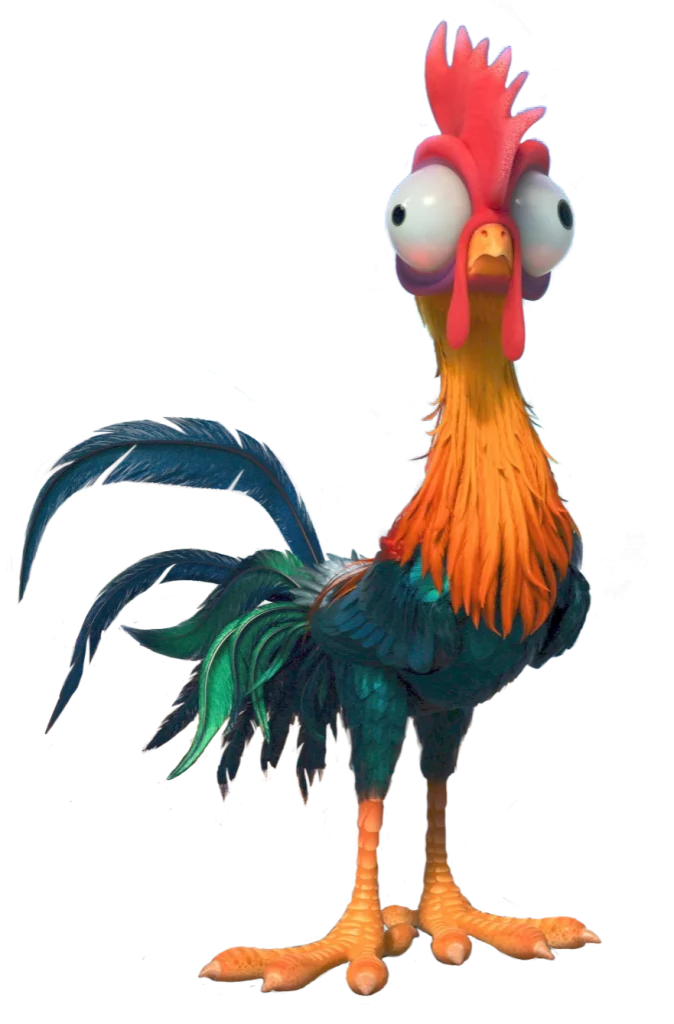
BANTAM ROOSTER (Real-Life Heihei)
| COMMON NAME | Bantam Chicken / Bantam Rooster / True Bantam |
| CLOSEST WILD RELATIVE | Red Jungle Fowl (Gallus gallus) — wild ancestor of all domestic chickens, native to Southeast Asia including the Philippines |
| SCIENTIFIC NAME | Gallus gallus domesticus (domestic chicken); Red Jungle Fowl ancestor: Gallus gallus |
| ANIMAL CLASS | Bird |
| DISNEY COUNTERPART | Heihei — Moana (2016, 2024 sequel); bantam rooster with Red Jungle Fowl / Nankin Bantam traits |
Scientific Classification
| Kingdom | Animalia |
| Phylum | Chordata |
| Class | Aves |
| Order | Galliformes |
| Family | Phasianidae |
| Genus | Gallus |
| Species | G. gallus domesticus |
Physical Characteristics — Bantam Rooster
| Height | 20 to 30 cm (8 to 12 inches) — roughly one-quarter to one-third the size of a standard chicken |
| Weight | 500 g to 1 kg (1.1 to 2.2 lbs) depending on breed |
| Comb Type | Single comb most common (as in Heihei’s design); rose comb varieties also exist |
| Plumage | Varies widely by breed; Red Jungle Fowl-type bantams have rich red-orange hackles, black and green iridescent tail feathers, and red facial skin |
| Lifespan | 5 to 10 years with proper care; some individuals reach 12 years |
| Egg Size | Bantam eggs are approximately half the size of a standard chicken egg |
| Eggs per Year | 100 to 150 eggs annually depending on breed and care |
| Sexual Maturity | 4 to 6 months |
Which Bantam Is Closest to Heihei?
| Breed | Heihei Similarity | Availability in PH | Temperament |
| Red Jungle Fowl (Gallus gallus) | Highest — closest wild ancestor; Heihei’s build and coloring match closely | Present in wild; available from breeders | Alert, active, flighty — definitely not Heihei’s personality |
| Nankin Bantam | Very high — one of the oldest true bantam breeds; small, buff-colored to reddish | Rare in Philippines; specialist breeders only | Calm, friendly, good with children |
| Old English Game Bantam | High — compact, upright posture, game bird build matches Heihei’s silhouette | Available from cockfighting supply networks in Mindanao | Feisty and territorial — more personality than Heihei |
| Aseel Bantam | Moderate — muscular compact build | Available in Mindanao from game bird breeders | Aggressive toward other roosters |
| Silkie Bantam | Low on looks, surprisingly high on obliviousness | Available at SM and pet shops | Gentle, docile, slightly confused — actually the most Heihei-like in personality |
Habitat & Distribution — Red Jungle Fowl
| Native Range | South and Southeast Asia — India, Sri Lanka, Myanmar, Thailand, Vietnam, Malaysia, Indonesia, Philippines |
| Philippine Status | Native species — Gallus gallus is found in Philippine forests, including parts of Mindanao and the Visayas |
| Habitat Types | Tropical forest edges, scrubland, agricultural borders |
| Climate Preference | Tropical, warm and humid — naturally suited to Philippine conditions |
| Conservation Status | LC — Least Concern (Red Jungle Fowl wild populations); domesticated bantams not listed |
| Population Trend | Stable (domestic); some concern about hybridization with domestic chickens affecting wild gene purity |
Diet & Behavior
| Diet Type | Omnivore |
| Primary Food | Seeds, insects, small invertebrates, greens, kitchen scraps, commercial poultry feed |
| Activity Pattern | Diurnal — active from dawn to dusk, roosts at night |
| Social Structure | Flock-oriented; rooster establishes pecking order; bantam roosters can be territorial toward other males |
| Roosting | Instinctively roosts elevated at night — provide a perch at least 30 to 60 cm off the ground |
| Vocalization | Roosters crow — bantam crows are higher-pitched and slightly less loud than standard roosters but still audible to neighbors |
| Foraging | Scratches at ground constantly — like Heihei, they will investigate everything in their path |
| Reproduction | Year-round in Philippine climate; hen incubates eggs for 21 days |
PET SUITABILITY FOR DAVAO CITY: 4 out of 5
| 5 | Excellent — beginner-friendly, easy care |
| 4 | Good — suitable for most owners with basic knowledge |
| 3 | Challenging — requires specific knowledge |
| 2 | Very difficult — experts only |
| 1 | Not suitable — wild animal or illegal |
OVERALL RECOMMENDATION: Bantam roosters are one of the most rewarding backyard birds you can keep in Davao — compact, characterful, and genuinely entertaining — as long as you can handle the crowing and have at least a few square meters of outdoor space.
Living With a Bantam Rooster: Suitability, Care & Honest Advice
Chickens are super underrated as companion animals, they have real personalities, and they do more for your home than most people realize.
Bantams specifically… they’re the version of that for people who live in smaller spaces or who just want something with more personality per kilogram than a standard-size chicken.
In Davao, bantam roosters are well-suited to our climate.
They came from the tropics.
The Red Jungle Fowl, which is the wild ancestor of all domestic chickens and the closest real-world equivalent to Heihei’s design, is actually native to Southeast Asia including the Philippines. Davao’s 27 to 32-degree heat and high humidity is not a challenge for these birds the way it is for, say, a Husky or a Golden Retriever.
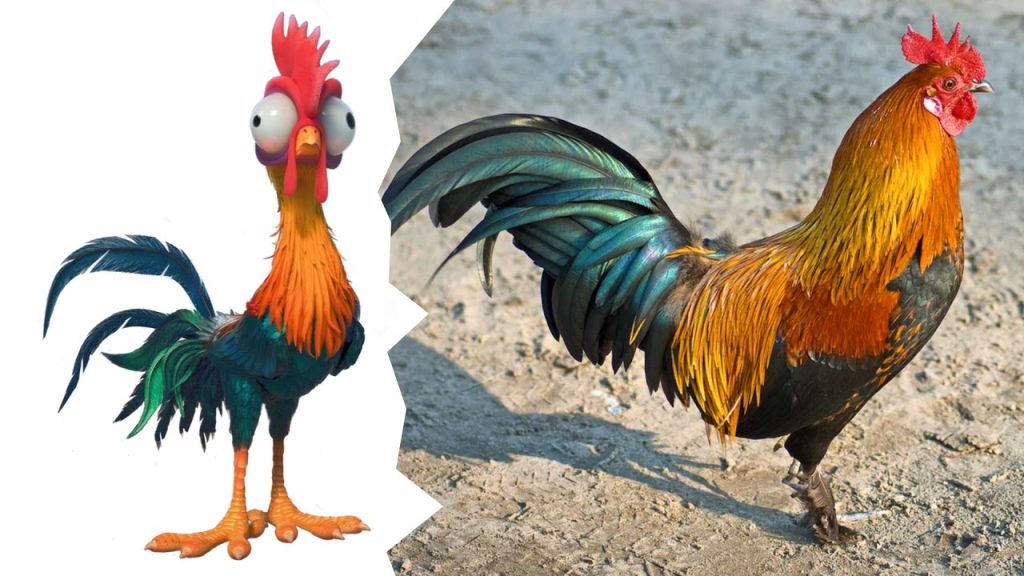
They were made for this weather.
Space requirements are the best news about bantams.
A standard chicken needs 0.37 to 0.93 square meters of coop space and more run space on top of that.
A bantam needs roughly half of that. In a typical Davao subdivision lot of 120 to 200 sqm, you can comfortably keep two or three bantams in a small covered enclosure with access to a patch of garden for foraging.
They are also lighter on the garden than standard chickens… they scratch, yes, but with smaller feet and less force.
The crowing… I have to be honest about the crowing.
Bantam roosters crow.
The pitch is higher than a standard rooster (some people find it slightly less abrasive, some find it more so) but it is still a rooster crowing at 4am. In a subdivision with close neighbors, this is something you have to think about and possibly discuss before getting one.
If your neighbors are already keeping roosters, you’re probably fine.
If yours is the only rooster in the block, expect some comments eventually.
Now… is Heihei’s personality realistic?
The Disney version is oblivious to the point of comedy, wandering into danger, staring at nothing, forgetting what it was doing mid-step.
Real bantam roosters are not quite that dimensionally challenged.
They are actually reasonably intelligent birds… chickens in general are much smarter than their reputation suggests.
But they do have moments of spectacular distraction, especially when foraging.
Watch a bantam rooster encounter a new object in its environment and you will see something that looks very much like Heihei deciding whether a rock is edible.
Feeding is easy.
Commercial poultry starter or layer pellets from any agricultural supply store in Davao, supplemented with kitchen scraps (rice, vegetable trimmings, small insects, cooked egg), and fresh water changed daily. Bantams eat less than standard chickens so feed costs are significantly lower.
For free-range or semi-free-range setups, they’ll supplement their diet by foraging. In a fully enclosed run, supplement with garden greens.
Health and vet care for bantams in Davao is manageable.
Common issues include respiratory infections during heavy rainy season, external parasites (lice and mites — check under the wings and around the vent regularly), and internal worms.
A basic deworming schedule every three to four months, occasional dust bathing access (they do this themselves if you provide dry soil or wood ash), and keeping the coop dry during the rainy season covers most preventive care.
Poultry vets or agricultural extension officers at the Davao City Agriculture Office can advise on local disease concerns and vaccination programs for Newcastle disease, which is the main viral threat to backyard poultry in the Philippines.
Handling and enrichment.
Bantams raised from chicks with regular gentle handling become quite tame and will come to you for treats, allow themselves to be picked up, and follow you around the garden in a way that is genuinely endearing.
A rooster that has been socialized properly is a very different animal from one that has been ignored or kept in a cage.
Enrichment is simple: space to forage, things to investigate, other chickens for company (bantams are social and do better with at least one companion), and a safe elevated roost for nighttime sleeping.
LEGAL STATUS IN THE PHILIPPINES: Fully legal. Domestic chickens including bantams are unregulated as livestock and pets. The Red Jungle Fowl (Gallus gallus) in its wild form is protected under RA 9147 as native wildlife — but domesticated bantam breeds are not subject to wildlife restrictions. Cockfighting regulations apply to gamecocks used in sabong but not to bantams kept as pets.
CARE TAGS: Beginner-Friendly • Davao Climate Ideal • Small Space Suitable • Rooster Crowing Note • Social — Needs a Companion • Kid-Friendly
Pros & Cons
| Pros | Cons |
| Perfectly suited to Davao’s tropical climate — no temperature management needed | Roosters crow — early and loudly — potential neighbor issue in subdivisions |
| Half the space requirement of standard chickens — works in smaller lots | Bantam eggs are half the size of standard eggs — lower egg yield per bird |
| Sociable and tameable with regular handling — genuine personality per bird | More vulnerable to aerial predators (hawks, owls) due to small size — covered run recommended |
| Lower feed costs than standard chickens | Roosters can be territorial with other male birds — limit to one rooster per flock |
| Naturally pest-controlling — they eat insects and scratch out grubs from soil | Can damage garden beds if allowed to forage unsupervised in planted areas |
| Excellent for children as a first responsibility animal | Shorter lifespan than cats or dogs — emotional attachment comes with a shorter timeline |
Trivia
- Heihei is officially voiced by Alan Tudyk, who also voiced the Moana villager who suggests eating him. Tudyk produced Heihei’s vocalizations by making sounds into a pillow, then having the audio team pitch-shift and manipulate the results. Real bantam roosters are considerably louder and not muffled by any available pillow.
- The Red Jungle Fowl (Gallus gallus) is native to the Philippines and is the direct wild ancestor of every domestic chicken breed on Earth, including all bantam breeds. This means Heihei’s wild cousins are genuinely living in Philippine forests right now, including parts of Mindanao.
- Bantam chickens are not miniature versions of standard breeds — ‘true bantams’ like the Nankin Bantam (one of Heihei’s closest breed equivalents) have no standard-size counterpart and were never bred down from a larger bird. They are naturally small and have been documented in poultry literature since at least the 1600s.
- Chickens in general are significantly more intelligent than their reputation suggests. Studies have demonstrated numeracy, basic self-control, and the ability to understand that hidden objects still exist — a cognitive skill human children don’t develop until around 7 months of age. Heihei, specifically, does not demonstrate any of these abilities. He is the exception, not the rule.
- The filmmaking team at Disney celebrated Heihei’s survival in the film by eating fried chicken. The irony of this was noted and apparently embraced enthusiastically.
- In Moana 2 (2024), Heihei returns to assist Moana on her mission to restore the island of Motufetu. Despite the nine years between films, his cognitive abilities appear unchanged. Some animals are consistent.