

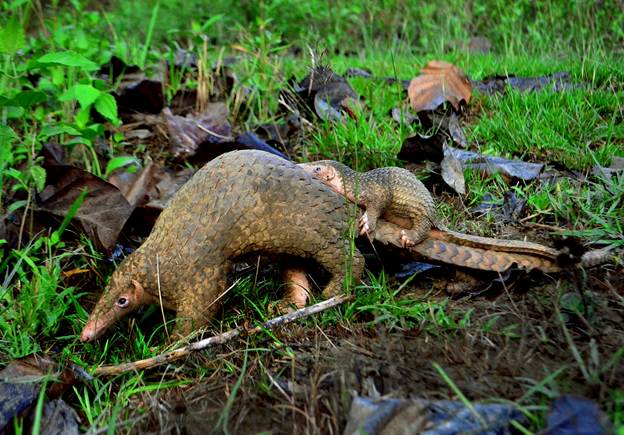
I’ll start with a number.
An estimated 195,000 pangolins were trafficked in a single year — 2019 — for their scales alone.
That number does not include the ones caught for their meat.
It does not include the ones that died in transit before reaching their buyers.
It is just the ones counted.
The real number is almost certainly higher.
One of those eight pangolin species is ours. The Philippine Pangolin, Manis culionensis, called balintong in Palawan where it lives.
It is found nowhere else on Earth except the Palawan faunal region. And its population has declined by an estimated 95 percent between 1980 and 2018.
Ninety-five percent.
In forty years.
Mostly because people on the other side of the South China Sea believe, without any scientific evidence to support it, that pangolin scales cure disease.
They don’t.
Pangolin scales are made of keratin.
The same thing as your fingernails.

So we are losing our only pangolin species to superstition and organized crime.
And most Filipinos have never seen one, never heard of it, and couldn’t identify it in a photograph.
That last part is something we can actually fix.
So let’s start there.
PHILIPPINE PANGOLIN / BALINTONG
| COMMON NAME | Philippine Pangolin / Balintong (Palawan) |
| SCIENTIFIC NAME | Manis culionensis |
| ANIMAL CLASS | Mammal |
Scientific Classification
| Kingdom | Animalia |
| Phylum | Chordata |
| Class | Mammalia |
| Order | Pholidota |
| Family | Manidae |
| Genus | Manis |
Physical Characteristics
| Body Length | 30 to 45 cm (12 to 18 inches) body; tail adds another 25 to 38 cm |
| Weight | 2 to 7 kg (4.4 to 15.4 lbs) |
| Scales | Overlapping keratin scales cover the entire body except the face, inner limbs, and belly — the only scaled mammal on Earth |
| Tongue | Extremely long and sticky; extends beyond the snout to probe ant and termite nests |
| Lifespan in Wild | Estimated 8 to 13 years |
| Lifespan in Captivity | Rarely survives in captivity; most die within months of capture from stress and dietary failure |
| Sexual Maturity | Approximately 2 years; produces only 1 offspring per year |
Habitat & Distribution
| Native Range | Endemic to the Palawan faunal region of the Philippines — found on Palawan island, Culion, Busuanga, and surrounding smaller islands |
| Habitat Types | Tropical forest, forest edges, and secondary growth; semi-arboreal — climbs trees using prehensile tail |
| Climate Preference | Tropical, warm and humid |
| Conservation Status | CR — Critically Endangered |
| Population Trend | Decreasing — population declined approximately 95 percent between 1980 and 2018 |
Diet & Behavior
| Diet Type | Insectivore (myrmecophage — specialist ant and termite feeder) |
| Primary Food | Ants, termites, and their eggs and larvae — has no teeth; uses muscular stomach and keratinous spines to grind prey |
| Activity Pattern | Primarily nocturnal; some crepuscular activity |
| Social Structure | Solitary |
| Defense Mechanism | Rolls into a tight ball, scales providing armor; can also release a foul-smelling secretion from anal glands |
| Reproduction | Single offspring per year; mother carries young on her tail |
| Generation Length | Estimated 7 years — recovery from population loss is extremely slow |
PET SUITABILITY FOR DAVAO CITY: 1 out of 5
| 5 | Excellent — beginner-friendly, easy care |
| 4 | Good — suitable for experienced owners |
| 3 | Challenging — requires specific knowledge |
| 2 | Very difficult — experts only |
| 1 | Not suitable — critically endangered, illegal, and dies in captivity |
OVERALL RECOMMENDATION: This animal is not a pet and it is near extinction and the only useful thing anyone reading this can do is help stop that.
Living With the Philippine Pangolin: Suitability, Care & Honest Advice
There is no honest care guide for keeping a Philippine Pangolin because keeping one is both illegal and effectively a death sentence for the animal.
Pangolins are among the most difficult mammals on Earth to maintain in captivity.
They are dietary specialists that eat only ants and termites… live ones, from specific species, dug out of the ground.
They cannot be fed commercial food.
They cannot be sustained on substitutes.
Even the world’s best-resourced zoos have struggled to keep pangolins alive for more than a few months after capture.
Most die of stress, starvation, or aspiration pneumonia from being force-fed inappropriate food by handlers who don’t know what they’re doing.
So if you see someone offering a pangolin for sale… anywhere, online, at a market, through a contact… that animal is already dying. It was probably taken from the wild within the last few weeks.
It will not survive long in whoever buys it.
And the person selling it is committing a criminal offence under RA 9147, punishable by up to twelve years in prison and fines of up to one million pesos.
The Philippine Pangolin cannot survive in Davao because it cannot survive anywhere outside Palawan’s specific forest ecosystem… and increasingly it’s struggling even there, because the forests of Palawan are also under pressure from logging, agricultural expansion, and the same organized trafficking networks that are emptying it out for overseas markets.
The demand is almost entirely international.
Pangolin scales sell in Chinese black markets for thousands of dollars per kilogram.
The meat is considered a luxury item.
None of this has any scientific basis for health benefits.
All of it is driving a species to extinction.
What you can do is practical and specific.
Report sightings of pangolins being sold or offered for trade to the DENR-BMB hotlines: 925-8952 and 925-8953, or through facebook.com/denrbiodiversity. In Mindanao, the DENR Region XI office covers Davao and can be reached directly.
If you see a pangolin offered for sale on social media, screenshot it, note the seller’s profile, and report it to both DENR and the platform.
TRAFFIC Philippines also accepts wildlife crime tips and coordinates with enforcement agencies.
These reports lead to actual operations.
In 2020, a Philippine Pangolin was rescued from an illegal trader in Quiapo, Manila, through exactly this kind of enforcement action.
The animal was brought to the Wildlife Rescue Center at Ninoy Aquino Parks and Wildlife Center.
That rescue happened because someone reported it.
In parts of Mindanao, barangay-level anti-poaching communities have been organized in partnership with DENR and local NGOs to monitor forest edges and report suspicious activity.
These groups are not well-funded and not well-publicized but they are real and they matter.
Protecting the Philippine Pangolin from Davao is indirect but not impossible: support organizations funding Palawan forest conservation, refuse to buy wildlife products of any kind, and make noise when you see the trade happening online.
What CITES Means and How to Report Trafficking
LEGAL STATUS IN THE PHILIPPINES: Critically Endangered, fully protected under RA 9147 (Wildlife Resources Conservation and Protection Act) since 2004. CITES Appendix I listing prohibits all international commercial trade. Penalties for possession, hunting, trading, or transporting: 2 to 12 years imprisonment and PHP 5,000 to PHP 1,000,000 in fines. No private ownership permit exists for this species.
CARE TAGS: Critically Endangered • CITES Appendix I • Dies in Captivity • Report Sightings to DENR • Palawan Endemic • Do Not Buy Wildlife Products
Reasons to Fight for It vs Reasons It Is Losing
| Reasons to Fight for It | Reasons It Is Losing |
| The only scaled mammal on Earth — biologically unique with no close relatives | Population declined 95 percent in 40 years — one of the steepest collapses of any mammal |
| Endemic to the Philippines — found nowhere else, making our responsibility absolute | Dies in captivity almost universally — rescue and rehabilitation success rate is extremely low |
| CITES Appendix I and RA 9147 provide strong legal framework for protection | Trafficking is driven by international organized crime networks that outpace enforcement |
| Barangay-level community patrol programs in Mindanao and Palawan show that local action works | Pangolin scales have zero proven medical value but demand from traditional medicine markets persists |
| Reporting mechanisms exist and have led to successful rescues and prosecutions | Most Filipinos have never heard of balintong — invisibility protects the traffickers, not the pangolin |
Trivia
- Pangolins are the only mammals in the world covered in scales. Those scales are made of keratin — the exact same protein as human fingernails and rhino horns — yet they are trafficked for supposed medical properties that have never been scientifically demonstrated in any peer-reviewed study.
- The Philippine Pangolin has the most restricted range of all eight pangolin species on Earth, found only in the Palawan faunal region of the Philippines. This makes every individual genetically irreplaceable.
- When threatened, a pangolin rolls into a tight ball with its scales facing outward — an effective defense against most natural predators. Against humans with sacks and knives, it is completely useless. The very instinct that protects it in the wild makes it easier to pick up and bag.
- A mother pangolin carries her single offspring on the base of her tail for the first few months of its life. The young pangolin curls up against its mother when she rolls into a defensive ball, protected inside her armor. The image of that is genuinely something.
- An estimated 195,000 pangolins were trafficked in 2019 for their scales alone, according to WWF. That single year’s toll is almost certainly larger than the entire remaining wild population of the Philippine Pangolin.
- In 2020, the Philippine government joined global calls to investigate the link between pangolin trafficking and zoonotic disease transmission. Pangolins have been identified as a potential intermediate host for coronaviruses. The wildlife trade does not just threaten the animals being traded — it creates conditions for the next pandemic.

