

I have never seen one in person.
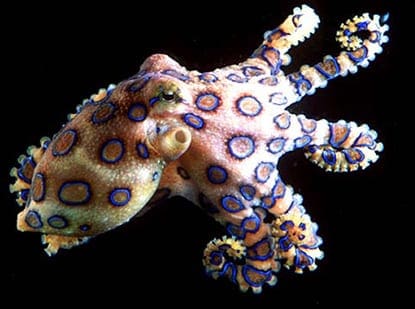
But I’ve watched enough videos and looked at enough photographs to say with complete confidence that the Blue-Ringed Octopus is one of the most beautiful animals I have ever seen images of.
That iridescent blue… the way the rings pulse and glow when it feels threatened… it looks less like a real animal and more like something someone designed for a fantasy film.
You look at it and you think: I want to keep that in an aquarium.
I want to watch it move around a tank. I want to show it to people who come to visit.
And then you read a little more about it and you think: absolutely not.
Never.
Keep that away from me and everyone I care about.
Both of those thoughts are correct and they are not in conflict.
The Blue-Ringed Octopus is genuinely one of the most visually stunning animals found in Philippine waters.
It is also one of the most dangerous animals in the ocean, carrying enough tetrodotoxin in its salivary glands to kill 26 adult humans.
The bite is painless.
There is no antivenom.
Death from respiratory failure can occur in 15 minutes.
It is not aggressive and it does not go looking for trouble, but it is small, it hides in rocks and crevices and tide pools, and the people who get bitten are almost always the ones who picked it up because it looked so beautiful and so harmless.
Looks can kill.
BLUE-RINGED OCTOPUS
| COMMON NAME | Blue-Ringed Octopus |
| SCIENTIFIC NAME | Hapalochlaena lunulata (Greater Blue-Ringed Octopus — most common in Philippine waters); also H. maculosa, H. fasciata, H. nierstraszi |
| ANIMAL CLASS | Invertebrate (Cephalopod Mollusc) |
Scientific Classification
| Kingdom | Animalia |
| Phylum | Mollusca |
| Class | Cephalopoda |
| Order | Octopoda |
| Family | Octopodidae |
| Genus | Hapalochlaena |
Physical Characteristics
| Body Size | 7 to 10 cm (2.7 to 3.9 inches) including arms — roughly the size of a golf ball |
| Weight | Approximately 80 g (2.8 oz) |
| Coloration | Yellowish-brown at rest; vivid iridescent blue rings pulse and glow when threatened or agitated — the rings are a warning display |
| Number of Rings | 50 to 60 bright blue rings on body and arms (Greater species) |
| Lifespan | Approximately 1 to 2 years in the wild; short-lived species |
| Ink Sac | Absent — unlike most octopuses, blue-ringed octopuses have no ink defense |
Habitat & Distribution
| Native Range | Indo-West Pacific — Sri Lanka, Philippines, Indonesia, Papua New Guinea, Australia, Japan |
| Philippine Range | Present throughout Philippine coastal waters; found in shallow reef areas, rocky tide pools, and under stones to depths of 10 m (33 ft) |
| Habitat Types | Shallow coral reefs, rocky intertidal zones, sandy flats with rock cover, tide pools |
| Conservation Status | LC — Least Concern |
| Population Trend | Stable |
Diet & Behavior
| Diet Type | Carnivore |
| Primary Food | Small crustaceans (crabs, hermit crabs, shrimp), small fish, bivalves |
| Hunting Method | Ambush and venom injection — bites prey and injects tetrodotoxin to paralyze |
| Activity Pattern | Nocturnal to crepuscular; hides in crevices during daylight |
| Social Structure | Solitary |
| Temperament | Non-aggressive toward humans — bites occur almost exclusively when the animal is handled or feels trapped |
| Reproduction | Female lays 50 to 100 eggs; broods them in den until hatching; dies shortly after — similar sacrificial maternal behavior to the Giant Pacific Octopus |
| VENOM FACT: The Blue-Ringed Octopus carries tetrodotoxin (TTX) — the same toxin found in pufferfish — produced by bacteria in its salivary glands. A single adult carries enough to kill 26 adult humans. There is NO antivenom. Treatment is supportive only: immediate rescue breathing and emergency medical care to keep the victim breathing until the toxin clears. The bite itself is often painless, which means victims sometimes do not realize they have been bitten until paralysis begins. |
PET SUITABILITY FOR DAVAO CITY: 1 out of 5
| 5 | Excellent — beginner-friendly, easy care |
| 4 | Good — suitable for experienced owners |
| 3 | Challenging — requires specific knowledge |
| 2 | Very difficult — experts only |
| 1 | Not suitable — dangerous and not recommended |
OVERALL RECOMMENDATION: Admire it in photos, watch it on video, do not touch it if you see one in the wild, and absolutely do not put one in your home aquarium — especially if you have children.
Can You Keep One in an Aquarium?
Technically… some people do.
There is a small community of very experienced marine aquarists, mostly in Europe and Australia, who keep Blue-Ringed Octopuses in carefully prepared tanks.
They use escape-proof enclosures with Astroturf-lined lids and multiple locking clips.
They wear cut-resistant Kevlar gloves and sleeves for any tank maintenance.
They have emergency protocols written out and posted near the tank.
They have researched everything there is to know about the animal before acquiring one.
Even then, most experts in the marine biology and toxicology community still think this is not a good idea.
And I agree with them completely.
The practical problems are significant even before you get to the venom.
The Blue-Ringed Octopus, like almost all octopi, is an escape artist… it can squeeze through any gap large enough for its beak, which is tiny.
Standard aquarium lids are not secure enough.
The animal is also sensitive to ammonia spikes in the water and will die quickly in a poorly maintained tank.
It needs live prey (live crabs and shrimp) since it rarely adapts to frozen food.
It lives only 1 to 2 years even in ideal conditions, so all that setup is for a very short-lived animal.
And it is nocturnal and spends most of the day hiding, so you would rarely even see it.
But all of that is secondary to the real issue.
Is it safe for kids?
No. It is not safe for anyone.
A child who notices something beautiful and small and blue-ringed in a tank and reaches in… that is not a scenario anyone should be creating.
The bite is painless.
The child may not even cry.
And respiratory failure can begin within minutes.
There are no what-ifs here.
This animal and children in the same household is a combination that should never happen.
Is it safe for adults?
Only if you are an experienced aquarist who has done extensive research, built a purpose-designed escape-proof system, and treats every tank interaction as a potential medical emergency.
Which is a very specific kind of person.
Probably not you.
Definitely not me.
I’ve never seen one in person and I am fine with that arrangement continuing indefinitely.
What to Do If You See One in the Wild
The Blue-Ringed Octopus is present in Philippine coastal waters including areas around Davao Gulf, Samal Island, and dive sites throughout Mindanao. Divers and people walking in tide pools can encounter them. Here is what you do:
- Do not touch it. Do not pick it up. Do not let your children touch it. The rings are a warning, not an invitation.
- If it is not glowing its blue rings, it may be very difficult to identify — it looks like a small brownish octopus sitting on a rock. Treat any small octopus in a tide pool or shallow reef as potentially dangerous.
- Observe from a respectful distance. It is genuinely beautiful and watching it is a privilege. You do not need to touch it to appreciate it.
- If someone is bitten: call emergency services immediately, begin rescue breathing if breathing stops, keep the victim calm. Do not apply a tourniquet. Get to a hospital with resuscitation equipment as fast as possible.
LEGAL STATUS IN THE PHILIPPINES: Protected under RA 9147 as Philippine wildlife. Collecting, keeping, or trading Blue-Ringed Octopuses without DENR permits is illegal. Given the extreme danger they pose, private keeping is strongly discouraged even where technically permissible.
CARE TAGS: Do Not Handle • Not Safe for Children • No Antivenom Exists • Expert Aquarists Only • Found in Philippine Waters • Observe From Distance Only
Pros & Cons
| Reasons It Fascinates | Reasons to Keep Your Distance |
| One of the most visually stunning animals in the ocean — the glowing blue rings are extraordinary | Carries enough tetrodotoxin to kill 26 adult humans; no antivenom exists anywhere in the world |
| Present in Philippine coastal waters — accessible for responsible observation while diving | Bite is painless — victims often don’t know they’ve been bitten until paralysis begins |
| Fascinating biology: no ink sac, sacrificial maternal behavior, venom produced by symbiotic bacteria | Death from respiratory failure can occur within 15 minutes of a bite |
| Short lifespan (1 to 2 years) makes it a compelling research and conservation subject | Absolutely not safe around children under any circumstances whatsoever |
| High curiosity factor makes it excellent wildlife education content | Escape artist — no standard aquarium lid is secure enough without extensive modification |
Trivia
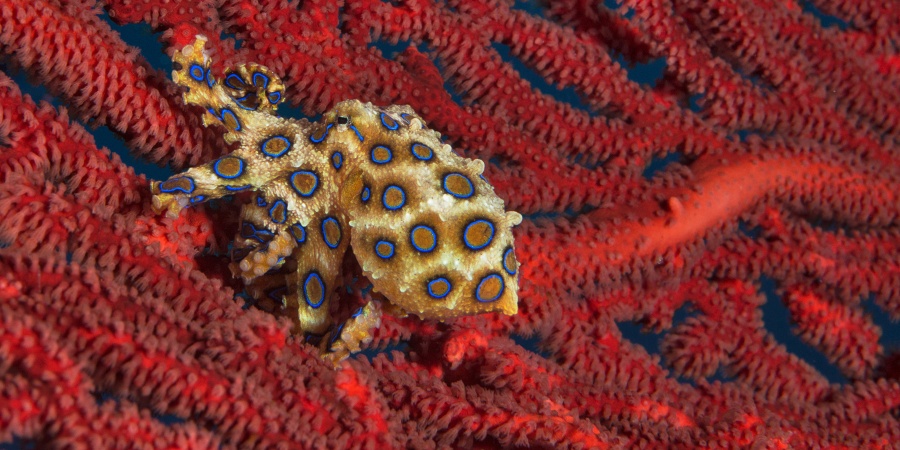
- The blue rings are not always visible. At rest, the Blue-Ringed Octopus is a dull yellowish-brown color that blends easily into rock and coral. The vivid iridescent blue only appears when the animal feels threatened — which is precisely the moment when handling it becomes most dangerous.
- The tetrodotoxin in its venom is not produced by the octopus itself but by symbiotic bacteria (Vibrio, Pseudoalteromonas, and related species) living in its salivary glands. The octopus is essentially a very beautiful delivery system for bacterial toxin.
- Unlike most octopuses, the Blue-Ringed Octopus has no ink sac. This is one reason it shows up occasionally in the marine aquarium trade — it won’t cloud the tank. Toxicologists are generaly not pleased about this fact.
- The Greater Blue-Ringed Octopus (Hapalochlaena lunulata) is the species most commonly encountered in Philippine waters and is found from Sri Lanka across the Indo-Pacific to Japan and Australia. It is considered one of the most toxic marine animals in the world.
- Despite their extreme toxicity, Blue-Ringed Octopuses are not aggressive. They are shy, reclusive animals that would rather hide than confront anything. Almost every documented bite has involved a human who picked one up or accidentally cornered one. The animal did not seek the encounter. The human did.
- There are currently four recognized species of Blue-Ringed Octopus, all in the genus Hapalochlaena. Researchers suspect there may be additional undescribed species in the Indo-Pacific, meaning this small, beautiful, terrifying genus may be larger than we currently know.

