

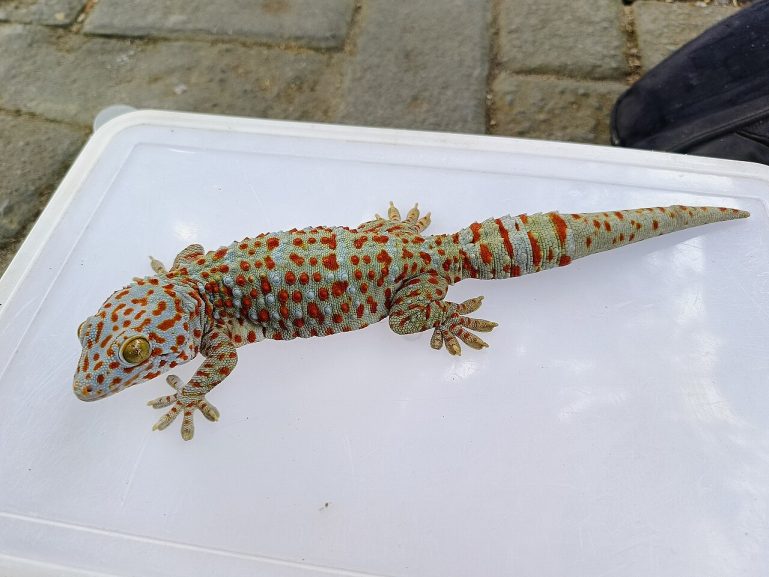
Almost every house in the Philippines has a Tokay Gecko.
You hear it before you see it… that loud, unmistakable “TUK KOOO’ (or ‘TO-KAY’ if you really want to adopt the americanized “sound”) bark echoing from somewhere behind the cabinet or up in the ceiling at 2am.
Most people never think about actually keeping one intentionally.
But the Tokay Gecko is a genuinely fascinating animal and, in the right hands, a rewarding reptile to keep.
The key phrase there is right hands.
Tokays are not beginner reptiles in the same way a Leopard Gecko or a Corn Snake is.
They are defensive, they bite hard, and they don’t tame easily.
I’ve been bitten by one and I kept one as a “house pet” for at least 3 years and he or she never became tame enough… hence me getting bitten.
But they are native to the Philippines, they are legal to keep, they are visually striking, and once you earn their tolerance they become one of the more interesting animals you can maintain in a Davao home.
Here is what you need to know.
Quick Stats
| SCIENTIFIC NAME | Gekko gecko |
| SIZE | 25 to 40 cm (10 to 16 inches) including tail; males larger than females |
| WEIGHT | 150 to 400 g (5 to 14 oz) |
| LIFESPAN | 10 to 15 years in captivity with proper care |
| ACTIVITY PATTERN | Nocturnal — most active after dark |
| TEMPERAMENT | Defensive and territorial; bites firmly and does not let go easily |
| LEGAL STATUS PH | Native Philippine species protected under RA 9147; wild-caught trade is regulated — always source captive-bred |
| DAVAO CLIMATE FIT | Excellent — native to this exact climate; no temperature equipment usually needed |
Housing
A single adult Tokay needs a minimum enclosure of 45x45x60 cm (wider and taller is better — they are arboreal climbers).
Vertical space matters more than floor space since they spend almost all their time on walls and ceiling surfaces. Glass or PVC front-opening terrariums with good ventilation work well. Screen-top enclosures work but lose humidity faster.
Provide multiple climbing surfaces: cork bark flats mounted vertically on the walls, bamboo poles, hollow logs, or PVC pipe sections. They need secure hiding spots at multiple heights.
Cover three sides of the enclosure with cork or foam background to give them something to grip and hide against. A secure lock is essential — Tokays are strong for their size and will push through loose-fitting doors.
Do not house two Tokays together unless you are actively breeding them under supervision. They are aggressively territorial and will fight, sometimes fatally.
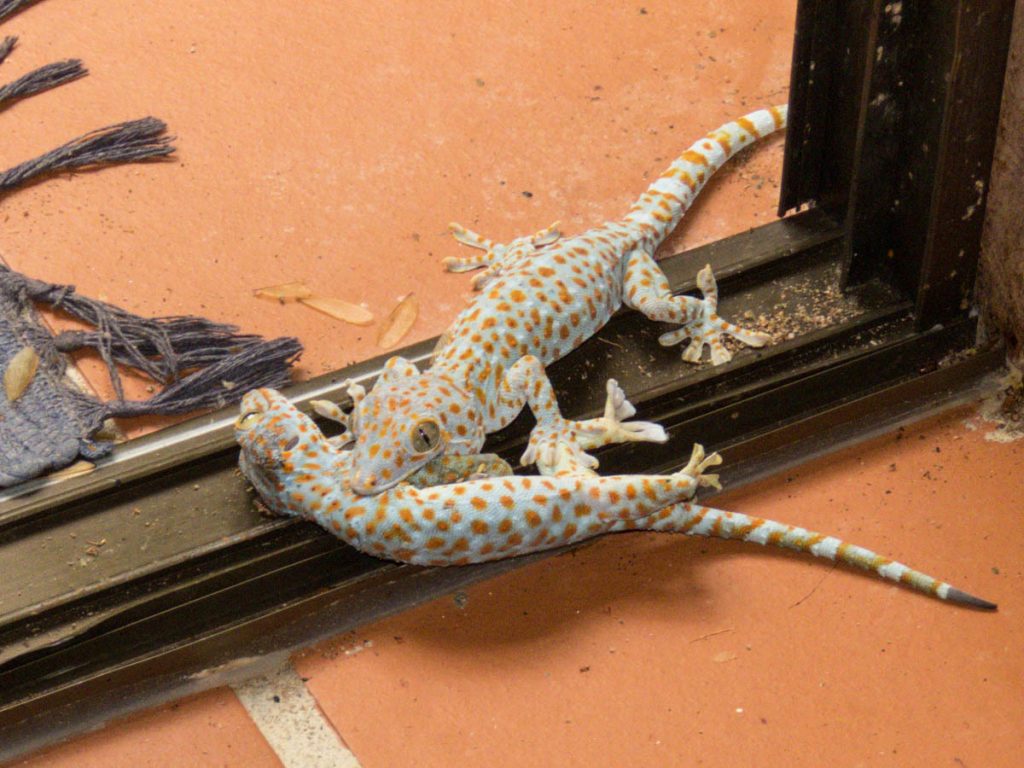
This is all in theory because the “Tokay Gecko” I kept was never caged. It just lived under a drawer and would only come out at night to feed on the table scraps I left for it.
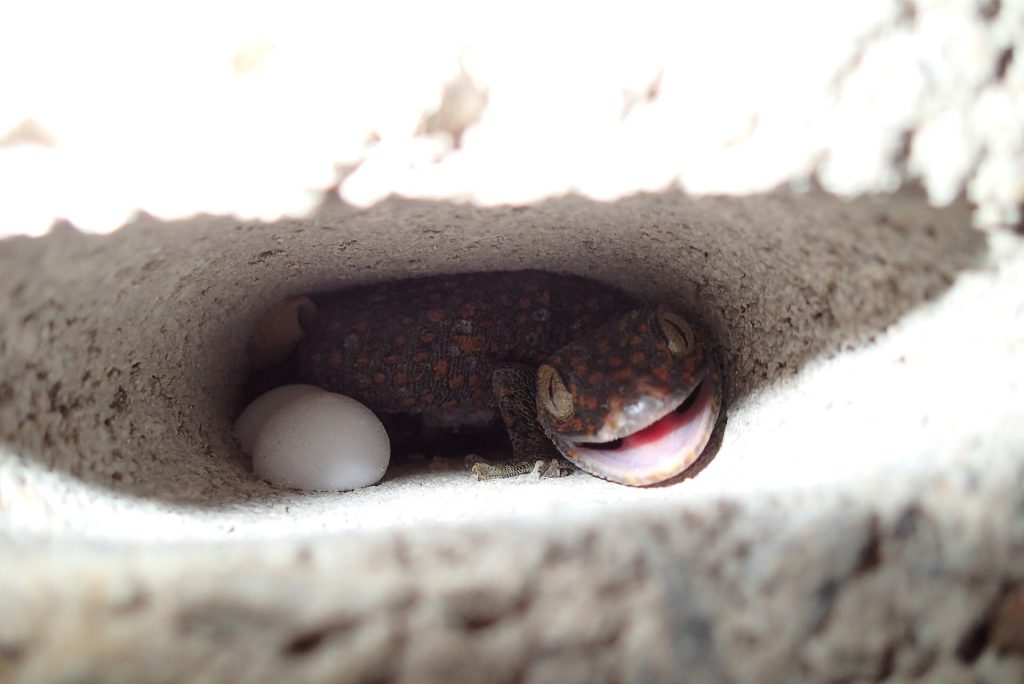
Temperature & Humidity
In Davao this is the easiest part.
Tokays are native here and Davao’s ambient temperature of 27 to 32 degrees is exactly their comfort range.
No heating equipment is needed in most Davao homes. A thermal gradient is still good practice — a slightly warmer basking spot of 30 to 32 degrees on one end and a cooler retreat of 24 to 26 degrees on the other.
Humidity should be 60 to 80 percent, which Davao’s natural humidity handles for most of the year. Mist the enclosure lightly once or twice daily with clean water. This also provides drinking water — Tokays lick droplets from surfaces and rarely drink from standing water dishes, though a shallow dish can be offered.
“Mine” had a shallow water bowl and every now and then I would see it drink from it but it preferred the condensation that built up on the glass window near where it lived.
Feeding
Tokays are primarily insectivores.
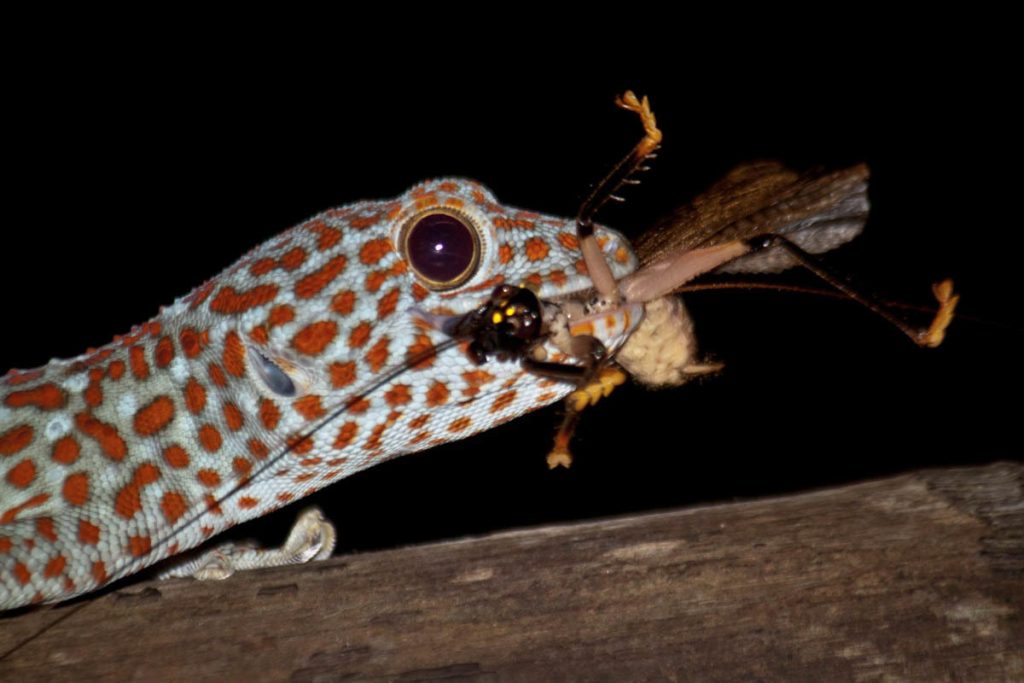
Crickets are the staple prey and the easiest to source in Davao from reptile hobby groups or some pet shops. Supplement with dubia roaches (more nutritious, less noise), mealworms, and occasional waxworms as a treat. All feeder insects should be gut-loaded (fed nutritious food) for 24 hours before offering and dusted with calcium and vitamin D3 supplement at every other feeding.
Adults eat every 2 to 3 days. Juveniles eat daily. Feed at dusk when they naturally begin hunting. Remove uneaten prey within a few hours to prevent stress from live insects in the enclosure overnight.
Now I said primarily insectivores because the one I kept would eat the food I offered it which makes it an opportunistic eater.
Handling — The Hard Part
Tokays bite.
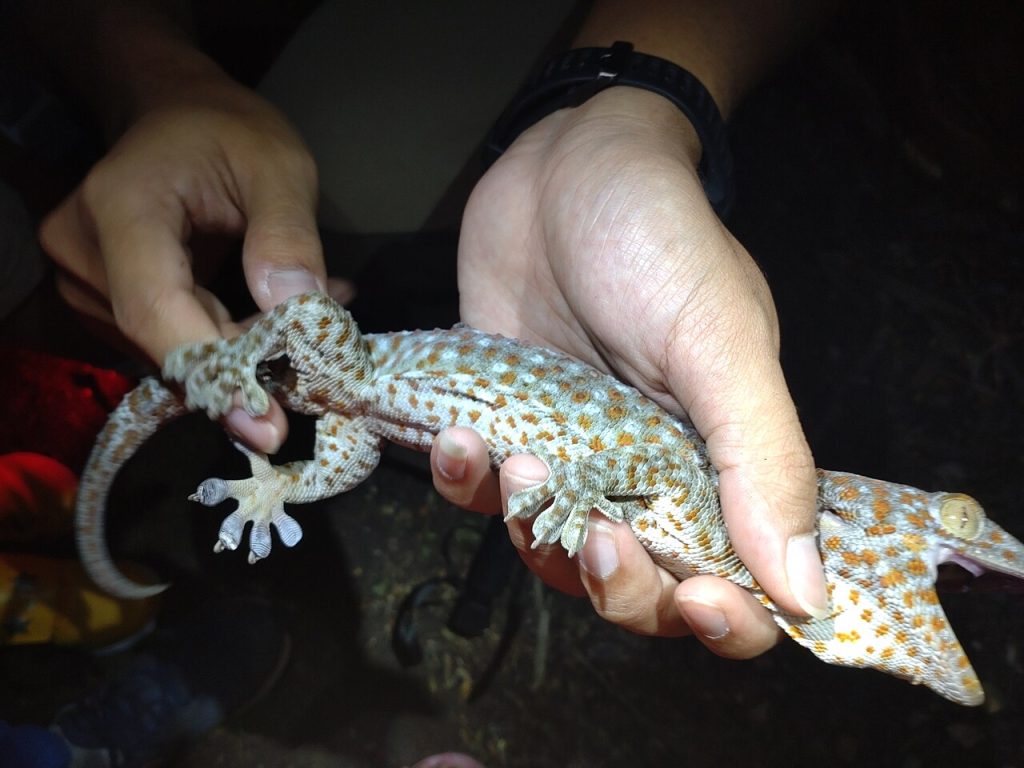
They bite hard, they hold on, and they will rotate their jaw to increase pressure if you pull away. The correct response to a Tokay bite is to stay calm, hold still, and wait for it to release on its own.
Pulling away tears the skin.
Good thing I had the presence of mind to stay calm when the Tokay Gecko I was taking care of bit me. My fault really, I thought I had tamed it enough to pick it up. And when I did, it immediately clamped on to my index finger and did not let go for at least 10 seconds.
It felt like having a large paper snap on to my finger.
Taming a Tokay requires consistent, short daily interactions starting from hatchling age if possible.
Use a hook or tongs to move them initially rather than bare hands. Over weeks of patient, non-threatening contact, many Tokays will eventually tolerate handling without striking. Some never fully tame. Accept this possibility before acquiring one.
| THE BITE REALITY CHECK: A Tokay Gecko bite from an adult is genuinely painful — not medically dangerous but strong enough to draw blood and leave a bruise. Thick leather gloves help initially but reduce your ability to feel and control the gecko. Most experienced keepers prefer to work ungloved and simply accept that early bites are part of the process. Hook training significantly reduces bite incidents. |
Health & Common Issues
| Issue | What to Watch For |
| Respiratory infection | Wheezing, open-mouth breathing, mucus around nostrils — usually from low temperatures or excessive cold drafts |
| Incomplete shedding (dysecdysis) | Retained shed on toes or around eyes — mist more frequently and provide a moist hide during shed cycle |
| Parasites | Weight loss, lethargy in wild-caught animals — a vet check on any new acquisition is strongly recommended |
| Metabolic bone disease | Soft jaw, rubbery limbs — caused by calcium or D3 deficiency; prevent with proper supplementation |
| Bite wounds | From cage mates — never house two Tokays together |
Finding a reptile-experienced vet in Davao takes some research. So beware.
Is It Worth It?
If you want a gecko that is visually dramatic, vocally expressive, native to the Philippines, and genuinely challenging to earn trust from… yes, the Tokay is worth it. If you want something handleable from day one that sits calmly on your shoulder, get a Crested Gecko instead.
The Tokay rewards patience, respect, and consistency. It is not the gecko for everyone. But for the right keeper in Davao, it is one of the most characterfull reptiles you can keep without a DENR permit… because it is already living in your ceiling for free.

