

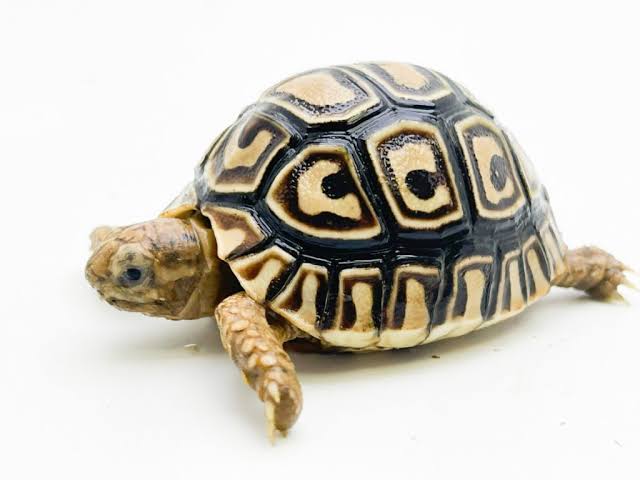
I didn’t know what a Leopard Tortoise was until I visited House of Monstera in Bacaca.
For those who haven’t been, it’s an exotic pet shop in Davao that is genuinely worth the trip.
We walked in with the intent to check out the hog-nosed snakes, sulcatas, and leopard geckos, I didn’t know I’d leave with burning questions about what leopard tortoises were.
While my wife and son were busy looking at the hog-nosed snakes, I examined the different tortoises they had on display.
I knew what most of them were. The red foots, the irradiateds and the Indian stars… but I didn’t know about leopard tortoises.
There they were. About 6 of them. Baby tortoises with beautiful shells, high-domed, with this incredible dark and gold spotted pattern.
I stood there for a moment thinking I was looking at irradiated tortoises, which I’ve seen before.
Then I thought maybe Indian Star Tortoises.
I actually had to ask.
Leopard Tortoise.
That was a new one.
And the more I looked at them, the more I wanted one.
Or two.
On the farm, where they’d have actual space to roam.
I didn’t go home with one.
I wanted to make sure I knew more abot them before buying one.
I had to know more.
And what I learned, I’m sharing with you guys.
LEOPARD TORTOISE
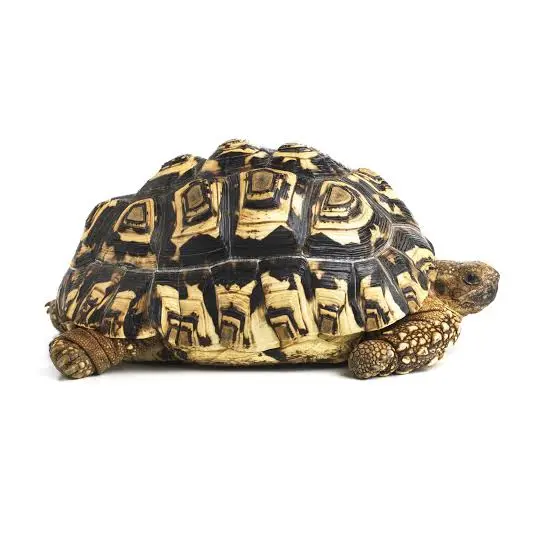
| COMMON NAME | Leopard Tortoise |
| SCIENTIFIC NAME | Stigmochelys pardalis |
| ANIMAL CLASS | Reptile |
Scientific Classification
| Kingdom | Animalia |
| Phylum | Chordata |
| Class | Reptilia |
| Order | Testudines |
| Family | Testudinidae |
| Genus | Stigmochelys |
Physical Characteristics
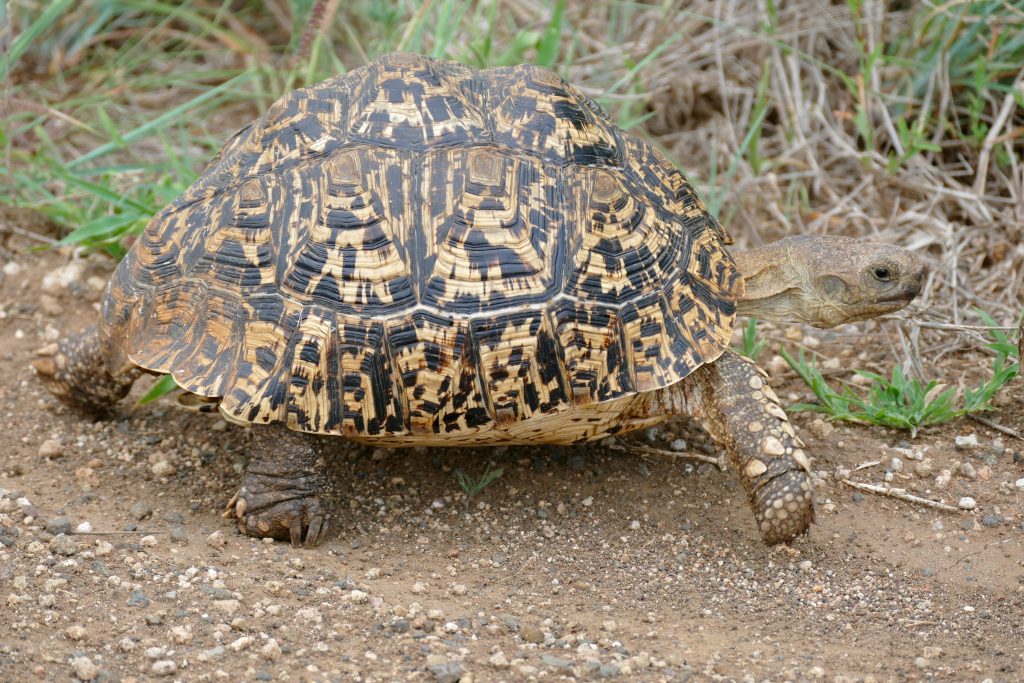
| Shell Length | 40 to 70 cm (16 to 28 inches) at adult size |
| Weight | 13 to 54 kg (29 to 119 lbs) — fourth largest tortoise species in the world |
| Shell Shape | Highly domed, steep-sided — what made me look twice at House of Monstera |
| Coloration | Cream to yellow with black spots and blotches — the leopard-print pattern the name comes from |
| Lifespan in Wild | Up to 100 years |
| Lifespan in Captivity | 80 to 100 years with proper care — generational commitment |
| Sexual Maturity | 12 to 15 years |
Habitat & Distribution
| Native Range | Eastern and southern Africa — Sudan, Ethiopia, Somalia, Kenya, Tanzania, South Africa |
| Habitat Types | Semi-arid savanna, thornbush, grassland |
| Climate Preference | Warm and dry; tolerates heat well but needs shade and fresh water access |
| Conservation Status | LC — Least Concern (IUCN) |
| CITES Status | Appendix II — international trade regulated; legal to keep with proper documentation |
| Population Trend | Stable |
Diet & Behavior
| Diet Type | Herbivore — strict grazer |
| Primary Food | Grasses, succulents, thistles, fallen fruit; high-fiber, low-protein diet essential |
| Activity Pattern | Diurnal |
| Social Structure | Solitary but tolerates others; males can be territorial with each other |
| Reproduction | Seasonal; female lays 5 to 30 eggs per clutch, up to 3 clutches per year |
| Incubation Period | 130 to 180 days |
PET SUITABILITY FOR DAVAO CITY: 3 out of 5
| 5 | Excellent — beginner-friendly, easy care |
| 4 | Good — suitable for experienced owners |
| 3 | Challenging — requires specific knowledge |
| 2 | Very difficult — experts only |
| 1 | Not suitable — wild animal or illegal |
OVERALL RECOMMENDATION: One of the most rewarding tortoises you can keep if you have the outdoor space — and for the farm, the space question answers itself.
Living With a Leopard Tortoise: Suitability, Care & Honest Advice
The mistake I almost made at House of Monstera, confusing the Leopard Tortoise with an Irradiated Tortoise or an Indian Star Tortoise, is actually an easy one.
All three have that striking high dome and bold patterning.
But up close the differences become clear… the Leopard Tortoise is considerably larger and the shell pattern is more blotchy than starlike.
Irradiated Tortoises are Critically Endangered and tightly restricted.
Indian Stars are protected under CITES Appendix I.
The Leopard Tortoise sits at CITES Appendix II, which means it can be legally kept in the Philippines with a DENR Certificate of Wildlife Registration. Important distinction.
The main challenge in Davao is humidity.
Leopard Tortoises are from dry African savanna and our 78 to 83 percent humidity is on the high end of what they tolerate comfortably.
Respiratory infections are the primary health concern for this species kept in humid tropical climates. The solution is an outdoor enclosure with excellent drainage, a dry covered sleeping area, and good airflow. Wet substrate that stays damp is the enemy.
On the farm where there’s space for a proper outdoor pen with natural sun exposure and drainage, this is very manageable.
Diet is simple but specific. High-fiber grasses and leafy weeds are the staple… think the kinds of things that grow along the farm borders naturally.
No fruit in large quantities, no high-protein food, no commercial pellets as a main diet.
Fresh water always available even though they come from a dry environment. They drink more than you’d expect and actually soak themselves periodically.
Size is the thing I keep coming back to.
A full grown Leopard Tortoise can reach 70 cm and over 50 kilograms.
This is not a windowsill terrarium animal.
The farm is exactly the kind of setup where one of these would genuinely thrive.
I’m going back to House of Monstera.
That’s the plan.
And get one.
Someday.
LEGAL STATUS IN THE PHILIPPINES: Legal to keep with a DENR Certificate of Wildlife Registration (CWR). Non-native exotic species requiring CITES Appendix II documentation for importation. Ensure any animal purchased comes with documentation of legal captive breeding provenance — ask the seller for DENR Wildlife Farm Permit before buying.
CARE TAGS: CITES Appendix II • DENR CWR Required • Outdoor Space Essential • Humidity Management Critical • 100-Year Companion • Farm-Ideal
Pros & Cons
| Pros | Cons |
| One of the most visually striking tortoises in the world — the shell pattern is extraordinary | Davao’s humidity requires careful enclosure design with drainage and dry sleeping areas |
| Legal to keep with proper DENR documentation — a clear, achievable permit path | Grows very large — not viable without significant outdoor space |
| Thrives in Davao’s warmth; no heating equipment needed outdoors | 100-year lifespan means you are making a decision that outlasts most other commitments |
| Farm or large property setting is ideal — gives the animal the space it genuinely needs | Requires CITES import documentation — verify seller’s Wildlife Farm Permit before purchasing |
| Diet consists mostly of local grasses and weeds — extremely low feed cost | Respiratory infections from humidity if drainage and shelter are not properly managed |
Trivia
- The Leopard Tortoise is the fourth largest tortoise species in the world, behind only the Aldabra Giant Tortoise, Galapagos Tortoise, and African Spurred Tortoise (Sulcata) — all three of which have appeared in previous hayopetc.com articles.
- Unlike most tortoises, Leopard Tortoises can actually swim and have been observed crossing rivers in the wild. They inflate their lungs before entering water which keeps them buoyant. This is not a skill you need to test in captivity.
- The pattern on each individual Leopard Tortoise is unique — like a fingerprint. No two shells are identical, which makes individual identification possible without tags or marking.
- The Leopard Tortoise is one of the few tortoise species that does not estivate (go dormant in dry season) or hibernate — it remains active year-round, which is one reason Davao’s consistent warm temperature suits it well despite the humidity challenge.
- House of Monstera in Bacaca, Davao City, is one of the few places in Mindanao where you can actually see Leopard Tortoises up close before deciding to get one. If you haven’t visited, it’s worth the trip even if you’re not shopping — the variety of exotic plants and animals there is genuinely impresive.

