

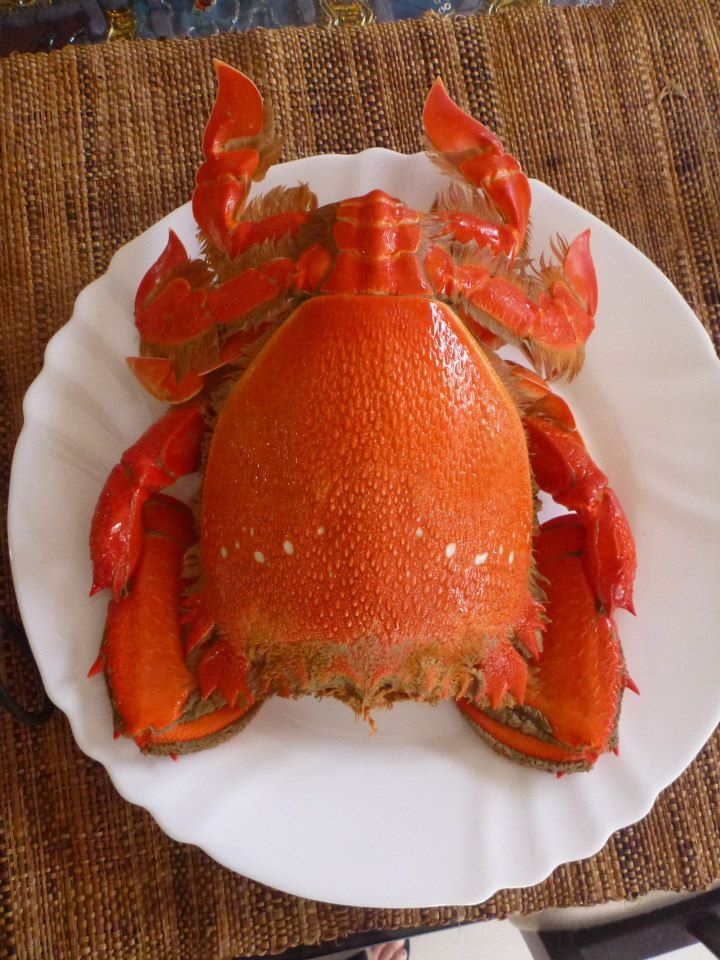
We’re three articles into the crab series now.
Oooofff…. Why this sudden interest in crabs?
I can’t explain it either.
I guess it started with the Tasmanian Giant Crab, then we talked about the Alimango, which is the practical choice, native to our waters, established aquaculture methods, strong market, and I remain genuinely excited about it.
Now we’re at the one that is arguably the most interesting from a purely Filipino perspective.
The Curacha. Ranina ranina.
The Red Frog Crab.
The Spanner Crab.
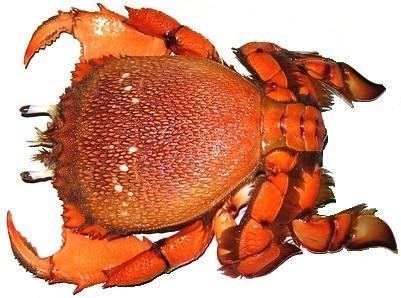
Called ’emperor crab’ in Vietnam, where historical monarchs apparently ate it regularly and with good reason.
In the Philippines it’s most famous as the star of what might be the most celebrated sauce in all of Mindanao… the Alavar sauce of Zamboanga City. Coconut milk, crab fat, secret spices, ladled over a bright red crab that arrives at the table already looking like it was designed to be photographed.
I have actually eaten curacha, and it was genuinely one of the better seafood experiences I’ve had.
The meat is found mostly in the body rather than the claws, which is different from most crabs you’re used to… you don’t need to crack anything, you just open the body with your hands and the meat is right there.
Sweet, clean, firm without being tough.
Perfectly paired with Alavar sauce
.
CURACHA / SPANNER CRAB / RED FROG CRAB
| COMMON NAME | Curacha (Philippines / Chavacano), Spanner Crab (Australia), Red Frog Crab, Emperor Crab (Vietnam / Huỳnh Đế) |
| SCIENTIFIC NAME | Ranina ranina |
| ANIMAL CLASS | Invertebrate (Crustacean) |
Scientific Classification
| Kingdom | Animalia |
| Phylum | Arthropoda |
| Class | Malacostraca |
| Order | Decapoda |
| Suborder | Pleocyemata |
| Infraorder | Brachyura |
| Family | Raninidae |
| Genus | Ranina |
| Species | R. ranina (Linnaeus, 1758) |
Physical Characteristics
| Body Length | Up to 15 cm (5.9 inches) carapace length |
| Weight | Up to 900 g (2.0 lbs); most commercially caught individuals 300 to 700 g |
| Carapace Shape | Distinctive — wider at the front than the back, giving it an elongated, unusual profile compared to typical crabs |
| Color | Reddish-brown with ten white spots on the carapace; uniquely, the red color remains the same even after cooking |
| Claws | Smaller and flatter than most crabs; adapted for digging and burrowing into sand rather than crushing |
| Lifespan | Not well documented in scientific literature |
| Sexual Maturity | Not precisely documented; egg-bearing females found year-round with peak November to February |
Habitat & Distribution
| Native Range | Wide Indo-Pacific distribution — East Africa, Indian Ocean, Southeast Asia, Philippines, Japan, Hawaii, Vietnam, coastal Australia |
| Philippine Range | Most abundant in southwestern Mindanao coastal waters between Zamboanga and the Sulu Archipelago; also present in other Philippine seas |
| Habitat Types | Sandy-smooth substrata at coastal and offshore depths; buries itself in sand while hunting |
| Depth Range | 10 to 100 meters (33 to 328 feet) |
| Water Temperature | Tropical and subtropical — warm coastal waters; compatible with Philippine sea temperatures |
| Conservation Status | Not listed on IUCN Red List; populations considered stable; managed under Australian fishery regulations in Australian waters |
| Population Trend | Stable globally; some localized pressure from fishing in Philippine waters |
Diet & Behavior
| Diet Type | Carnivore / Ambush Predator |
| Primary Food | Small bottom-dwelling fish, invertebrates; hunts from beneath the sand surface |
| Hunting Method | Buries itself in sand with only eyes and mouthparts exposed; ambushes prey passing overhead |
| Activity Pattern | Nocturnal — active at night, buried during the day |
| Social Structure | Solitary |
| Reproduction | Year-round in Philippine waters; females produce 26,000 to 354,000 eggs per spawning; egg-bearing females found all months with November to February peak |
| Fishing Method | Baited traps and tangle-nets suspended over flat frames; caught year-round in Zamboanga and Sulu coastal waters |
Why the Curacha Is Worth Talking About as Food
Before we get into farming feasibility, I want to spend a moment on what makes this crab special as a food animal because I think it’s genuinely underappreciated outside of Zamboanga and the people who’ve been lucky enough to eat it.
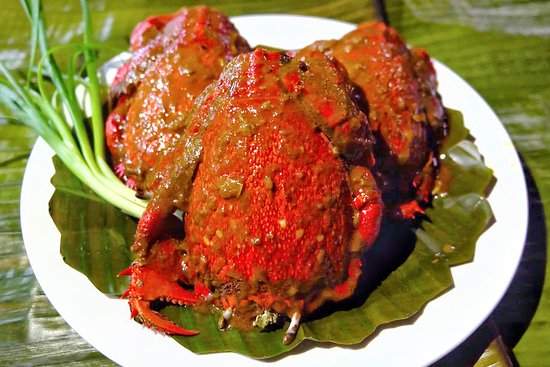
Most crabs you eat in the Philippines — alimango, alimasag — have most of their meat in the claws. The curacha is different. The meat is in the body.
You pick it up, open it with your hands, and the flesh is right there, clean and ready.
No shell crackers, no digging for scraps in claw joints.
For a food animal this is actually a significant practical advantage.
And the meat itself… sweet, firm, with a delicate flavor that the Alavar sauce complements rather than overwhelms.
| Preparation | Description |
| Halabos (Steamed) | The simplest preparation — steamed whole, served with calamansi and soy sauce. The natural sweetness of the meat is the point. No sauce needed if the crab is fresh. |
| Ginataang Curacha | Cooked in coconut milk with garlic, ginger, and spices. The coconut milk carries the crab’s natural fat and sweetness through the sauce. Rich, aromatic, best with hot steamed rice. |
| Curacha Alavar | The flagship preparation of Zamboanga City. Steamed curacha finished with the Alavar sauce — a proprietary blend of coconut milk, taba ng talangka (crab roe paste), and secret spices developed by Teresa Alavar in 1973. The sauce is sold in packets at the Alavar Seafood Restaurant in Zamboanga. It is the taste Zamboanga is most famous for. |
| Grilled / Ihaw | Less common but excellent — the carapace chars slightly over charcoal and the body meat picks up smoke flavor. Works well with a simple garlic butter baste. |
| The Alavar Seafood Restaurant in Zamboanga City has been serving Curacha Alavar since the 1970s. The sauce — coconut milk, crab roe paste, and secret spices — was created by matriarch Teresa Alavar and has become inseparable from Zamboanga’s culinary identity. The restaurant now sells bottled Alavar sauce commercially, so if you can’t get to Zamboanga, you can at least get the sauce. Pair it with the freshest crab you can find and it works remarkably well. |
FARMING FEASIBILITY FOR THE PHILIPPINES: 2 out of 5
| 5 | Straightforward — viable with standard aquaculture infrastructure |
| 4 | Challenging but achievable with investment and expertise |
| 3 | Very difficult — significant technical and logistical barriers |
| 2 | Extremely unlikely — requires conditions nearly impossible to replicate |
| 1 | Not currently feasible — fundamental biological barriers exist |
OVERALL ASSESSMENT: Better than the Tasmanian crab situation, and present in Philippine waters, but captive breeding has so far stumped researchers — the biology of this animal does not cooperate with aquaculture the way we’d like.
The curacha is present in Philippine waters.
That’s the good news.
You don’t need to import anything or engineer special temperature systems.
The water temperatures around Zamboanga and the Sulu Sea are exactly what this animal lives in naturally. And the demand for curacha in the Philippines — and increasingly in export markets — is real and growing.
At P300 to P500 per kilo at current Philippine market prices, and significantly more in premium restaurant contexts, the economic case for farming it would be strong if the farming actually worked.
The problem is that captive breeding of Ranina ranina has so far been met with very little success. Researchers in Australia, Japan, and the Philippines have all attempted it.
The larvae are extremely delicate and difficult to raise through the early life stages.
The species has a complex larval development cycle that is not well understood and even less successfully managed in hatchery conditions.
What this means practically is that there is no reliable seed supply for curacha farming the way there is for alimango.
You cannot go to a BFAR hatchery and order a batch of curacha juveniles.
The broodstock and larval rearing technology hasn’t been solved yet. Without that, you cannot build a grow-out operation because you have nothing to grow out. You’d be dependent entirely on wild-caught juveniles, which creates the same sustainability problems that wild capture fisheries have always had.
The other complication is habitat.
The curacha is a sandy-bottom, burrowing animal.
It doesn’t do well in the muddy earthen pond setups that work perfectly for alimango. You would need a sandy substrate system, which adds infrastructure complexity and cost. And because it is primarily nocturnal and buries itself, monitoring stock health and survival rates in a farming context is more difficult than with surface-active animals.
So where does that leave us?
The curacha is worth watching closely because the demand is there, the animal is present in Philippine waters, and if someone cracks the larval rearing problem the farming potential unlocks quickly. Japan and Australia both have commercial incentives to solve this and research continues.
The Philippine Crab Series: Where Each Species Stands
| Species | Score | Farming Status | Main Barrier |
| Tasmanian Giant Crab | 1/5 | Not viable | Needs cold water (10-18°C) — impossible naturally in PH |
| Curacha / Spanner Crab | 2/5 | Research stage only | Captive larval rearing unsolved worldwide |
| Mud Crab / Alimango | 4/5 | Commercially viable now | Cannibalism management; seed supply consistency |
LEGAL STATUS IN THE PHILIPPINES: Curacha is a commercially fished species in the Philippines, primarily in the Zamboanga Peninsula and Sulu Archipelago regions. No specific aquaculture regulations exist for farming because no commercial farming operation has been established. Wild capture is regulated by BFAR under existing fisheries laws. A Fisheries or Aquaculture permit from BFAR would be required for any farming venture.
TAGS: Philippine Crab Series Part 3 • Zamboanga Specialty • Farming Challenged • Present in Philippine Waters • Premium Seafood • Watch This Space
Pros & Cons
| Reasons to Be Excited | Reasons to Be Patient |
| Native to Philippine waters — no cold water engineering needed unlike the Tasmanian crab | Captive larval rearing has not been successfully achieved at commercial scale anywhere |
| Outstanding flavor — arguably the best-tasting crab in the Philippine market | No reliable seed supply exists; dependent on wild-caught juveniles without a hatchery solution |
| Whole-body meat distribution makes it easy to eat and attractive for restaurants | Sandy substrate habitat requirements add infrastructure complexity |
| Strong and growing market demand domestically and for export | Biology not well understood — limited published research on reproduction and larval ecology |
| Alavar sauce connection gives it enormous brand recognition in Filipino food culture | Current market prices (P300-P500/kg) are lower than alimango premium pricing |
| Ongoing research in Australia, Japan, and Philippines means the farming problem may be solved | Until seed supply is solved, farming scale-up is impossible regardless of market demand |
Trivia
- The name ‘curacha’ comes from the Chavacano language of Zamboanga City — Chavacano is a Spanish-based creole language unique to the Philippines, and Zamboanga’s food culture reflects centuries of Spanish, Malay, and indigenous Tausug and Subanen influences blended together. The curacha is as much a cultural artifact of Zamboanga as it is a seafood species.
- In Vietnam, Ranina ranina is called ‘Huỳnh Đế crab’ — literally ’emperor crab’ — and was historically served at the imperial court. It is considered one of the premier delicacies in Vietnamese cuisine. The Vietnamese and Filipino appreciation for this crab developed entirely independently across different ocean routes.
- The curacha’s red color is unique among commercially important Philippine crabs in that it does not change when cooked. Most crabs turn red from cooking; the curacha arrives red and stays red. Some people who encounter it for the first time assume it is already cooked before it even hits the pot.
- The Alavar Seafood Restaurant in Zamboanga City was founded in the 1970s as a small seaside carinderia. The sauce created by Teresa Alavar became so famous that the restaurant now sells it commercially in packets that can be purchased online and in select supermarkets — meaning you can recreate curacha Alavar even if you’re in Davao, as long as you can source the crab.
- Unlike most crabs, the curacha’s meat is concentrated in the body rather than the claws. The claws are small and flat, adapted for digging in sand rather than crushing prey. For a seafood eater, this means less work for more reward — you open the body with your hands and the meat is immediatley accessible without tools.
- Australia has the largest commercial spanner crab fishery in the world, harvesting an estimated 3,592 tonnes annually, primarily in Queensland waters. The Australian fishery is carefully managed with size limits (minimum 100 mm carapace length) and female protection during spawning season. This makes Australian spanner crab one of the more sustainably managed crustacean fisheries globally.

