

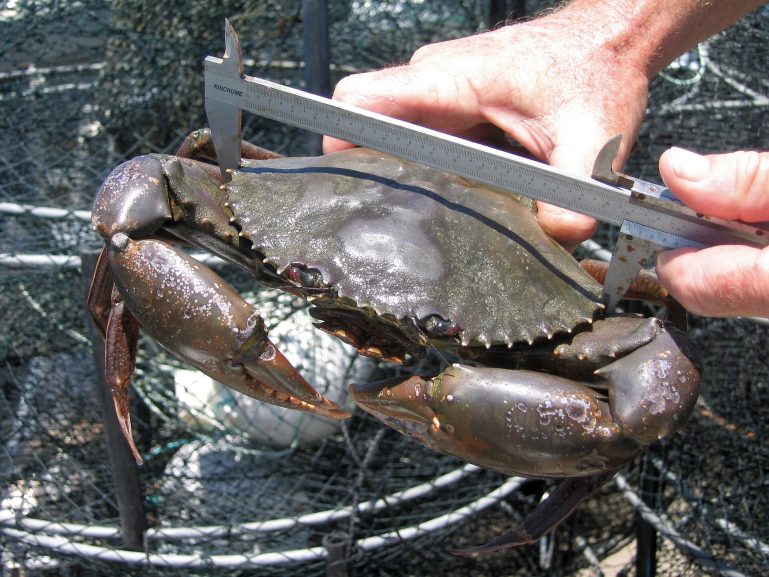
If you read my piece on the Tasmanian Giant Crab, you already know how that one ended.
The farming feasibility for the Philippines is basically zero right now because you would need a refrigerated ocean and nobody has figured out how to build one of those on a reasonable budget.
But I mentioned the Mud Crab at the end of that article as a realistic alternative.
And I meant it.
Because while I was sitting there watching the BEFRS episode with my son and thinking about what we could actually grow on the farm… the alimango kept coming back to me.
It is the crab that makes the most sense for the Philippines.
It is also, if you prepare it right, genuinely delicious in a way that doesn’t require a Japanese chef and forty thousand pesos per specimen to appreciate.
Alimango.
Scylla serrata.
The Giant Mud Crab.
You’ve eaten it.
I’ve eaten it.
It shows up in most markets covered in mud with its claws tied shut, stacked in basins of water, looking prehistoric and irritated.
It’s one of the most recognizable seafood in the Philippines.
And it is also one of the most viable aquaculture species in Southeast Asia with real commercial potential that isn’t being fully realized yet by most small and medium Philippine farms.
I think this is something worth pursuing as a business.
MUD CRAB / ALIMANGO
| COMMON NAME | Mud Crab / Giant Mud Crab / Mangrove Crab / Alimango (Filipino) |
| SCIENTIFIC NAME | Scylla serrata (primary commercial species; S. tranquebarica, S. olivacea, and S. paramamosain also present in Philippine waters) |
| ANIMAL CLASS | Invertebrate (Crustacean) |
Scientific Classification
| Kingdom | Animalia |
| Phylum | Arthropoda |
| Class | Malacostraca |
| Order | Decapoda |
| Family | Portunidae |
| Genus | Scylla |
| Primary Species | S. serrata (largest and most commercially valuable) |
Physical Characteristics
| Carapace Width | Up to 28 cm (11 inches) in large males; commercial harvest typically at 15 to 20 cm |
| Weight | Up to 3 kg (6.6 lbs); commercial harvest target 300 g to 1 kg depending on market |
| Color | Dark olive to brownish green; claws darker, often with purple or blue tones on larger individuals |
| Claws | Large, powerful, capable of significant crushing force — always handled with caution |
| Lifespan | 2 to 4 years in the wild; commercial harvest typically within 6 to 8 months of pond entry |
| Sexual Maturity | Approximately 12 months in the wild; females distinguishable by broader abdomen |
Habitat & Distribution
| Native Range | Indo-Pacific — East Africa, Red Sea, Indian subcontinent, Southeast Asia, Australia, Pacific Islands; widely distributed throughout the Philippines |
| Habitat Types | Mangrove estuaries, tidal mudflats, coastal lagoons, brackish ponds; tolerates a wide salinity range |
| Water Temperature | 23 to 32 degrees Celsius — Davao’s coastal waters are naturally perfect |
| Salinity Tolerance | Euryhaline — survives in freshwater (0 ppt) to full seawater (35 ppt); optimal brackish range 10 to 25 ppt |
| Conservation Status | Not listed on IUCN Red List; wild populations under pressure from overharvesting in some areas |
| Population Trend | Decreasing in wild; increasing in aquaculture production |
Diet & Behavior
| Diet Type | Omnivore / Opportunistic Predator |
| Primary Food | Molluscs, small fish, crustaceans, carrion, organic detritus; in ponds fed trash fish, chicken entrails, commercial pellets |
| Activity Pattern | Nocturnal — most active at night, buries in mud during the day |
| Social Structure | Solitary and territorial; cannibalistic, especially during moulting |
| Reproduction | Year-round in tropical conditions; females produce 1 to 6 million eggs per spawning |
| Moulting | Periodic — crabs shed their shell to grow; soft-shell stage lasts hours to days and is both a vulnerability and a premium product opportunity |
| Burrowing | Digs burrows in soft mud; pond design must account for escape attempts and burrowing behavior |
FARMING FEASIBILITY FOR THE PHILIPPINES: 4 out of 5
| 5 | Straightforward — viable with standard aquaculture infrastructure |
| 4 | Challenging but achievable with investment and expertise |
| 3 | Very difficult — significant technical and logistical barriers |
| 2 | Extremely unlikely — requires conditions nearly impossible to replicate |
| 1 | Not currently feasible — fundamental biological barriers exist |
OVERALL ASSESSMENT: This is the one. Native to Philippine waters, proven aquaculture methods, strong domestic and export market, and Davao’s coastal environment is genuinely ideal for it — this is the premium crab farming opportunity worth pursuing.
Why the Philippines Is Actually Perfect for Alimango Farming
The alimango thrives at 23 to 32 degrees. Davao’s coastal and estuarine water temperature sits right in that range year-round.
You don’t need chillers.
You don’t need special ocean engineering.
You need ponds, brackish water, feed, and knowledge.
All four of those things are available in the Philippines right now.
The alimango is native here.
It has been caught and eaten in this archipelago since before anyone was writing things down.
It lives naturally in the mangrove estuaries all along the Davao Gulf coast, in Samal, in the brackish zones where rivers meet the sea.
The wild population gives you a reference point for what the animal needs.
The farming infrastructure to grow it commercially already exists at various scales across the country, from small backyard pond operations in the Visayas to larger integrated mangrove-crab farms in Eastern Samar and Palawan.
The market case is also strong, and getting stronger.
Premium alimango runs from P500 to P1,200 per kilo depending on size, condition, and time of year. Large, fat-filled females (what the market calls ‘alimangong may itlog’ or egg-bearing females) can command even higher prices.
Export prices to Japan, Hong Kong, Taiwan, and Singapore are significantly higher again.
The global market for live premium mud crab is growing, and the Philippines is geographically positioned to supply it.
The challenges are real though… Cannibalism is a major issue in mud crab farming… crabs will eat each other, especially during the moulting phase when the shell is soft.
Managing stocking density, providing enough shelter structures (bamboo, PVC pipes, nets, mesh boxes), and monitoring for moulting crabs is ongoing labor.
Seed supply is another challenge… sourcing consistent, healthy mud crab juveniles (megalops larvae or small crablets) is not always straightforward, though BFAR hatcheries and private suppliers in Mindanao and Visayas do supply them.
And water quality management matters more than people think.
Alimango are tolerant, but consistently poor water quality produces slow growth and high mortality.
How to Actually Farm Alimango: A Practical Guide
This is the part I spent the most time researching because it’s the part that actually matters for anyone who wants to do this.
What follows is a consolidated overview of what mud crab farming at small to medium scale in the Philippines looks like in practice.
Pond Setup is the foundation. Mud crab ponds are typically earthen ponds located in or near mangrove areas or in brackish water zones near the coast.
Ideal pond size for a manageable small operation is 500 to 2,000 square meters.
The pond needs good water exchange capacity… tidal flow is ideal, otherwise water pumps for exchange. Banks need to be solid and at least 50 cm above high tide level because alimango are escape artists and will find every gap. A bamboo or net barrier around the pond perimeter at a 45-degree outward angle significantly reduces escapes. Depth should be 0.8 to 1.2 meters.
Stocking Density matters more than most beginners think.
Overstocking causes cannibalism, poor growth, and low survival. For grow-out (juvenile to market size), the recommended density is 1 to 3 crabs per square meter depending on management intensity.
Higher stocking requires better shelter provision and more frequent monitoring. Individual caging (one crab per net cage suspended in the pond) eliminates cannibalism entirely and produces consistently large, premium crabs but requires significantly more labor and infrastructure investment.
Feeding is straightforward but consistent.
In the wild alimango eat anything they can catch or find. In ponds they are typically fed trash fish, chicken entrails, small clams, or a combination of fresh feed and commercial crab pellets.
Feed daily at about 5 to 10 percent of body weight for juveniles, tapering to 3 to 5 percent for larger crabs. Feed at dusk or early evening since they are nocturnal feeders. Remove uneaten feed before it degrades water quality.
Water Quality management keeps the crabs healthy and growing at the right pace.
Optimal salinity is 10 to 25 ppt brackish… too fresh and growth slows, too saline and stress increases. pH of 7.5 to 8.5. Temperature 23 to 32 degrees (Davao is naturally in range). Regular water exchange of 20 to 30 percent every few days, or daily tidal exchange if tidal flow is available.
Watch for algae blooms and low oxygen events after heavy rain.
Moulting Management is the part that catches new farmers off guard.
Crabs moult periodically and during the soft-shell phase they are completely vulnerable to attack from tankmates.
If you want soft-shell crab as a product (which commands premium prices), harvest the crab the moment you observe pre-moult signs (darkened shell edges, reduced feeding, restlessness) and hold it individually in a container until the moult is complete. If you want hard-shell market crab, manage stocking density and shelter provision to minimize moult-period losses.
Harvest timing depends on your target market.
- For live hard-shell crab at wet market prices, harvest at 200 to 500 g (3 to 6 months from juvenile stocking).
- For premium large crab targeting restaurant buyers or export, grow to 600 g to 1 kg (6 to 10 months).
- For fattened female crab with developed gonads (the highest-value product), a specialized fattening phase of 2 to 4 weeks in individual cages before harvest produces dramatically better prices.
Rough Economics: Alimango Farming in Davao
| Item | Small Operation (500 sqm pond) | Medium Operation (2,000 sqm pond) |
| Pond preparation cost (one-time) | P15,000 to P30,000 | P60,000 to P120,000 |
| Crablet / juvenile seed (per batch) | P3,000 to P8,000 | P12,000 to P32,000 |
| Feed cost per grow-out cycle | P5,000 to P12,000 | P20,000 to P48,000 |
| Estimated harvest (6 months) | 100 to 200 kg | 400 to 800 kg |
| Farm gate price (conservative) | P500 to P700 per kg | P500 to P700 per kg |
| Gross revenue per cycle | P50,000 to P140,000 | P200,000 to P560,000 |
| Premium market price (restaurant/export) | P800 to P1,200 per kg | P800 to P1,200 per kg |
These numbers are rough estimates based on published BFAR production data and current Davao market prices.
Actual returns depend heavily on survival rates, feed conversion, local market conditions, and whether you’re selling wholesale or direct to restaurants and consumers. The premium end of the market (direct to restaurants, fattened females, soft-shell crab) can push returns significantly higher than the conservative figures above.
LEGAL STATUS IN THE PHILIPPINES: Mud crab aquaculture is legal and actively encouraged under Philippine fisheries law. Freshwater and brackish water pond aquaculture operations require a Fishpond Lease Agreement (FLA) or Gratuitous Permit from BFAR for ponds on public land, or can be operated on private land with local government permits. Wild collection of broodstock requires a BFAR permit. BFAR Region XI (Davao) provides technical assistance and can be contacted for permit guidance.
TAGS: Aquaculture Recommended • Native Philippine Species • Davao Climate Ideal • Commercial Farming Viable • Premium Market Potential • BFAR Supported
Pros & Cons of Alimango Farming
| Pros | Cons |
| Native to Philippine waters — no special import permits, no biosecurity complications | Cannibalism is a serious and constant management challenge |
| Davao’s brackish coastal environment is naturally ideal — zero temperature modification needed | Juvenile seed supply can be inconsistent; quality varies across suppliers |
| Strong and growing domestic and export market with premium pricing | Escape-proofing ponds requires careful construction and ongoing maintenance |
| Fast grow-out cycle (6 to 10 months) compared to most premium seafood species | Water quality management requires consistent attention and monitoring |
| Multiple product options: hard-shell, soft-shell, fattened female — different markets, different price points | Market price volatility during harvest gluts can compress margins |
| BFAR technical support and extension programs available in Davao Region | High initial labor requirement, especially for individual-cage fattening systems |
Trivia
- Scylla serrata is the largest species of mud crab in the world, with the largest recorded individuals exceeding 3 kg and 28 cm carapace width. A crab that size at current Davao premium market prices would be worth P2,400 to P3,600 as a single animal.
- The Philippines is one of the top producers of mud crab in Southeast Asia, with significant production in Eastern Samar, Bohol, Palawan, and parts of Mindanao. National production figures from BFAR consistently show mud crab as one of the highest-value aquaculture commodities per kilogram in the country.
- Female mud crabs develop orange egg masses under their abdominal flap before spawning. These ‘alimangong may itlog’ (egg-bearing females) are highly prized in the market and command 30 to 50 percent premiums over similarly sized males at most Philippine wet markets.
- Mud crabs can move surprisingly fast despite their bulk and their claws are powerful enough to cause serious injury. Commercial farmers and market vendors always secure the claws with rope or rubber bands before handling. Never pick one up from the back without checking that the claws are secured.
- Soft-shell mud crab (harvested immediately after moulting, before the new shell hardens) is a premium restaurant product across Southeast Asia and Japan. A single soft-shell alimango that would sell for P200 to P300 as a standard hard-shell crab can fetch P400 to P600 or more processed and sold to restaurants. The production method requires intensive individual monitoring but the margin improvement is significant.
- Mud crabs have been observed using tools in the wild, specifically carrying shells or debris to block the entrance of their burrows. They are also capable of navigating back to their home burrow over considerable distances, suggesting a form of spatial memory that is unusual among crustaecans.

