


VISAYAN WARTY PIG
| COMMON NAME | Visayan Warty Pig / Baboy Ihalas / Babpy Ihaas / Baboy Ramo / Baboy Sulop / Baboy Talonon |
| SCIENTIFIC NAME | Sus cebifrons |
| ANIMAL CLASS | Mammal |
Scientific Classification
| Kingdom | Animalia |
| Phylum | Chordata |
| Class | Mammalia |
| Order | Artiodactyla |
| Family | Suidae |
| Genus | Sus |
Physical Characteristics
| Body Length | 100 to 150 cm (39 to 59 inches) |
| Height at Shoulder | 55 to 65 cm (22 to 26 inches) |
| Weight | Males: up to 80 kg (176 lbs); Females: smaller, typically 40 to 55 kg (88 to 121 lbs) |
| Lifespan in Wild | Estimated 10 to 15 years |
| Lifespan in Captivity | Up to 20 years (documented in zoo populations) |
| Sexual Maturity | Approximately 12 to 18 months |
Habitat & Distribution
| Native Range | Endemic to six Visayan Islands: Cebu, Negros, Panay, Masbate, Guimaras, Siquijor. Surviving wild populations documented only in Negros and Panay. Believed extinct on Cebu, Guimaras, and Siquijor. |
| Habitat Types | Tropical lowland and montane forest, forest edges, occasionally agricultural land bordering forest |
| Climate Preference | Tropical; warm and humid, 24 to 32 degrees C |
| Conservation Status | CR — Critically Endangered (IUCN) |
| Population Trend | Decreasing |
Diet & Behavior
| Diet Type | Omnivore |
| Primary Food | Roots, tubers, fruits, fallen vegetation; increasingly raids cultivated crops as forest habitat disappears |
| Activity Pattern | Crepuscular to Nocturnal |
| Social Structure | Small groups of 4 to 6 individuals; family units |
| Reproduction | Seasonal — piglets typically born during dry season, January to March |
| Gestation Period | Approximately 114 to 140 days |
| Litter Size | 3 to 4 piglets on average |
PET SUITABILITY FOR DAVAO CITY: 1 out of 5
| 5 | Excellent — beginner-friendly, easy care |
| 4 | Good — suitable for experienced owners |
| 3 | Challenging — requires specific knowledge |
| 2 | Very difficult — experts only |
| 1 | Not suitable — wild animal or illegal |
OVERALL RECOMMENDATION: A Critically Endangered Philippine endemic that belongs in the forest, not a backyard — appreciate it, protect it, and absolutely do not eat it.
Suitability Analysis
To be honest, straight away.
I have never seen a Visayan Warty Pig in person.
Or at least… I don’t think I have.
If I did, I didn’t know what I was looking at.
I was born in Tacloban City in Leyte and spent parts of my childhood moving around the Visayas, which is exactly where this animal is from.
But I was a city kid and the forest wasn’t somewhere I spent much time.
What I have encountered though is is the baboy ramo.
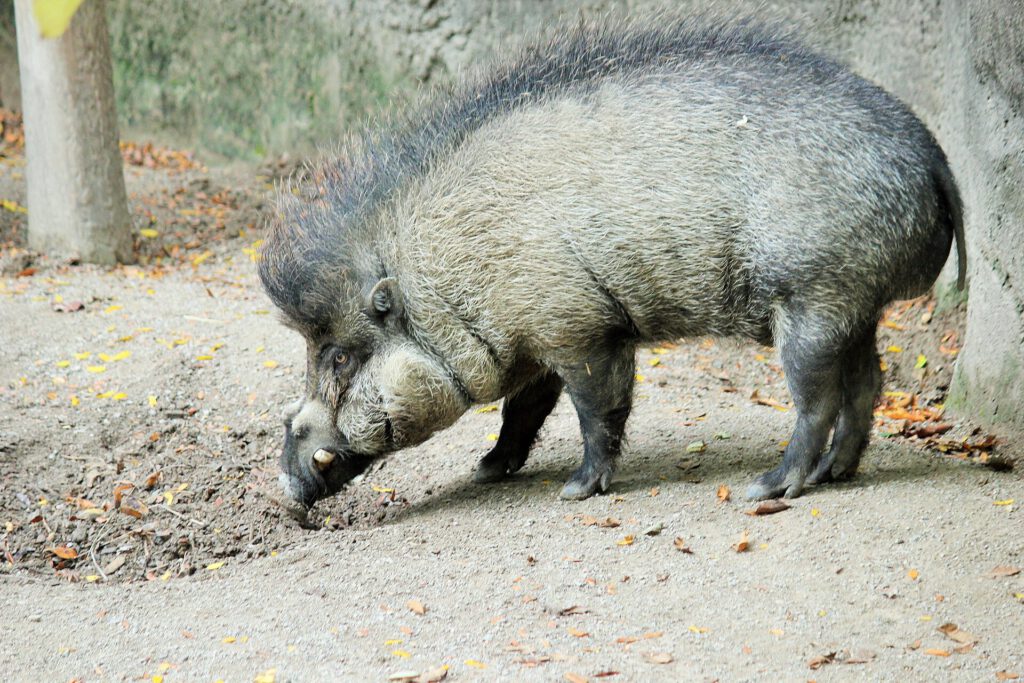
In Zamboanga, on land that my family had connections to, I actually participated in hunting one.
And I want to say this clearly for anyone who thinks wild pigs are just bigger, rougher versions of farm pigs: they are not.
A wild pig that is cornered is one of the most terrifying animals you will ever face on four legs.
They are aggressive, they are fast, they are powerful, and they will attack.
If you come between a mother and her piglets, she will not hesitate.
They can knock a grown man flat on the ground and the tusks… the tusks can do serious damage.
Gouge your legs, your midsection, your face if you fall.
That hunt in Zamboanga… well let’s just say I learned to respect wild pigs and pigs in general after that.
So when I think about the Visayan Warty Pig as a potential pet… think again.
This animal is Critically Endangered. It is protected under RA 9147, the Wildlife Resources Conservation and Protection Act, and is listed on CITES Appendix II.
Keeping one without a DENR permit is illegal. Full stop. And even if you could get a permit, this is not a domesticated animal.
It is a wild pig with tusks and the willingness and temperament to use them.
I will also admit something here because I think it’s worth saying honestly.
My first thought when I started reading about the Visayan Warty Pig was… I bet it’s delicious.
Wild pigs are.
The baboy ramo we hunted in Zamboanga tasted completely different from farm pork.
Leaner, better tasting in a way that’s hard to describe if you haven’t tried it.
And then I started reading about how few of these animals are left in the wild and that thought passed pretty quickly.
You can’t eat something that’s disappearing.
Or at least, you shouldn’t.
Maybe if we manage to increase their numbers and get them out of any endangered status.
Maybe then everyone gets to enjoy it.
If it tastes good.
I just wonder how it’ll affect the environment if e have whoe troops of wild pigs uprooting small trees and plants… but that’s a different story… one we can discuss over at my farming blog…
Anywhoo….
For Davao specifically… the Visayan Warty Pig is not even native to Mindanao.
It’s a Visayan island endemic.
Bringing one to Davao (even if it were legal, which it isn’t without proper permits) would remove it from the ecosystem it belongs to.
A 120 sqm lot is not enough to emulate a forest habitat although the climate here is compatible enough temperature-wise, but the space, the habitat, the legality, and the conservation reality all point in the same direction: Don’t do it.
As our beloved former president once said…

So remember: The Visayan Warty Pig is animal that needs to be left where it belongs.
Care Guide
This care guide is written in theory for educational purposes, for institutions and accredited facilities rather than private owners.
Because that’s who should realistically be dealing with this animal.
The Visayan Warty Pig survives in the wild in two island populations, both declining.
In captivity it exists in a small number of zoological facilities with dedicated conservation breeding programs.
That’s what’s appropriate for this animal’s care.
Housing for a wild pig of this size requires substantial outdoor space with natural substrate for rooting. Pigs are intelligent animals and they need to express natural behaviors: digging, foraging, rooting through soil and leaf litter.
A concrete pen is not appropriate for long-term welfare.
You’re looking at a large enclosed area of at minimum several hundred square meters, with mud wallowing space (pigs regulate body temperature through wallowing), shade, and secure fencing that accounts for the fact that a determined pig can dig under, push through, or simply charge through barriers that seem sturdy enough.
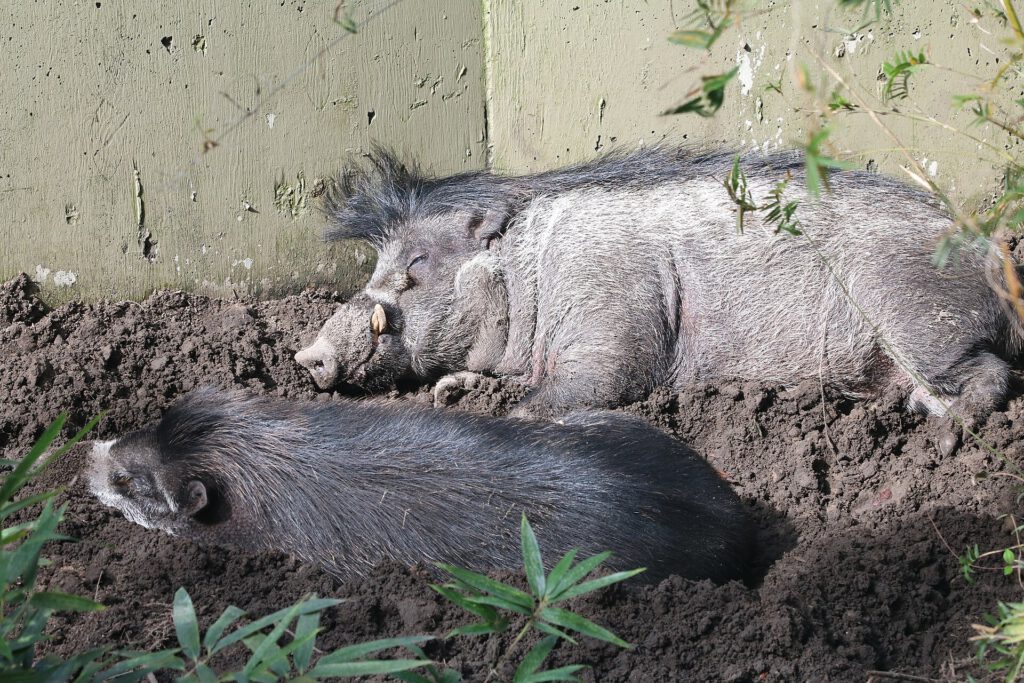
Electric fencing is standard at facilities that house wild boar species.
Feeding in captivity is managed through a combination of commercial omnivore diet (similar to what is used for wild boar in zoological settings), supplemented with roots, tubers, fruits, and vegetables. Fresh vegetables and root components can be sourced from most markets… camote, gabi, various root crops, fallen fruit.
But this is hypothetical because again, you are not legally keeping one of these in a private residence.
Temperature and humidity in Davao are naturally compatible with this species. They come from the tropical Visayan islands where conditions are similar. Shade and wallowing access are the critical components for thermoregulation, not air conditioning or heating equipment. In that sense, a farm property in the Davao region would climatically suit them. The climate is not the problem here.
Hygiene and enclosure maintenance for any pig species requires regular mucking out of the resting area, management of the wallow (which becomes very muddy very quickly), and monitoring for skin parasites and internal worms.
Pigs root in the ground and pick up parasites easily.
A regular deworming schedule and skin checks are part of responsible management. Veterinary access for an exotic wild pig species in Davao is extremely limited. You would need to connect with wildlife veterinarians through the DENR or through zoological networks, not a general practice vet in Davao.
Handling and temperament… this is where I want to circle back to what I said about the baboy ramo in Zamboanga.
Wild pigs are not handleable in the way that dogs or even goats are.
Even animals raised in captivity from piglets retain their wild instincts.
The tusks on an adult male Visayan Warty Pig are functional weapons, not decorations.
The species is known to be aggressive when threatened.
At zoological facilities, staff do not casually enter enclosures with adult males.
Management through protected contact (barriers always between keeper and animal) is standard.
Enrichment takes the form of foraging opportunities, rooting material, puzzle feeders, and varied terrain. These are highly intelligent animals and boredom leads to destructive and dangerous behavior.
LEGAL STATUS IN THE PHILIPPINES: Strictly protected under RA 9147 (Wildlife Resources Conservation and Protection Act). Critically Endangered under IUCN. Listed on CITES Appendix II. Private ownership without DENR permit is illegal. Hunting is prohibited. Any trade or possession without documentation is a criminal offense.
CARE TAGS: Critically Endangered • Illegal Without DENR Permit • Zoological Care Only • Philippine Endemic • Conservation Priority • Not a Pet
Pros & Cons
| Pros (as a species to protect) | Cons (as a private pet — not applicable) |
| Highly intelligent — first pig species recorded using tools for digging | Critically Endangered; keeping one privately removes it from conservation programs |
| Davao’s tropical climate is naturally compatible temperature-wise | Illegal without DENR permit; enforcement is serious under RA 9147 |
| Fascinating social behavior in small family groups | Adult males have functional tusks and will use them; not safely handleable |
| Active captive breeding programs exist in Philippine and international zoos | Requires very large natural enclosure — not viable on a standard property |
| Part of Philippine natural heritage worth fighting to preserve | Hybridizes with domestic pigs, making conservation breeding complicated |
Trivia
- The Visayan Warty Pig was the first pig species ever recorded using tools — specifically, using bark and sticks as digging tools — observed at a French zoological facility. This places them among a very small group of non-primate mammals known to use tools.
- The ‘warts’ on the face of the male are actually fleshy protrusions thought to act as natural protection against the tusks of rival males during fights — essentially built-in face shields.
- The species is believed to be functionally extinct on Cebu, Guimaras, and Siquijor. The first wild photographs ever taken of the species were only captured in 2012, during a camera trapping expedition in the Northern Negros Natural Park.
- In the Waray language of Leyte and Samar, they are called ‘baboy ramo’ — the same term used locally for wild pigs more generally across parts of Mindanao and the Visayas, which causes confusion between this species and other Philippine wild pig species.
- Approximately 95 percent of the Visayan Warty Pig’s original habitat has been cleared for agriculture, making it one of the most severely habitat-depleted endemic species in the Philippines.
- The species readily hybridizes with feral domestic pigs, which is a serious genetic conservation threat. Pure-bred wild populations are increasingly rare even in areas where some animals survive, because domestic pig escapees interbreed with them in the remaining forest fragments.
Sources: Wikipedia (Sus cebifrons — Visayan warty pig; Wild pigs of the Philippines), IUCN Red List (Sus cebifrons), CITES Appendix II, RA 9147 (Wildlife Resources Conservation and Protection Act), Negros Interior Biodiversity Expedition 2012 camera trapping documentation, personal field experience with wild pig species in Zamboanga.

