

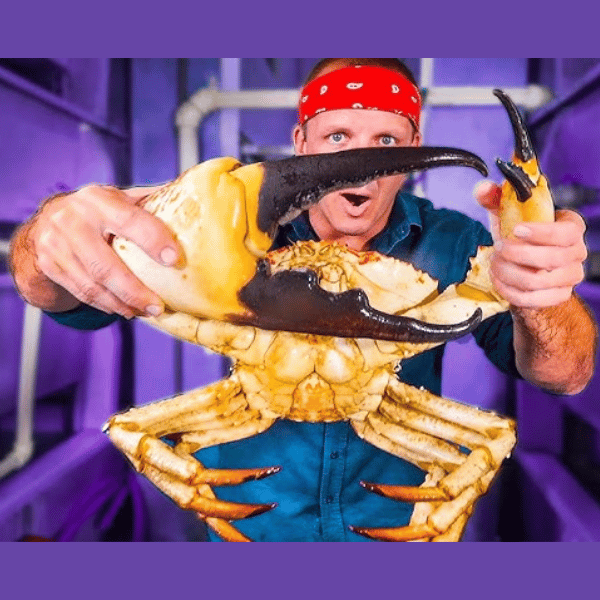
It started the way a lot of things start in our house: Lyle and I got curious about something.
My son and I were watching the Best Ever Food Review Show on YouTube… which if you don’t know it, is one of those channels where they travel around eating incredible things and making you deeply aware of how limited your own food experiences are.
And on this particular episode, they had a Giant Tasmanian King Crab. Five kilograms. Nearly forty thousand pesos worth of crab.
And they brought it to a Japanese chef who prepared it four different ways.
My son and I watched the whole thing without saying much wondering how it really must’ve tasted.
The claw meat, the sushi with salmon roe, the clay pot rice with Hokkaido grains… and then the final preparation where all the remaining ingredients went back inside the crab’s head over an antique Japanese grill and the fat and brain reduced into this sauce that the host could barely find words for.
I immediately sent the video to my wife.
She watched it.
Her response was basically: someday.
We will eat this someday.
And then my brain, being the way it is, went immediately from ‘I want to eat this’ to ‘I wonder if I can grow these.’
Because that’s where my head goes.
Not just consumer.
Producer.
So I started reading.
And the answer…
Well…
TASMANIAN GIANT CRAB
| COMMON NAME | Tasmanian Giant Crab / Tasmanian King Crab / Giant Deepwater Crab / Queen Crab / Bullcrab |
| SCIENTIFIC NAME | Pseudocarcinus gigas |
| ANIMAL CLASS | Invertebrate (Crustacean) |
Scientific Classification
| Kingdom | Animalia |
| Phylum | Arthropoda |
| Class | Malacostraca |
| Order | Decapoda |
| Family | Menippidae |
| Genus | Pseudocarcinus |
| Species | P. gigas |
Physical Characteristics
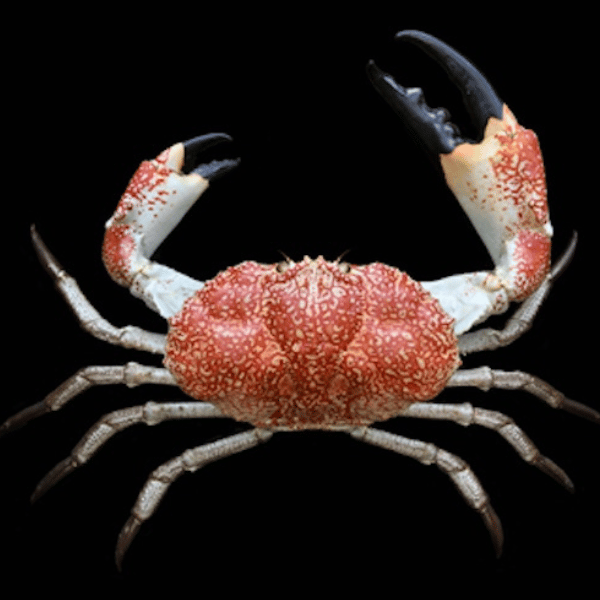
| Carapace Width | Up to 46 cm (18 inches) |
| Weight | Up to 17.6 kg (39 lbs); the specimen on BEFRS weighed approximately 5 kg |
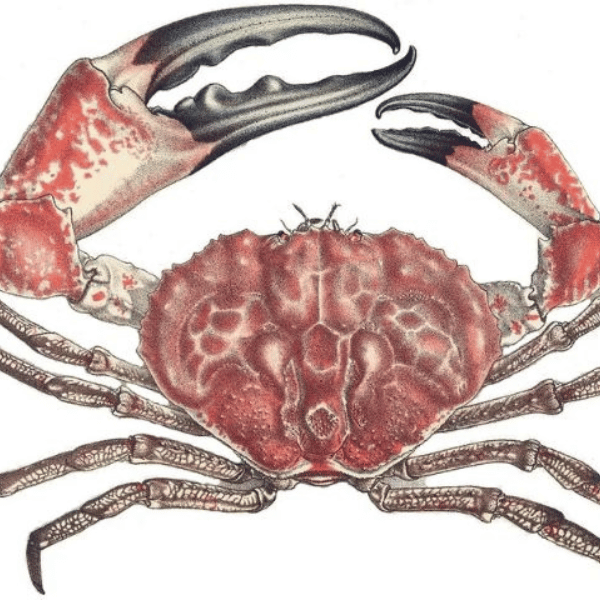
| Claw | Males have one dramatically enlarged claw (the molariform chela); asymmetrical and powerful |
| Color | Orange-red shell with cream flecks; black-tipped claws |
| Lifespan | Long-lived; exact lifespan not fully documented but estimated at several decades |
| Sexual Maturity | Males mature at approximately 150 mm carapace length; females smaller and mature earlier |
Habitat & Distribution
| Native Range | Southern Australia — primarily Tasmania, also South Australia, Victoria, and Western Australia |
| Habitat Types | Rocky and muddy bottoms of the deep ocean; continental shelf break |
| Depth Range | 140 to 270 meters (460 to 885 feet) deep — this is critical and we will come back to this |
| Water Temperature | 10 to 18 degrees Celsius — cold, deep Southern Ocean water |
| Conservation Status | Not listed on IUCN Red List; managed under Australian fishery quotas |
| Total Allowable Catch | 20.7 tonnes per year as of 2024/25 quota — extremely limited wild harvest |
Diet & Behavior
| Diet Type | Carnivore / Scavenger |
| Primary Food | Carrion, slow-moving prey including gastropods, other crustaceans, starfish |
| Activity Pattern | Slow-moving, primarily nocturnal forager |
| Social Structure | Largely solitary; seasonal movements related to depth and temperature |
| Reproduction | Females carry eggs; egg-bearing females protected under Australian law |
| Growth Rate | Very slow — one of the reasons farming is so difficult |
What the Best Ever Food Review Show Got Right
The BEFRS episode did a good job of capturing what makes this crab so remarkable as a food experience. The Japanese chef prepared it four ways and every single preparation highlighted a different quality of the meat.
| Course | What Was Served |
| The Claw | Cracked open and dipped in panza sauce — showcased the raw succulence of the meat straight from the source |
| Crab & Salmon Sushi | Leg meat folded into Japanese-style ‘taco’ sushi with seaweed, sushi rice, wasabi, and salmon roe — the sweetness of the crab paired against the brininess of the roe |
| Clay Pot Rice | Body meat grilled over charcoal, cooked into a clay pot with Hokkaido rice, sake, soy sauce, scallions, and fish dashi — the crab flavor infused the entire dish |
| The Crab Ensemble | All remaining ingredients — soup, claw meat, crab fat, brain — rendered back inside the head over an antique Japanese grill into an intensely concentrated sauce. The finale. |
Someday.
We’re going to eat this someday.
FARMING FEASIBILITY FOR THE PHILIPPINES: 1 out of 5
| 5 | Straightforward — viable with standard aquaculture infrastructure |
| 4 | Challenging but achievable with investment and expertise |
| 3 | Very difficult — significant technical and logistical barriers |
| 2 | Extremely unlikely — requires conditions nearly impossible to replicate |
| 1 | Not currently feasible — fundamental biological barriers exist |
OVERALL ASSESSMENT: Farming it in the Philippines faces biological barriers that are very hard to get around with current technology.
Can We Actually Farm These in the Philippines?
Okay.
So this is the part I spent the most time on after watching that BEFRS episode.
What would it take to produce this commercially?
We have the farm.
We have the space.
The Philippines is surrounded by ocean.
How hard could it be?
…apparently… harder than almost anything else in aquaculture, as it turns out.
And here’s why.
The Tasmanian Giant Crab lives at depths of 140 to 270 meters in water temperatures of 10 to 18 degrees Celsius. The Southern Ocean off Tasmania.
Cold.
Deep.
Very cold.
Very deep.
The average sea surface temperature around Davao and most of the Philippines is somewhere between 28 and 30 degrees Celsius.
So…
A Tasmanian Giant Crab placed in Philippine waters would not thrive.
It would struggle almost immediately and die relatively quickly.
The temperature requirement is not something you can work around with shade or fans.
You would need refrigerated seawater systems running continuously at depth… which is technically possible in a land-based facility but the electricity cost at Philippine rates (we’re at P8.99 per kWh on the farm) would be astronomical, and that’s before you even get to the cost of sourcing live specimens to start a breeding population.
The second problem is growth rate.
Tasmanian Giant Crabs are slow.
Very slow.
They take years… many years… to reach marketable size.
The third problem is that no commercial aquaculture operation for this species exists anywhere in the world at scale right now.
There have been research attempts in Australia but commercial farming of Pseudocarcinus gigas remains in early-stage territory at best.
This is not like growing bangus or tilapia where the methods are established and the supply chains exist.
This would be genuinely pioneering work with no roadmap.
So… is the dream dead?
Not entirely.
There are two honest paths I can see from here.
The first is to watch what happens in Australia over the next decade as aquaculture research develops further. If someone cracks the cold-water deep-sea crab farming problem at commercial scale, the methods will eventually become transferable.
The second is to look at what we can grow here that occupies a similar premium market position. Philippine Mud Crabs (alimango), Blue Swimming Crabs (alimasag), and the emerging market for premium crab in the Philippines are all more realistic near-term opportunities.
The market appetite is real.
The product just has to be something our ocean can actually support.
For now, the Tasmanian Giant Crab remains what it was when I watched that BEFRS episode with my son.
Something to aspire to.
Something to save up for.
Something to eat, someday, somewhere, when the right opportunity presents itself.
My wife already said someday.
I’m holding her to it.
| The BEFRS specimen cost approximately P40,000 to P43,000 (roughly USD 780) for a single 5 kg crab. At current Australian export prices, live Tasmanian Giant Crabs sell for approximately AUD 150 to 200 per kilogram to premium restaurants and international buyers. The total annual wild harvest is just 20.7 tonnes — across all of Australia. The scarcity is structural, not temporary. |
What Filipino Farmers Can Do Instead (Realistic Alternatives)
If the goal is premium crab production in the Philippines, here are the species and approaches that are actually viable right now:
| Species | Why It Works Here | Market Potential |
| Mud Crab (Scylla serrata / Alimango) | Native to Philippine waters, thrives in mangrove ponds, established aquaculture methods, strong local and export demand | High — premium alimango commands P500 to P1,200 per kilo in Davao markets |
| Blue Swimming Crab (Portunus pelagicus / Alimasag) | Widely distributed in Philippine seas, can be pond-raised or ranched, good feed conversion | Medium to High — increasing export demand for canned and fresh crab meat |
| Spanner Crab / Red Frog Crab (Ranina ranina) | Found in Philippine waters, high-value specialty market, less competition than mud crab | High potential — limited aquaculture development means early mover advantage |
| Coconut Crab (Birgus latro) | Native to coastal Philippines, legally farmable with DENR permit, extraordinary flavor, premium novelty market | Very High — but requires proper licensing and slow growth rate similar to Tasmanian crab |
LEGAL STATUS (Philippines): Tasmanian Giant Crabs are not native to Philippine waters and importing live specimens would require BFAR (Bureau of Fisheries and Aquatic Resources) permits and biosecurity clearance. Given the absence of any established Philippine aquaculture framework for this species, importation for farming purposes faces significant regulatory hurdles in addition to the biological ones.
TAGS: Premium Seafood • Deep Cold Water Species • Not Currently Farmable in Philippines • Australian Endemic • BEFRS Featured • Dream Meal
Pros & Cons of Tasmanian Giant Crab Farming
| Reasons to Keep Dreaming | Reasons to Be Realistic |
| Extraordinary premium value — AUD 150 to 200 per kilo at export | Requires 10 to 18 degree Celsius cold seawater — impossible naturally in Philippine waters |
| Global demand for premium seafood is growing, especially in Asia | Extremely slow growth rate — years to reach marketable size |
| The BEFRS episode proves the market appetite and public fascination is real | No commercial-scale aquaculture exists anywhere in the world yet |
| Nothing else looks or tastes quite like it — zero competition in premium segment | Electricity cost of refrigerated seawater systems at Philippine rates is prohibitive |
| If Australian aquaculture methods develop, the knowledge becomes transferable | Importing live specimens for breeding stock faces major BFAR and biosecurity barriers |
Trivia
- The Tasmanian Giant Crab is the largest crab species in Australia and one of the largest in the world, with record individuals reaching 17.6 kg (39 lbs) and carapace widths of 46 cm (18 inches) — wider than a typical laptop screen.
- It is the only living species in the genus Pseudocarcinus, making it a genuinely unique creature with no close living relatives. Its nearest evolutionary cousins are extinct.
- Males have dramatically asymmetrical claws — one large molariform chela for crushing prey, one smaller claw for more delicate manipulation. The size difference between the two claws on a large male can be startling.
- Before export to live seafood markets in Asia (particularly Japan, Hong Kong, and Singapore), Tasmanian Giant Crabs are held in tanks at 10 to 14 degrees Celsius. Maintaining that temperature during transport is a logistical and cost challenge that contributes significantly to the final retail price.
- The total allowable catch for the entire Australian Tasmanian Giant Crab fishery was set at just 20.7 tonnes for 2024/25 — roughly the weight of three large male African elephants — which explains why a single 5 kg specimen costs nearly P40,000 at a Japanese restaurant.
- The Best Ever Food Review Show episode featured a chef using every single part of the crab across four courses including the brain and fat rendered inside the shell as a final sauce. Nothing was wasted. For an animal that takes this long to grow and costs this much to catch, that felt entirely appropriate.

