

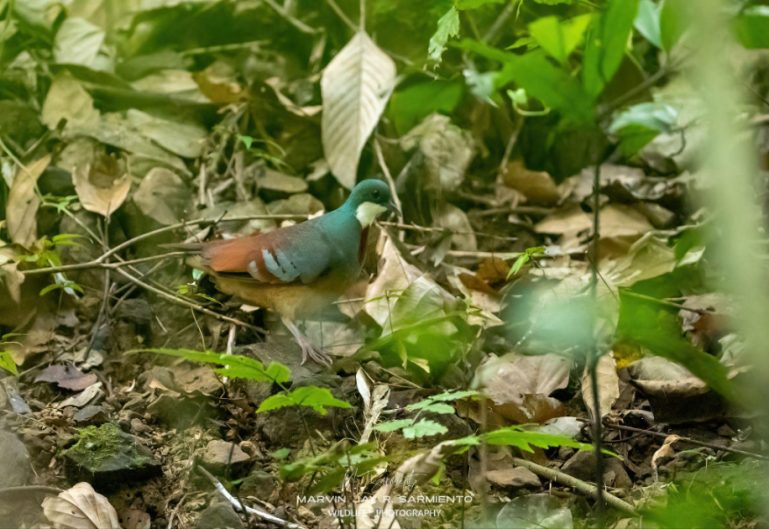
I was born in Tacloban City, Leyte.
And even though I was so intrigued by animals and wildlife, my focus was on animals that were in Africa and other places. I only realize now that the island’s wildlife never really registered for me as a child.
Tacloban, to me, was a city of noise and street food and relatives and the particular smell of the sea mixed with market air.
The forest was somewhere else.
The birds were just birds.
So when I came across the story of the Leyte Bleeding-Heart Pigeon, this small, secretive ground dove that had been considered lost to science for over a hundred years and then suddenly, quietly, reappeared in the karst forests of my home island… I realized I kinda missed out..
My birthplace has a bird that looks like it has been stabbed in the chest.
It vanished from the scientific record for more than a century.
And then a team of bologists who did weeks of grueling fieldwork in difficult terrain found it again.
Alive.
In the forests of Leyte.
I didn’t grow up knowing about this bird.
But I’m glad it’s still there.
I’m glad someone went looking.
LEYTE BLEEDING-HEART PIGEON
| COMMON NAME | Leyte Bleeding-Heart Pigeon / Leyte Bleeding-Heart Dove |
| SCIENTIFIC NAME | Gallicolumba crinigera leytensis (subspecies of the Mindanao Bleeding-Heart) |
| ANIMAL CLASS | Bird |
| NOTE | Currently classified as a subspecies of Gallicolumba crinigera but may be elevated to full species status based on distinct physical and genetic differences from the Mindanao population |
Scientific Classification
| Kingdom | Animalia |
| Phylum | Chordata |
| Class | Aves |
| Order | Columbiformes |
| Family | Columbidae |
| Genus | Gallicolumba |
| Species | G. crinigera |
| Subspecies | G. c. leytensis (Leyte / Samar / Bohol) |
Physical Characteristics
| Body Length | Approximately 25 to 30 cm (10 to 12 inches) |
| Weight | Approximately 150 to 210 g (5.3 to 7.4 oz) — estimated, based on related subspecies |
| Lifespan in Wild | Not well documented; related species estimated at 5 to 15 years |
| Lifespan in Captivity | Not documented for this subspecies |
| Sexual Maturity | Not documented |
Leyte vs Mindanao Bleeding-Heart: Key Differences
| Feature | Leyte Subspecies (leytensis) | Mindanao Subspecies (crinigera) |
| Forehead Color | Pearly white — distinctive and brighter | Grey |
| Eye Skin Color | Crimson red around the eyes | Light green / blue-grey |
| Breast Color | Upper and lower breast dark green | White throat, light brown lower breast |
| Bill | Slightly different coloration | Standard coloration for species |
| Range | Leyte, Samar, Bohol | Mindanao, Basilan, Dinagat Islands |
| Scientific Record | Lost to science for 100+ years; rediscovered 2024 | Documented continuously, though rare |
| Potential Status | May be elevated to full species | Currently the primary species |
Habitat & Distribution
| Native Range | Leyte, Samar, and Bohol (Eastern Visayas / Central Philippines); considered the ‘Leyte’ subspecies range |
| Habitat Types | Primary and secondary tropical lowland and montane rainforest; karst limestone forest; forest floor dweller |
| Elevation | Up to 750 m (2,460 ft) above sea level |
| Climate Preference | Tropical, warm and humid; consistent with Eastern Visayas conditions |
| Conservation Status | VU — Vulnerable (as part of Gallicolumba crinigera species); may warrant Endangered or Critically Endangered assessment as a distinct population |
| Population Trend | Decreasing — habitat loss and hunting are primary threats |
Diet & Behavior
| Diet Type | Omnivore |
| Primary Food | Seeds, fallen fruits, berries, worms, insects — forages on the forest floor |
| Activity Pattern | Diurnal |
| Social Structure | Believed to be solitary or in pairs |
| Behavior | Extremely shy and secretive; runs from danger rather than flying; rarely leaves the forest floor except for roosting and nesting |
| Call | Repeated soft woo-oo, similar to most doves and pigeons |
| Reproduction | Breeding period thought to occur during rainy season (March to June); lays a single creamy white egg; incubation 15 to 18 days |
PET SUITABILITY FOR DAVAO CITY: 1 out of 5
| 5 | Excellent — beginner-friendly, easy care |
| 4 | Good — suitable for experienced owners |
| 3 | Challenging — requires specific knowledge |
| 2 | Very difficult — experts only |
| 1 | Not suitable — wild animal or illegal |
OVERALL RECOMMENDATION: This bird was lost for over a century and has just been found again — the only thing you should want to do with it is protect it. Not keep it as a pet.
Suitability Analysis
The Leyte Bleeding-Heart Pigeon is not a pet.
It is not a cage bird.
It is a Critically threatened Philippine endemic that was missing from scientific records for more than one hundred years, quietly surviving in what remains of Leyte’s forest, and was only recently rediscovered through weeks of exhausting fieldwork in karst limestone terrain.
The fact that it was found again is one of the better pieces of wildlife news the Philippines has had in recent memory. The absolute last thing anyone should be doing is trying to remove one from the wild.
Under RA 9147, the Wildlife Resources Conservation and Protection Act, this bird is protected Philippine wildlife. Capturing, keeping, trading, or harming it is a criminal offense.
It does not require a separate listing to be protected under this law — all Philippine wildlife is covered unless specifically exempted.
The Bleeding-Heart doves are not exempted.
The main threats to this bird are the same threats facing most of Philippine wildlife: deforestation, hunting for food or the pet trade, and the general pressure of human expansion into forest areas.
Leyte has already lost enormous amounts of forest cover, accelerated by Typhoon Yolanda in 2013 and the agricultural and logging pressure that preceded it. Every hectare of forest that remains on Leyte is potentially critical habitat for the Bleeding-Heart and dozens of other endemic species that have nowhere else to go.
| The Leyte Bleeding-Heart was first scientifically described from specimens collected in the mountains of northern Leyte in 1918 by ornithologist Ernst Hartert. For over a century after those original specimens, there were no confirmed sightings of this subspecies in the wild. The recent rediscovery was celebrated as a major Philippine conservation milestone. |
Care Guide
There is no private care guide for the Leyte Bleeding-Heart Pigeon because there should be no private care situation for this animal. What I can offer is an educational overview of what this bird needs in the wild, and what conservation-focused care looks like in the institutional context of zoological facilities that work with bleeding-heart doves.
In the wild, Bleeding-Heart doves need intact tropical forest with a dense canopy and a complex, leaf-littered forest floor where they can forage. They spend almost their entire lives on the ground, scratching through leaf litter for seeds, fallen fruits, small insects and worms. They are not open-country birds. They are not garden birds. They need forest, specifically the kind of old-growth or mature secondary forest that is increasingly rare in the Philippines.
In the few zoological facilities internationally that keep the related Luzon Bleeding-Heart (Gallicolumba luzonica), care involves large planted aviaries that simulate forest floor conditions, a diet of mixed seeds, small fruits, mealworms and insects, and minimal human disturbance.
These birds are extremely stress-prone.
They do not adapt well to captivity and even in the best facilities, breeding success is inconsistent. The idea of keeping one in a backyard cage in a Davao subdivision is not just illegal… it would almost certainly result in the bird dying of stress within weeks.
The climate on Leyte (and in Davao, for that matter) is broadly compatible with their natural needs in terms of temperature and humidity. But climate is only one component of habitat. The forest floor complexity, the canopy cover, the specific acoustic environment of an intact tropical forest… these cannot be replicated in captivity outside of highly specialized facilities. And even there, it barely works.
If you genuinely care about this bird (and I hope reading this has made you care), the most useful thing you can do is advocate for forest protection in Leyte and Samar and Bohol. These are the islands where this subspecies survives. The forests there are its only home. Every tree planted matters. Every illegal logger reported matters. Every responsible ecotourism visit to remaining forest areas that directs money toward conservation matters.
LEGAL STATUS IN THE PHILIPPINES: Fully protected under RA 9147 (Wildlife Resources Conservation and Protection Act). Capturing, trading, keeping, or harming this bird is a criminal offense. As an endemic Philippine species in a vulnerable population, it receives automatic protection under the law. No private ownership permit is available for this species.
CARE TAGS: Critically Threatened • Rediscovered 2024 • Illegal to Own • Forest Floor Specialist • Leyte / Eastern Visayas Endemic • Conservation Priority
Pros & Cons
| Reasons This Bird Matters | Threats It Faces |
| One of the most distinctive birds in the Philippine archipelago — visually striking and scientifically fascinating | Forest habitat in Leyte critically reduced by typhoon damage, logging, and agricultural expansion |
| Its rediscovery in 2024 proves that conservation fieldwork in difficult terrain is worth doing | Hunting for food and the pet trade continues to pressure wild populations |
| May represent a distinct species, which would make protecting it even more urgent | Extremely shy behavior makes population surveys difficult and population estimates unreliable |
| A symbol of what Leyte’s remaining forests still hold — and what could be lost if those forests go | Climate change and increasing typhoon intensity puts remaining Eastern Visayas forest habitat at further risk |
Trivia
- The ‘bleeding heart’ marking on these doves is not a wound — it is a patch of vivid red feathers on the breast that has evolved to look startlingly like a stab wound or blood running from a wound. The effect is most dramatic in the Luzon species but present in all Gallicolumba bleeding-hearts. Filipino naturalists historically called it ‘puso ng paloma’ — the dove’s heart.
- The Leyte Bleeding-Heart subspecies was first described scientifically in 1918 from specimens collected in the northern mountains of Leyte by Ernst Hartert, a German ornithologist. The type locality is listed as ‘mountains in the north of Leyte.’ No confirmed wild sighting was recorded for over a century afterward.
- Bleeding-heart doves are ground birds that almost never fly unless they absolutely have to. When threatened, they run. This behavior, combined with their cryptic coloring on the forest floor, is part of why they are so rarely seen even where they remain present.
- The genus Gallicolumba is found only in the Philippines and some Pacific islands. The Philippines has the greatest concentration of bleeding-heart dove species in the world — including the Luzon, Mindanao, Negros, Mindoro, and Sulu bleeding-hearts — making the archipelago globally critical for this group’s survival.
- There is ongoing scientific discussion about whether the Leyte subspecies (leytensis) should be elevated to full species status. The distinctive pearly-white forehead and crimson eye skin, combined with its isolated island population and long separation from the Mindanao subspecies, support the case for treating it as a separate species. If that reclasification happens, conservation protections and resources would follow more specifically.

