

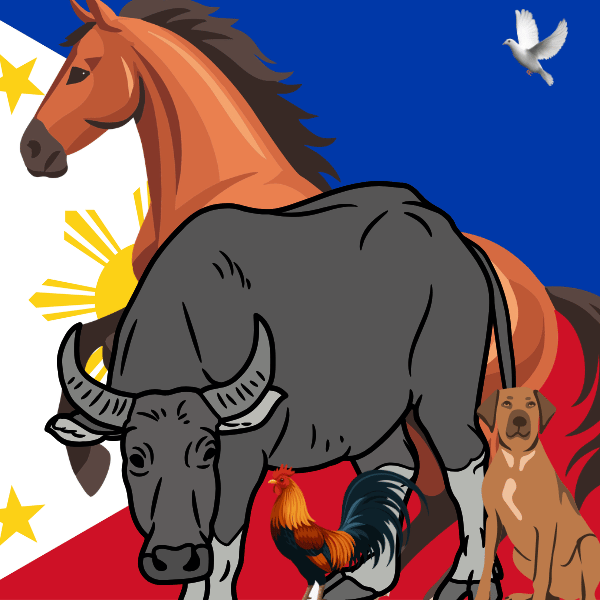
Every August, we celebrate National Heroes Day in the Philippines.
This year, it falls on the 31st of August.
We talk about Rizal, Bonifacio, Luna, Gabriela Silang.
We talk about the revolts, the resistance, the revolution.
But we never talk about the parts played by animals.
Animals worked alongside Filipinos through centuries of colonial rule, through revolution and war, through the slow, grinding work of building a nation from the land up.
They carried messages, hauled supplies, fed armies, and in some cases died in the same battles as the people who led them.
This is their story.
A small part of it, anyway.
1. Carabao (Kalabaw)
There is no animal more central to Philippine history than the carabao.
Before there were roads, before there were trucks, before there were irrigation systems built by engineers… there was the kalabaw, chest-deep in muddy paddy fields, pulling plows through soil that would have taken ten men a week to turn by hand.
The carabao made Philippine agriculture possible at scale.
- It helped plant the rice that fed the revolution.
- It hauled the nipa and bamboo that built every barrio from Luzon to Mindanao.
During the Philippine-American War, carabaos were critical logistics animals for guerrilla forces moving through terrain that wheeled vehicles couldn’t navigate.
The Americans understood this and responded with a deliberate policy of carabao slaughter to cripple the insurgency’s supply lines — an act of agricultural warfare that devastated rural communities and is still rarely discussed in history class.
It is for its hard work and how it symbolizes Filipino strength and resilience that the carabao is considered our national animal
2. Horse (Kabayo)
Spanish colonial rule introduced the horse to the Philippines and, in doing so, handed the ilustrado class both a symbol of status and a tool of war.
Andres Bonifacio’s Katipuneros fought largely on foot, with bolos and improvised weapons, against Spanish cavalry.
Antonio Luna, the fiercest military mind of the Philippine Revolution, understood that mounted mobility was the difference between a guerrilla raid and a sustained campaign.
Emilio Aguinaldo traveled by horse during the revolution’s most critical movements.
The horse was not just transport — it was command presence, the physical manifestation of authority on a battlefield. When you saw a man on a horse, you saw someone who could see further, move faster, and decide quicker than anyone around him.
3. Carrier Pigeon (Kalapati)
Before radio, before telephone lines reached the mountains, before any reliable communication infrastructure existed in the Philippine archipelago, revolutionary forces used carrier pigeons to transmit messages between units separated by terrain, distance, and enemy patrols.
The pigeon’s ability to find its home loft across hundreds of kilometers made it the fastest and most reliable communication technology available to guerrilla forces.
During World War II, Filipino and American forces continued using carrier pigeons in Mindanao and Leyte when radio equipment was damaged or compromised.
4. Fighting Cock (Manok Panabong)
This one is less obvious but no less real.
Cockfighting has been part of Filipino culture since before Spanish colonization.
The Spanish actually used the sabungan (cockfighting arena) as a controlled social space — taxed, permitted, supervised. What the colonizers did not fully appreciate was that the sabungan was also where information moved.
Revolutionary organizers used cockfighting gatherings as cover for meetings, as networks for spreading seditious literature, and as spaces where people from different towns could exchange information under the nose of Spanish authorities who considered the gathering harmless entertainment.
Andres Bonifacio himself is believed to have used the social infrastructure around sabungan culture to organize early Katipunan cells across Manila and the surrounding provinces. The manok panabong didn’t fight for independence. But the spaces built around it helped plan it.
5. Dog (Aso)
Dogs served Philippine communities as early warning systems through every period of colonial conflict. Barrio dogs that would bark at the approach of strangers — Spanish patrols, American soldiers, Japanese forces — gave communities precious minutes of warning.
This may sound small or insignificant to most people but in a guerrilla war, minutes are everything.
During the Japanese occupation of World War II, documented cases exist of Filipino families whose dogs alerted them to approaching Japanese patrols during search operations, allowing them to hide supplies, weapons, or the people who would have been taken.
The Aspin — Asong Pinoy, our native mixed-breed — was not a trained military dog.
It was a community dog staying alert, staying loyal, and barking at the right moment.
Philippine History’s Animal Heroes at a Glance
| Animal | Filipino Name | Historical Role |
| Carabao | Kalabaw | Agricultural backbone; logistics animal; deliberate war target by American forces |
| Horse | Kabayo | Revolutionary cavalry; command mobility; symbol of authority |
| Carrier Pigeon | Kalapati | Long-distance communication between guerrilla units; pre-radio intelligence network |
| Fighting Cock | Manok Panabong | Cover for revolutionary organizing; social network for Katipunan recruitment |
| Dog | Aso / Aspin | Early warning sentinel; community guardian during Japanese occupation |
What Animals Teach Us About History
History is usually written about people who gave speeches, signed documents, or commanded armies. But beneath every revolution, every war, every slow generational effort to build something worth keeping… there were animals.
Working. Carrying. Alerting. Connecting. Dying.
- The carabao didn’t choose to work the fields that fed the Katipunan.
- The pigeon didn’t choose to carry the message that saved a unit from ambush.
- The dog didn’t choose to bark at the patrol coming through the barangay at midnight.
But they did it anyway, because that is what these animals do when they live alongside us… they contribute everything they have to the life we are building together, without asking what it is for.
This month, let us take a moment to think about them.
The animals who shaped this country along with the people whose names we actually remember.
They earned it too.

