

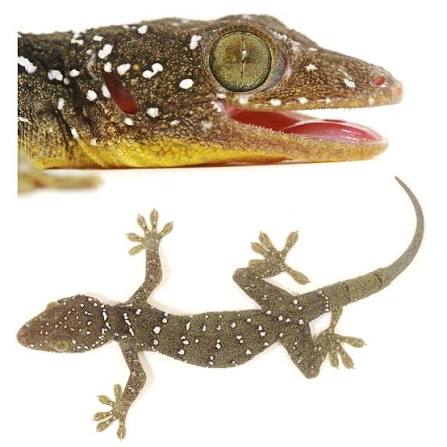
Luperosaurus alvarezi. A brand-new species of Philippine gecko, formally described in a peer-reviewed journal in March 2026, named after James Alvarez… a field researcher who died on December 8, 2018, while conducting bat research on Mt. Apo.
The highest mountain in the Philippines, right here in Mindanao.
The researchers who named this gecko after him wrote in the paper: ‘We are pleased to name the new species after our dear friend, frequent field companion and collaborator, the late James Alvarez… colleagues on both sides of the Pacific will sorely miss him.’
I don’t know James Alvarez personally.
I didn’t know him before I read this. But there is something about reading those words in a scientific paper, in the dry and careful language of taxonomy, that landed differently than I expected.
This man helped co-conceive, organize, and direct the fieldwork that eventually led to this discovery.
He died before the gecko was described.
And now it carries his name.
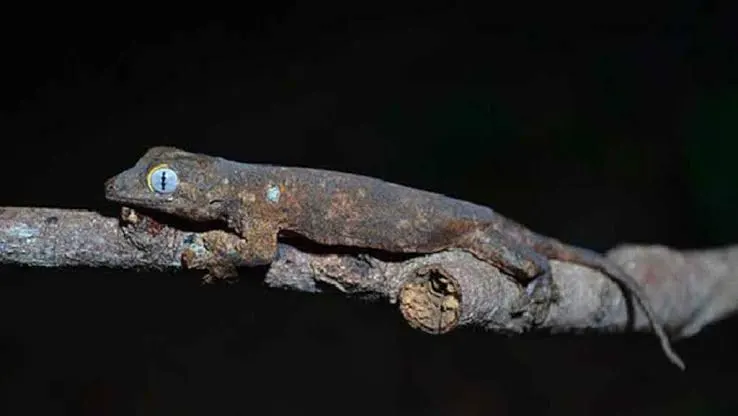
Somewhere in the karst forests of Sibuyan Island, a small lizard with bright yellow markings above its eyes and a light gray iris is going about its business with James Alvarez’s name on it forever.
That’s the kind of immortality most of us will never have.
LUPEROSAURUS ALVAREZI / ALVAREZ’S FRINGED FOREST GECKO
| COMMON NAME | Alvarez’s Fringed Forest Gecko / Sibuyan Wolf Gecko |
| SCIENTIFIC NAME | Luperosaurus alvarezi Meneses & Brown, 2026 |
| ANIMAL CLASS | Reptile |
| STATUS | Newly described species — formally published March 4, 2026 in PeerJ (DOI: 10.7717/peerj.20504) |
| NAMED AFTER | James Alvarez — field researcher and bat biologist who died on Mt. Apo, Davao, December 8, 2018 |
Scientific Classification
| Kingdom | Animalia |
| Phylum | Chordata |
| Class | Reptilia |
| Order | Squamata |
| Family | Gekkonidae |
| Genus | Luperosaurus |
| Species | L. alvarezi (new species) |
Physical Characteristics
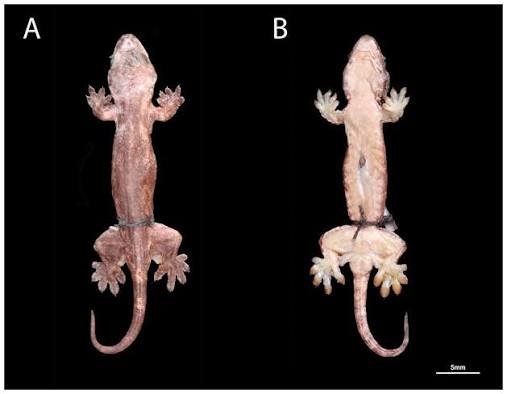
| Snout-to-Vent Length | 66.1 mm (male holotype); 78.3 mm (female paratype) — small but robust-bodied |
| Body Shape | Stout, dorsally subcylindrical; moderate cutaneous flaps along the edges of the limbs |
| Superciliaries | Bright yellow — one of the most immediately distinctive features of this species |
| Iris Color | Homogeneous light gray to blue — no reticulate network |
| Skin Texture | Smooth dorsal body without spinose tubercles; few enlarged flat scales on tail whorls |
| Digits | Widely dilated with deeply notched penultimate scansors; extensive interdigital webbing |
| Precloacofemoral Pores | 22 in both male and female — higher than most related species |
| Coloration (live) | Mottled dark brown dorsum; bright yellow ventral surface with grayish-brown ventrolateral bands |
Discovery & Distribution
| Discovery Location | Mt. Guiting-Guiting Natural Park, Municipality of Magdiwang, Romblon Province, Sibuyan Island, Philippines |
| Coordinates | 12°28’11.5″N, 122°32’58.1″E; elevation 48 to 51 meters above sea level |
| Collection Date | May to June 2017 — specimens only now formally described in 2026 |
| Specimens Collected | Two adults — one male (holotype, PNM 9866) and one female (paratype, UPLB-MNH-Z-NS 4622) |
| Known Range | Currently known only from the type locality on Sibuyan Island |
| Habitat | Riverine forest; both specimens found on vines and saplings overhanging the Gaong River at night |
| Activity Pattern | Nocturnal — both specimens collected between 10pm and 2am |
| WHY ONLY TWO SPECIMENS? The researchers note that despite weeks of nocturnal surveys before and after the collection dates — across the same and adjacent habitats — no further Luperosaurus individuals were found on Sibuyan Island. Multiple earlier surveys by different teams in previous years had also failed to detect any Luperosaurus on the island. These two animals were found on the same night, in nearly identical microhabitats, and then the species vanished back into the forest. This rarity is itself a conservation concern. |
What This Discovery Means — and Why It Matters
The genus Luperosaurus… sometimes called fringed geckos, wolf geckos, or flap-legged geckos… is a group of lizards found almost exclusively in the Philippines. They are characterized by unusual cutaneous flaps along the edges of their limbs, broadly dilated digits, and extensive webbing between their toes. They look, to an untrained eye, a bit like a gecko that has been decorated for some kind of formal occasion. The flaps and frills give them a simultaneously delicate and prehistoric appearance.
They are also, by the admission of the researchers who study them, extremely difficult to find.
Secretive, nocturnal, forest-dependent, often restricted to specific microhabitats near rivers and streams. The fact that Luperosaurus alvarezi had not been detected in any previous survey of Sibuyan Island, including multiple surveys by experienced teams, tells you something about how easy it is to miss an entirely new species of lizard if you don’t happen to be in exactly the right place at exactly the right time of night.
Sibuyan Island itself is significant here.
It sits in the Romblon Island Group, geographically isolated from the major Philippine island groups by deep water channels.
That isolation matters enormously in island biogeography because deep water means no land bridge connections during past periods of lower sea levels… which means the plants and animals on Sibuyan have been evolving separately from their relatives on Luzon, the Visayas, and Mindanao for a very long time.
New species found on deep-water islands like Sibuyan are genuinely distinct evolutionary lineages, not just variants of mainland populations.
The researchers placed Luperosaurus alvarezi at the base of the Philippine Luperosaurus family tree, as the earliest-diverging lineage in the core Philippine clade.
In plain language: this gecko represents one of the oldest, most distinct branches of the group. It is not a minor variation on an existing species. It is its own thing, with its own evolutionary history, found nowhere else on Earth.
And we almost didn’t know it existed.
The forests of Mt. Guiting-Guiting Natural Park, where both specimens were collected, are under pressure from tourism, logging, mining, and road development, exactly the kind of slow anthropogenic attrition that doesn’t make headlines but quietly erases the conditions that species like this one need to survive.
The paper explicitly calls for immediate and extensive herpetological surveys of all remaining forest on Sibuyan, Tablas, and Romblon islands, noting that there may be additional undescribed Luperosaurus species in the same area, hanging on in the last remnants of intact habitat.
PET SUITABILITY FOR DAVAO CITY: 1 out of 5
| 5 | Excellent — beginner-friendly, easy care |
| 4 | Good — suitable for experienced owners |
| 3 | Challenging — requires specific knowledge |
| 2 | Very difficult — experts only |
| 1 | Not suitable — newly described, protected, known from two specimens only |
OVERALL RECOMMENDATION: There are two known specimens of this gecko on the planet. Both are in museum collections. The only appropriate response to this animal is to protect the forest it came from.
LEGAL STATUS IN THE PHILIPPINES: Protected under RA 9147 (Wildlife Resources Conservation and Protection Act) as Philippine wildlife. As a newly described endemic species from within a protected area (Mt. Guiting-Guiting Natural Park), it falls under automatic protection. Collection or trade without DENR permit is illegal.
CARE TAGS: Newly Described Species 2026 • Known From 2 Specimens Only • Sibuyan Island Endemic • Not a Pet • Named After James Alvarez • Forest Conservation Priority
Why This Discovery Matters vs What Could Threaten It
| Why This Discovery Matters | What Could Threaten Its Survival |
| Represents the earliest-diverging lineage in Philippine Luperosaurus — a genuinely ancient and distinct evolutionary branch | Known from only two specimens — population size and true range completely unknown |
| Sibuyan Island’s deep-water isolation means this species evolved independently and exists nowhere else | Mt. Guiting-Guiting forests under pressure from tourism, logging, mining, and road development |
| Discovery proves intact Philippine forest still holds undescribed species — conservation fieldwork pays off | If additional surveys fail to find more individuals, the species may be rarer than the discovery suggests |
| Formal description in international journal permanently secures this species’ scientific recognition | No captive population exists — wild habitat loss would mean extinction with no fallback |
| Named after James Alvarez — ensures his contribution to Philippine natural history is permanently recognized | Researchers suspect additional undescribed Luperosaurus species may already be on the verge of extinction in unprotected forests nearby |
Trivia
- Luperosaurus alvarezi was collected on June 18, 2017, but was only formally described and published on March 4, 2026 — nearly nine years after its discovery. The time between field collection and formal taxonomic description is typical for complex scientific work requiring morphological analysis, DNA sequencing, phylogenetic modeling, and peer review.
- The holotype (the single official reference specimen for the species) is catalogued as PNM 9866 and is deposited at the Philippine National Museum in Manila. The paratype (the second supporting specimen) is at the UPLB Museum of Natural History in Los Baños, Laguna.
- The species was found at an elevation of only 48 to 51 meters above sea level — unusually low for a Luperosaurus, a genus more typically associated with mid-elevation forest. Both specimens were on vegetation overhanging a river, suggesting a strong association with riverine habitat.
- The bright yellow superciliaries (the scale ridge above the eye) are one of the most immediately distinctive features of this species — no other known Philippine Luperosaurus has the same combination of bright yellow superciliaries with a light gray iris. In life, these features make the gecko visually striking in a way that is entirely out of proportion to its small size.
- James Alvarez, for whom the species is named, died on December 8, 2018 — the Feast of the Immaculate Conception — while conducting bat research on Mt. Apo, Davao. He helped organize and co-direct the Sibuyan Island fieldwork that led to the gecko’s discovery. The researchers note that he ‘co-conceived, organized, and co-directed’ the fieldwork conducted by lead author Camila Meneses.
- The researchers explicitly state that Sibuyan Island and the surrounding Romblon Island Group likely harbor additional undescribed species of Luperosaurus — and possibly other undescribed vertebrates — in remaining unprotected forests on Tablas and Romblon islands. Luperosaurus alvarezi may be the first of several new discoveries from this biogeographically neglected region.

