

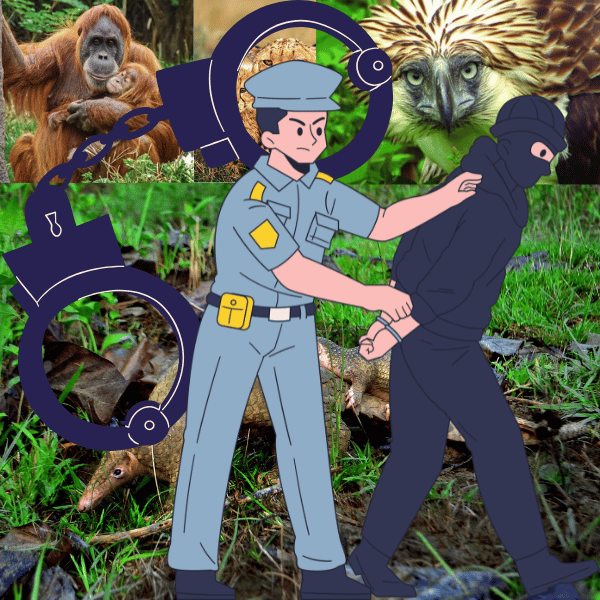
Wildlife trafficking is a serious criminal offense in the Philippines.
Under Republic Act No. 9147, also known as the Wildlife Resources Conservation and Protection Act, the illegal collection, possession, transport, and trade of protected wildlife carries penalties ranging from two to twelve years imprisonment and fines of PHP 5,000 to PHP 1,000,000, depending on the classification of the species involved.
If you witness, encounter, or suspect wildlife trafficking — whether in person, at a market, or on social media — reporting it is both your legal right and, under RA 9147, a protected act. Persons who provide information leading to a successful prosecution may receive a portion of the fines collected as a reward.
This page consolidates all verified contact information for reporting wildlife crime in the Philippines, with specific contacts for Davao City and the Davao Region.
National Reporting Contacts
| Agency | Contact | How to Use |
| DENR Biodiversity Management Bureau (BMB) | 925-8952 / 925-8953 bmb@bmb.gov.ph 0969-041-2467 | Primary national hotline for wildlife crime. Call or email with description of incident, location, and photos or video if available. |
| DENR BMB Social Media | facebook.com/denrbiodiversity | For online wildlife sales: post a tip via Messenger or tag the page with screenshots. BMB coordinates with law enforcement for follow-up. |
| DENR Central Office Action Center | (02) 8920-0689 0939-918-0169 actioncenter@denr.gov.ph | General DENR action center for escalated cases or when regional offices are unresponsive. |
| TRAFFIC Philippines | traffic.org | International wildlife trade monitoring network. Accepts anonymous tips. Coordinates with DENR and international enforcement agencies. Use the online report form at traffic.org. |
| Philippine National Police (PNP) Environmental Unit | 911 (emergency) Local PNP station | For active seizures, imminent harm to wildlife, or situations requiring immediate law enforcement response. |
Davao Region Contacts (DENR Region XI)
| Office | Contact | Coverage |
| DENR Region XI (Regional Office) | Km. 7, J.P. Laurel Ave. Lanang, Davao City 8000 (082) 234-0905 0906-378-8784 (Globe) 0947-611-6083 (Smart) rpao.denr11@gmail.com r11.denr.gov.ph @denr11official (Facebook) | Covers all of Davao Region including Davao City, Davao del Norte, Davao del Sur, Davao Oriental, Davao de Oro, and Davao Occidental. |
| CENRO Davao City | Gov. Chavez St., Davao City (082) 228-2557 0928-971-7791 | Covers Davao City proper and surrounding barangays. First point of contact for wildlife incidents within city limits. |
| PENRO Davao del Norte | Km. 55, National Highway Tagum City, Davao del Norte (084) 216-6302 | Covers Davao del Norte province including Tagum City, Island Garden City of Samal, and surrounding municipalities. |
Step-by-Step: How to File a Wildlife Crime Report
- Step 1 — Document safely. Do not confront the trafficker directly. Take photos or video discreetly from a safe distance. Note the location (barangay, landmark, GPS coordinates if possible), date and time, and a physical description of the individuals involved.
- Step 2 — For online wildlife sales. Screenshot the post, seller profile, contact number, and any pricing information before reporting. Wildlife sellers frequently delete posts after receiving inquiries. Report to the social media platform (Facebook, TikTok, etc.) using the platform’s own reporting tool AND simultaneously report to DENR BMB via Messenger or email.
- Step 3 — Contact the appropriate office. For Davao City incidents, contact CENRO Davao City (082) 228-2557 or DENR Region XI (082) 234-0905 first. For national-scale trafficking or if the regional office is unresponsive, contact DENR BMB directly at 925-8952 or 925-8953.
- Step 4 — File a formal complaint if possible. DENR offices accept written complaints. A formal complaint initiates an official case record and strengthens prosecution. You may request to remain anonymous — informant protection is provided under RA 9147.
- Step 5 — Follow up. Wildlife cases can move slowly. If you have filed a report and received no response within 30 days, follow up with the same office or escalate to the DENR Central Office Action Center at actioncenter@denr.gov.ph.
Legal Basis for Reporting
| Republic Act No. 9147 — Wildlife Resources Conservation and Protection Act (2001): Prohibits the collection, possession, transport, and trade of protected wildlife and their by-products without proper permits. Penalties range from 2 to 12 years imprisonment and PHP 5,000 to PHP 1,000,000 in fines depending on species classification. Critically Endangered species (such as the Philippine Pangolin and Philippine Eagle) carry the highest penalties. Under Section 27 of RA 9147, any person who provides information leading to the successful apprehension and conviction of violators may receive a reward equivalent to a portion of the fines imposed by the court. Anonymous reporting is accepted. |
| CITES — Convention on International Trade in Endangered Species: The Philippines is a signatory to CITES, the international agreement regulating wildlife trade between countries. Species on CITES Appendix I (including all pangolins and Philippine Eagle) are subject to the strictest trade prohibitions. Reporting suspected international wildlife trafficking — including online sales to foreign buyers — can be escalated through TRAFFIC Philippines to international enforcement networks including INTERPOL’s Environmental Security unit. |
What Happens After You Report
Upon receiving a report, DENR field officers will conduct a validation operation to verify the information. If sufficient evidence exists, an apprehension operation is coordinated with local law enforcement.
Confiscated wildlife is brought to the nearest DENR Wildlife Rescue Center for assessment and, where possible, rehabilitation and release. Prosecutors from the Department of Justice handle criminal cases with DENR providing technical support and expert testimony.
Cases involving Critically Endangered species are treated as priority prosecutions. The process from report to prosecution can take months to years depending on the complexity of the case and availability of evidence.
Your initial documentation — photos, screenshots, timestamps, and location data — is the most important contribution you can make to a successful outcome.
