

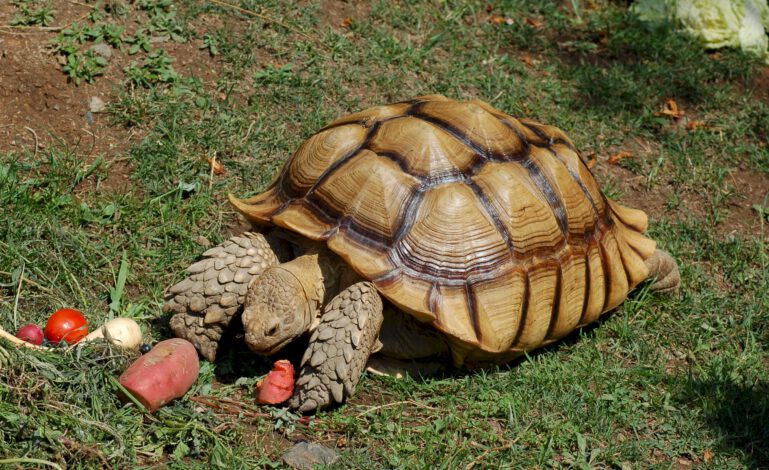
Scientific Name: Centrochelys sulcata
Scientific Classification
Kingdom: Animalia | Phylum: Chordata | Class: Reptilia | Order: Testudines | Family: Testudinidae | Genus: Centrochelys
I want a sulcata tortoise specifically because I want a pet that will outlive me.
Something that I can pass down to my son as an inheritance – not just money or property, but a living legacy that connects our family across generations.
A tortoise that my grandchildren might one day care for. It’s about creating a family tradition that spans 50, 70, maybe even 100+ years.
Physical Characteristics
Sulcata tortoises are the third-largest tortoise species in the world and the largest mainland tortoise in Africa. Adults typically reach 60-90 cm (24-36 inches) in shell length and weigh 36-100 kg (80-220 lbs), with some males exceeding 120 kg.
They have thick, yellowish-brown skin, powerful elephantine legs, and distinctive conical spurs on their hind legs (hence “spurred tortoise”). Their carapace is light tan to golden brown with prominent growth rings.
Hatchlings start at just 44 mm and 40 grams but grow rapidly – reaching 15-25 cm within the first few years. Sexual maturity is reached at 10-15 years. In captivity, they live 70-100+ years, with many reaching 150 years. Wild lifespan is believed to exceed 75 years.
Habitat & Distribution
Native to the Sahel region and southern edge of the Sahara Desert across North-Central Africa, from Senegal and Mauritania to Sudan, Ethiopia, and Eritrea.
They inhabit hot, arid grasslands, savannahs, and desert fringes at elevations up to 2,000+ meters with minimal rainfall (150-700 mm annually). Wild populations are Vulnerable (IUCN) due to habitat loss, livestock competition, and pet trade collection. Pet sulcatas are all captive-bred from stable populations.
DAVAO CLIMATE ADVANTAGE: Unlike the hedgehog and axolotl, sulcatas actually THRIVE in Davao’s tropical climate! They’re adapted to hot, dry environments and can handle our 27-32°C temperatures perfectly.
No expensive air conditioning or chillers needed – our climate is naturally compatible. This is one exotic pet where Davao’s weather is an asset, not a liability.
Diet & Behavior
Sulcatas are strict herbivores (graminivores) that feed primarily on grasses, hay, weeds, and succulent plants. Their diet must be high in fiber and very low in protein.
In Davao, they’ll happily mow your lawn – eating grass clippings, kangkong, dandelion, clover, and leafy greens. Fruits are occasional treats only (like candy for humans) – too much causes fatty liver disease.
They’re diurnal grazers, most active in morning and late afternoon, resting during midday heat. Sulcatas are expert diggers, creating burrows 30 inches to 10+ feet deep to escape heat and conserve moisture.
They’re generally docile but males can be territorial and aggressive toward each other. Females lay 15-30 eggs per clutch after a 60-day gestation period, breeding during rainy season (September-November in their native range).
Pet Suitability Assessment for Davao City
Rating: 4 out of 5
I’m rating sulcata tortoises at 4 out of 5 for Davao City – this is one of the best exotic pets for our climate. Here’s the honest assessment for families considering a multi-generational pet.
The Climate Compatibility is EXCELLENT: This is the first animal on our list where Davao’s tropical heat is actually perfect. Sulcatas naturally live in 26-40°C environments with high daytime temps and cooler nights. Our 27-32°C year-round is ideal. No chillers, no constant AC, no expensive temperature control. They can live outdoors full-time in Davao. During rainy season, just provide a dry shelter they can retreat to. This alone saves you tens of thousands of pesos compared to hedgehogs or axolotls.
The Space Reality – THIS IS CRITICAL: Baby sulcatas are cute 2-3 inch hatchlings that fit in your hand. Within 5 years, they’ll be 40-50 cm long and 15-25 kg. By 10 years, they’re full-size bulldozers weighing 45-90 kg and measuring 60-90 cm. You need a MINIMUM outdoor enclosure of 15×5 meters (50×16 feet) for one adult. That’s 75 square meters. The walls need to be concrete cinder blocks or brick, buried 60 cm deep, standing 60 cm high – because they WILL dig under and push through weaker materials. They can knock over heavy objects, damage AC units, dig under sheds, and destroy landscaping. If you don’t have a large yard in Davao (at least 100+ square meters), do not get a sulcata.
Legal Requirements in the Philippines: Sulcatas are CITES Appendix II species and exotic animals under RA 9147. You MUST buy from a seller with a DENR Wildlife Farm Permit (WFP) who provides a DENR-recognized Official Receipt.
Cost from licensed breeders in Metro Manila: ₱7,000-10,000 for 2.25-3 inch hatchlings, up to ₱120,000+ for breeding adults.
Always verify the WFP before purchase. Getting a Certificate of Wildlife Registration (CWR) from DENR is optional but recommended. For Davao residents, you’ll coordinate with DENR-Region XI. Never buy from unlicensed sellers – this puts you at criminal risk.
The 70-100 Year Commitment: This is not a dog or cat. If you get a hatchling at 30 years old, it will likely outlive you. Your son will inherit it at 50. Your grandchildren might care for it at 80. This tortoise could see five generations of your family.
Are you ready to write this animal into your will? Who takes it if your son moves abroad? What happens during family disputes? This isn’t just a pet purchase – it’s establishing a family legacy. Make sure everyone in the family is on board for the next century.
Estimated Cost: Hatchling setup: ₱15,000-25,000 for 4×2 feet indoor enclosure, heat lamps, substrate. After 2-3 years, you need outdoor transition. Permanent adult outdoor pen: ₱50,000-150,000 depending on materials (cinder blocks, buried walls, secure gate, shelter/house, landscaping).
Food costs are LOW compared to other pets – they literally eat grass and weeds. In Davao, many owners let them free-roam the yard as natural lawnmowers.
Occasional vet visits for shell rot or respiratory infections. Over 50+ years, you’re looking at ₱200,000-500,000 total investment, but most is upfront construction.
Our tropical grass grows year-round – free food! No expensive hay imports needed. Our warm climate means no heating costs. Many Davao tortoise owners let them roam gardens during the day.
The Philippine tortoise community is active and supportive. Veterinary care for reptiles is improving in Davao, though still limited compared to Manila.
Unlike furry pets, tortoises don’t cuddle, play fetch, or show affection. They recognize feeders and follow routines, but they’re not interactive pets for young children.
The novelty wears off when kids realize it just eats grass and digs holes. However, they teach patience, responsibility, and long-term thinking. Your son will learn to care for something that spans his entire lifetime.
Health & Maintenance: Sulcatas are hardy once established. Common issues: pyramiding (from improper diet/humidity), shell rot (from too much moisture), respiratory infections (from drafts/cold), and intestinal impaction (from eating substrate).
Young tortoises need 80%+ humidity for proper shell growth – this is easy in Davao during rainy season, harder during dry months. Adults are much more forgiving. Weekly shell checks, monthly weight monitoring, clean water daily.
Neighbor Considerations: A 90 kg tortoise that destroys fences, eats gardens, and bulldozes through boundaries is NOT a good pet for subdivisions with small lots or shared walls. You need space AND tolerance from neighbors.
In rural Davao areas with larger yards, perfect. In Camella or similar subdivisions – terrible idea.
The Aggression Factor: Males ram each other violently during breeding season. They’ve killed other tortoises by flipping them over or inflicting injuries with their gular scutes. If you get two males, you need completely separate enclosures. Females are generally peaceful. Never house multiple males together.
Escape Artists: They dig under fences, push through weak walls, and are surprisingly mobile. A motivated sulcata can travel several kilometers if it escapes.
Davao’s open drainage systems and canals pose drowning risks – they can’t swim and sink like rocks. Your enclosure security is critical.
The Bottom Line: If you have a large yard in Davao (100+ sqm), want a multi-generational family legacy, can afford ₱75,000-200,000 upfront for proper housing, have secured DENR permits, and genuinely want a living family heirloom that outlives you – a sulcata tortoise is actually one of the BEST exotic pets for our climate. The climate match alone makes it infinitely more practical than temperature-sensitive species.
But if you live in a subdivision with <100 sqm lot, want an interactive pet, need to rent housing (landlords won’t accept this), or aren’t ready for a literal century-long commitment that you’ll pass to your children in your will – this is NOT the pet for you.
I love the idea of a living legacy. But talk to your children seriously. Will they WANT a 50-year-old, 90 kg tortoise when they’re 40?
What if they marry someone allergic to dust?
What if they move to a condo?
What if they emigrate?
Make sure this “inheritance” won’t become a burden. Maybe start with visiting tortoise owners in Davao first. Shadow someone who’s had one for 20+ years. See the reality of elderly tortoise care before committing to 100 years.
That said – there’s something profoundly beautiful about a pet that spans generations. A living connection between grandfather, father, and grandson. If you can truly provide for it across that timeline, a sulcata tortoise in Davao is one of the few exotic pets where the climate and lifestyle actually work in your favor.

