

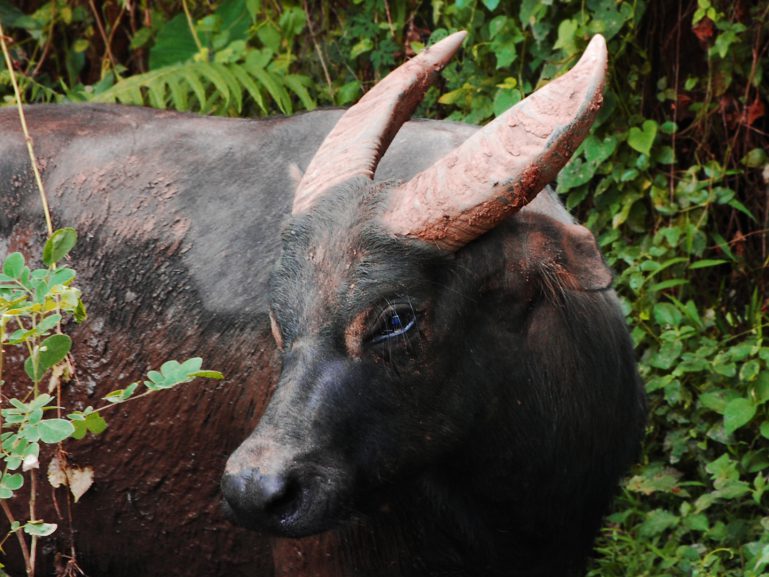
The Tamaraw (scientific name Bubalus mindorensis) is a small, wild buffalo that’s found only in the Philippines — specifically on the island of Mindoro.
Unlike its bigger and more familiar cousin the carabao (or typical water-buffalo), the Tamaraw is more compact, stocky, and distinct: its coat is dark brown to grayish, its legs are short and stout, and it bears short, thick horns shaped in a “V,” not the wide C-shaped horns typical of water buffalo or carabaos.
On average, a full-grown Tamaraw stands about one meter at the shoulder. Its body length (excluding tail) is around 2.2 meters, with the tail adding another 60 cm or so. Their weight varies: many adult Tamaraws weigh somewhere between roughly 180 kg and 300 kg.
In terms of appearance, besides the general dark coat, Tamaraws often have lighter or whitish markings — at least on parts of the legs, hooves, and sometimes subtle light strips near the eyes.
Their ears are of moderate size (there are older detailed anatomical descriptions), their horns have flat surfaces with a triangular base — and though the horns are stout, regular rubbing in the wild tends to smooth their outer surfaces.
Overall, the Tamaraw looks like a “miniature wild buffalo” slightly hairy, powerful, rugged — made to push through thick vegetation and climb steep terrain.
Where Tamaraws Live & How They Live
Once upon a time, Tamaraws were much more widespread on Mindoro. They were found across varying elevations — from sea level all the way up to about 2,000 meters above sea level.
Their habitats were diverse: dense forests, marshy river valleys, bamboo thickets, open glades created naturally or by landslides or forest fires, wetlands, riparian zones, grasslands — basically wherever there was vegetation enough for grazing and water nearby.
But over the decades, things have changed drastically.
Human settlement on Mindoro increased after malaria was brought under control near the turn of the 20th century, leading to logging, conversion of forests to agricultural land, and widespread habitat destruction.
As a result, the Tamaraw’s range shrank. Nowadays they are confined mostly to a few remote areas, often at mid-elevation (roughly 300 to 1,000 meters), inhabiting grasslands, secondary forests, and forest-grassland mosaics — usually near water sources.
In terms of diet and daily routine, Tamaraws are herbivores. They eat grasses, young bamboo shoots, wild sugarcane, and similar vegetation.
They used to be diurnal — feeding during the day — but because of human disturbance (logging, settlement, hunting), many have become more nocturnal, to avoid contact with humans.
Behaviorally, Tamaraws are more solitary than social. They don’t form large herds the way many other bovines do; instead, adults tend to live alone. Mothers may stay with their calves for a few years, but generally they move about individually.
Females give birth to a single calf after a gestation period of about 300 days. Calves stay with their mothers for 2 to 4 years before striking out on their own. In the wild, a Tamaraw may live around 20 years — sometimes up to 25.
Why the Tamaraw Matters — its Significance to Conservation and to the Philippines
The Tamaraw isn’t just another animal — to me (and I think to the Philippines), it’s a national treasure.
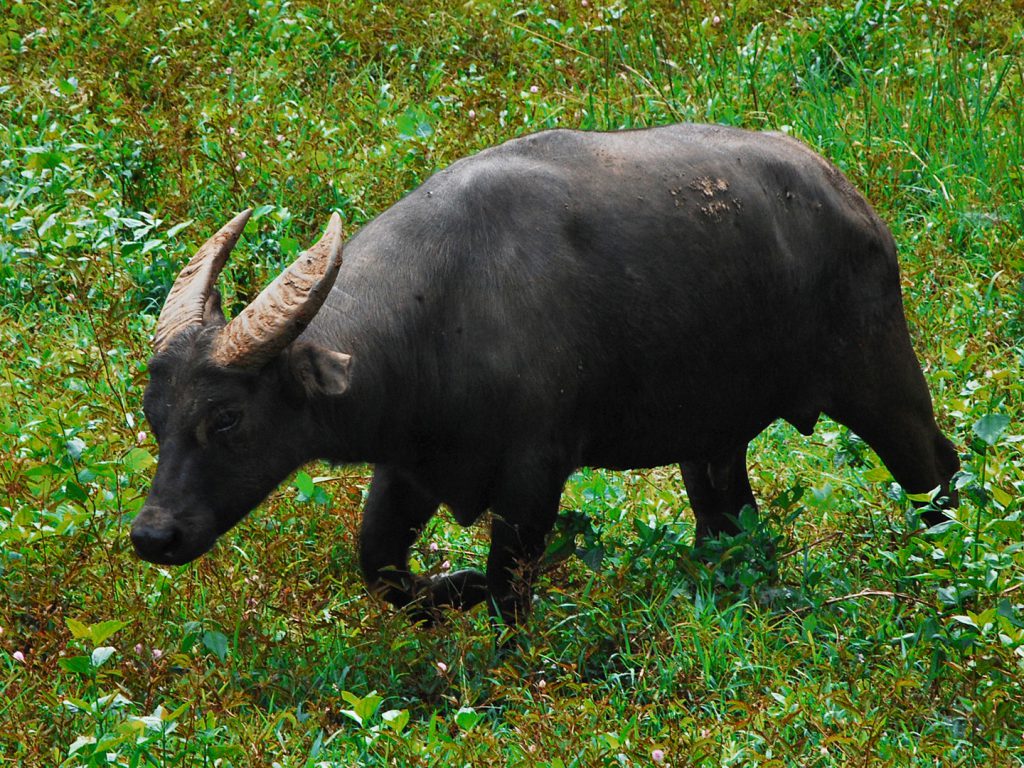
- Unique, endemic species: The Tamaraw is the only wild bovine species native exclusively to the Philippines. That alone makes it irreplaceable. Losing it would mean losing a unique piece of the nation’s natural heritage.
- Indicator of ecosystem health: Because Tamaraws rely on forest, grassland, wetlands, and clean water — and require reasonably large, undisturbed areas — their survival reflects the state of Mindoro’s ecosystems. Healthy habitats — meaning trees, water, grasses, minimal human disturbance — help Tamaraws thrive. If they decline, it often signals that environment is degrading.
- Symbol of conservation challenges and successes: The Tamaraw’s story encapsulates many of the threats wildlife face: habitat loss, hunting, disease, human expansion. It also highlights conservation efforts: protected areas, monitoring, habitat management. Its continued existence reminds us that saving biodiversity requires sustained effort. As of recent decades, only a few hundred remain in the wild, making them one of the rarest large mammals on Earth.
- Cultural and national identity value: For Filipinos, the Tamaraw isn’t just wildlife — it’s part of identity. It represents the uniqueness of our islands, the fragility of our natural heritage, and the importance of protecting what’s ours. I believe every time people see a Tamaraw (or even learn about it), it reminds us why conservation matters — not only for science, but for pride, identity, legacy.
In short: the Tamaraw is a living emblem of what makes the Philippines special — and a symbol of what we stand to lose if we don’t protect our nature.
The Grim Reality: Why Tamaraws are Critically Endangered
Once, there may have been as many as 10,000 Tamaraws roaming Mindoro. But over time, because of a convergence of factors, their numbers have plummeted.
- Habitat destruction: Logging, conversion of forests to farmland, settlement expansion — all reduced and fragmented the places Tamaraws could inhabit.
- Hunting and poaching: For many years, hunting was common, for meat or horns. Although now protected by law, past hunting has taken a heavy toll.
- Disease: Introduction of domestic cattle brought diseases like rinderpest in the 1930s, which decimated many wild populations.
- Low reproductive rate / life history traits: Tamaraws only give birth to one calf at a time, with several years between births, and young stay with the mother for years. This means population recovery is slow, and every lost individual has huge impact.
Today, the species is classified as Critically Endangered under the IUCN Red List. Its trade is banned, and it is listed in Appendix I of the CITES — meaning it is strictly protected from international trade.
Around 300–500 individuals are estimated to remain in the wild, scattered across a few isolated subpopulations.
Because of its dire status, the Tamaraw has become a flagship species for conservation on Mindoro. Efforts to preserve or restore its habitat, prevent poaching, and monitor population are vital — not just for the buffalo, but for whole ecosystems.
What if Someone Wanted to Own a Tamaraw as a Pet — is That even an Option?
Oh you know you were going to hear this from me eventually. I mean, what if one could own one as a pet or let’s just say a mainstay in your farm. Not really for labor purposes, maybe just for display purposes.
Honestly, the idea sounds nice in theory — “owning a wild buffalo native to the Philippines” — but in reality, it simply isn’t feasible, ethical, or legal.
- Under law, Tamaraw are fully protected. They are critically endangered, listed under IUCN and CITES Appendix I.
- Their natural behavior — solitary, skittish, adapted to forest/grassland plus water sources — is completely incompatible with the constraints of typical captivity or domestic pet environments. They need room to roam, forage, water, cover.
- Past attempts at captive breeding failed. Decades ago there was a “gene pool” program (on Mindoro) where captured individuals were kept for breeding — but it produced only one surviving offspring, and the project was eventually abandoned.
- Removing individuals from the wild — even if possible — would further endanger the dwindling population, reducing genetic diversity and undermining chances for species recovery.
So realistically: owning a Tamaraw as a pet — for a private individual — should not be allowed, and thankfully under current laws and treaties, it isn’t.
The only way Tamaraws should exist is wild, in protected habitats, under conservation care (i.e. habitat protection, population monitoring).
What the Tamaraw’s Future Could — and Should — Look Like
I believe the future of the Tamaraw depends not just on protecting the last few hundred individuals, but on restoring confidence in their habitat and ensuring long-term ecosystem health. That means:
- Preserving and rehabilitating forested areas, grasslands, wetlands on Mindoro — including preventing logging, uncontrolled land conversion, uncontrolled grassland burning, and so on.
- Strengthening anti-poaching and enforcement of protection laws; making sure threats like illegal hunting, wildlife trade, and introduction of diseases from domestic animals are minimized.
- Supporting careful wildlife research: monitoring Tamaraw populations, studying their ecology (diet, behavior, movement), perhaps exploring modern conservation methods — but always with respect for their natural way of life.
- Encouraging education and awareness — especially among local communities on Mindoro and among Filipinos generally — so that Tamaraw becomes a symbol of pride rather than a trophy, a reminder of what we have to protect, not something to exploit.
If things are done right, maybe over decades we could see the Tamaraw population grow again — not to 10,000, but perhaps to a sustainable wild population, separated into secure subpopulations, able to roam freely across healthy habitat.
Final Thoughts
The Tamaraw isn’t just another wild animal. To me, it embodies the fragile beauty of Philippine biodiversity: rare, unique, resilient — but vulnerable, threatened, dependent on our care.
If we lose the Tamaraw, we lose something irreplaceable: a species found nowhere else but in our islands, a living link to natural landscapes that once covered much of Mindoro. But if we act with respect, commitment, and long-term vision, we might still give the Tamaraw the chance not only to survive — but to thrive.
For me, the story of the Tamaraw is a call: to care. Because in caring for them, we safeguard part of ourselves — our heritage, our identity, our home.

