

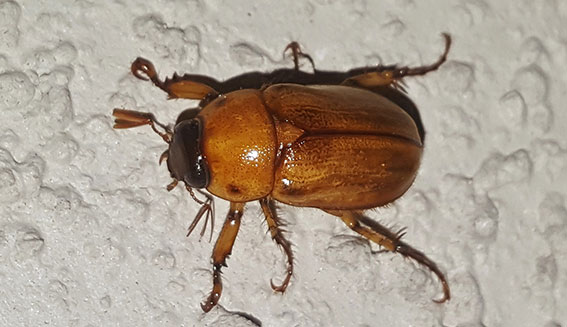
- “June bug” (also “June beetle” or “May bug” in some countries) is a common name for several species of scarab beetles that tend to appear in late spring or early summer. In temperate countries, they often emerge around May or June — hence the name.
- These are typically medium‑sized beetles; many belong to the scarab family (Scarabaeidae). Because of this variety, there’s no single “June bug” species universally — different regions have different species that go by that name.
- Their life cycles follow typical scarab‑beetle biology: larval (grub) stage underground, feeding on roots or decaying plant matter; then pupation; then adult emerges as a beetle.
Because of this variation in species, much of what follows is a generalization for scarab / June‑bug type beetles — not a guarantee.
What Does a June Bug Eat — and What Do They Eat as Larvae
- Larvae (grubs): Many June‑type beetles spend their larval stage underground, feeding on roots, decaying organic material, and soil detritus. This helps them grow and eventually pupate.
- Adults: Once they emerge as adults, their diet can shift. Many feed on leaves, flowers, fruit, or nectar. Some may nibble on soft plant matter. Others may not feed much at all, living mostly off stored larval reserves (depending on species).
So if you were to keep one as a pet, you’d have to mimic those conditions: have soil/earth substrate plus plant material (leaves, fruit, etc.) if the adult eats.
Do June Bugs Make Good “Pets”?
Before thinking about keeping one, there are a few big caveats (especially if you’re in the Philippines or a tropical region):
- Species uncertainty: Because there’s no universal “June bug,” you may not even know exactly which species you have — and beetle care depends heavily on species.
- Natural lifecycle & habitat needs: Many scarab larvae live underground, feeding on roots or decaying matter — hard to replicate in a small container. Adults may need space, humidity, and specific diet.
- Short adult lifespan: Many scarab beetles have short adult lives (often weeks to a few months). This means care commitment may last long only in larval form (underground), not necessarily as an adult pet.
- Legal / ecological issues: Capturing wild insects, especially ones that may be beneficial or endangered locally, can be ecologically irresponsible. It’s better to admire them in the wild than risk disrupting local ecosystems.
Because of all that, I’d consider June bugs poor candidates for typical “pet‑keeping” — unless you’re doing it strictly as an educational / temporary observation project, and you release them back into the wild responsibly.
June Bug Care Sheet
If you still want to try — treat the following as a “What‑it-would-take” checklist, not a guarantee of success.
| Condition | What to Provide / Do |
| Housing / Substrate | A deep container with loose soil (or a mix of soil + leaf litter + decaying plant matter), enough for a grub to burrow if you start from larva stage. Provide a layer about 10–15 cm deep. |
| Humidity & Environment | Moderate humidity — keep soil slightly moist but not waterlogged. Maintain a stable temperature (avoid extreme heat or cold). Provide ventilation but avoid constant direct sun or drying. |
| Food (Larva stage) | Soil rich in organic matter, decaying leaves, compost, maybe small roots (depending on species). |
| Food (Adult stage) | Leaves, soft fruit slices, flowers or nectar (depending on species). If the species doesn’t feed much as adult, provide shallow water dish or damp sponge for hydration. |
| Space / Enrichment | Enough ground area for movement; maybe plant matter, leaves, bark. Not necessarily ideal for “handling” — better observed than played with. |
| Lifecycle observation | If you start from larva, you may eventually witness pupation and emergence — fascinating but unpredictable. Prepare for short adult lifespan (weeks–months). |
| Ethical considerations | Research local insect laws, avoid removing from nature if not allowed, or release responsibly after observation. Avoid disrupting local ecosystems. |
How Long Do June Bugs Live?
- For many scarab‑type beetles (the ones commonly called “June bugs”), the adult lifespan tends to be short — often a few weeks to a few months. Their main life is spent underground as larvae, sometimes for a year or more.
- Because of this, if you only keep the adult as “pet,” you’ll likely have a short-term pet — which may be fine for observation, but disappointing if you expect “long-term pet life.”
Enjoy June Bugs — but Maybe Don’t Keep Them
I love the idea of reconnecting with small creatures — insects, beetles, but from what I’ve learned, June bugs (or scarab beetles lumped under that name) are tricky to keep responsibly — at least if you want to do right by them.
Their needs, natural lifecycle, and ecological role make them poor candidates for “pet‑keeping” in the usual sense.
If I were you and I still want to explore — I’d probably do it as a short‑term observation project: maybe find a grub under compost, raise it properly in soil, watch it pupate, and release the adult after observation.
That way you get the curiosity, the learning, and the respect — without risking ecological or ethical harm.

